
Digital Art
Generative Art
Generative art begins not with one fixed picture but with rules that can keep producing pictures. Grids, recursion, probability, noise, and data unfold many outcomes between control and accident.
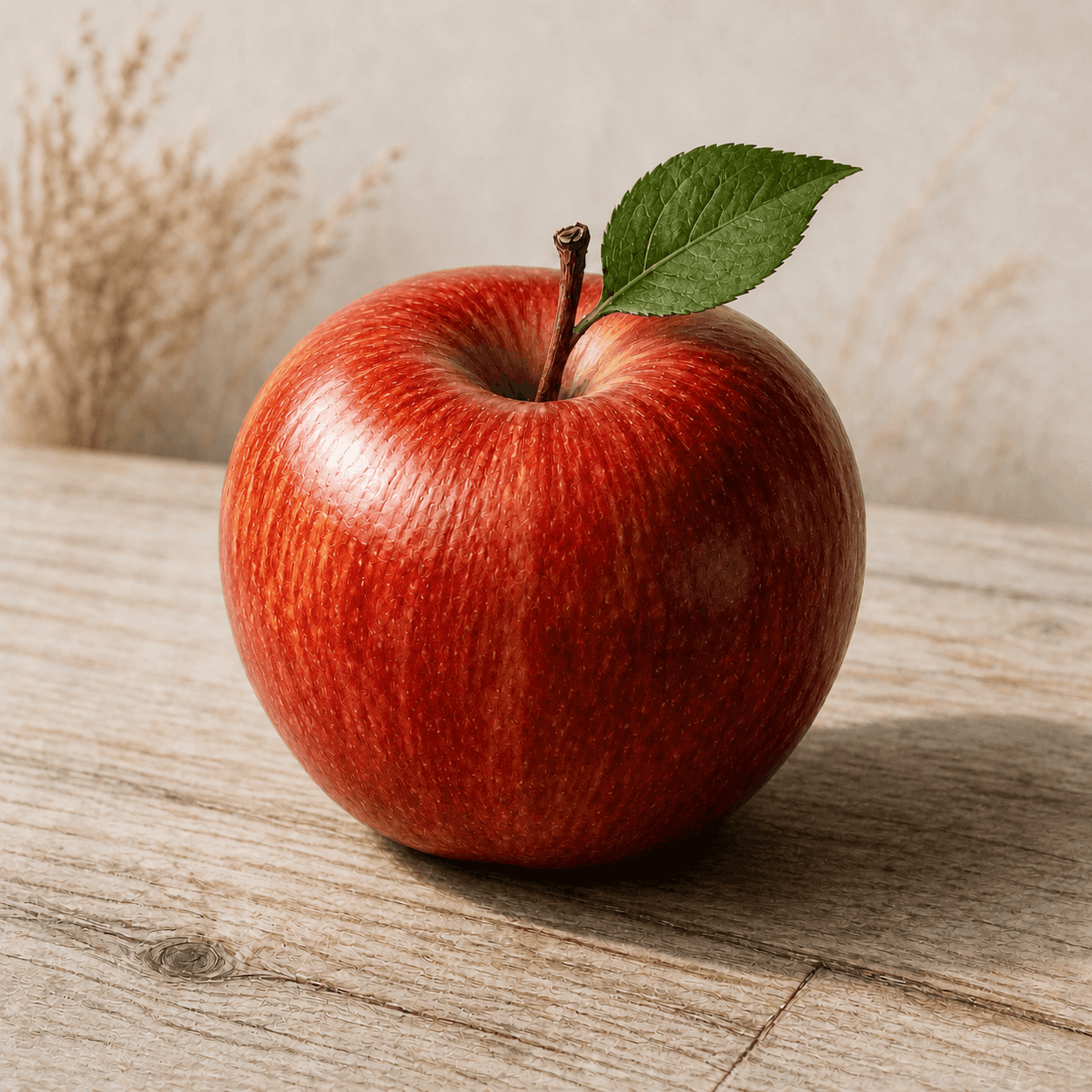
READ THE IMAGE
The apple reads as one sample from a running rule, not an object fully drawn in advance
Repeated marks and colour blocks share direction, density, and boundaries; local difference comes from parameter or seed. The apple supplies a constraint while its interior shows how a system makes different decisions from place to place.
- 01
Find repetition with a rule
Units may vary, but should share spacing, direction, scale, or behavioural logic.
- 02
See whether randomness is bounded
A seed makes variation; it does not make every point unrelated. The artist still sets range and distribution.
- 03
Trace parameters through the whole
Changing density, threshold, speed, or palette should redirect the entire system in legible ways.
- 04
Treat the image as one version
A generated image is often one run; seed and parameters explain how it can be reproduced or varied.
In one sentence
Design rules that can produce images first,
then treat each image as one result of the system running
A generative artist need not decide every final mark directly. They construct a system with some autonomy: hand rules, a machine, code, chance, or audience interaction. The point is not simply that a computer made it, but that rules, parameters, and selection define a space of possible outcomes. Random values create difference; constraints let those differences belong to one coherent world.
VISUAL LANGUAGE
Rule-system DNA
Rule
Specify behaviour before image
Parameter
Few variables steer the whole
Count, scale, threshold, and palette should visibly alter density, rhythm, or composition.Seed
Randomness can be recorded
The same seed can reproduce a version; a new seed creates a sibling under the same rules.Iteration
Repetition permits emergence
Local instructions executed many times can create collective structure no one mark was drawn to make.Choice
The artist stays in the system
Rules, output selection, parameter edits, medium, and display are all authorship decisions.Where it came from
From combinations, chance, and mechanical rules to plotters, creative coding, and on-chain series, generative art turns a work from one object into a process that can run
Dice music, looms, programmed composition, and rule-based drawing placed process before any single object long ago. Plotters and computers made algorithmic graphics visible in the 1960s; creative-coding tools later lowered the barrier to experimentation. Real-time visual work, data art, and on-chain projects now renew the question: when a system can make many images, is the work one image, the full set, or the rules that produce them?
Combination and mechanical rules arrive
Dice composition, woven patterns, and automatic devices show that one rule set can yield many variants.
Computer plotting emerges
Artists and engineers in research labs use algorithms and plotters to explore line, probability, and geometry.
Systems and interaction expand
Recursion, fractals, artificial life, and interactive installations make output respond to time, data, or viewers.
Creative coding becomes a medium
Processing, p5.js, real-time graphics, and on-chain publishing bring reproducible systems into art and design.
ARTISTS & WORKS
Meet it through four cases
Vera Molnár
Repeatedly varied squares and lines through simple rules and controlled ‘1% disorder’, testing how order can hold deviation.Frieder Nake
Used probability, mathematical structure, and plotters for early computer graphics that foreground programme and image.Casey Reas and Ben Fry
Processing helped establish code as a visual sketchbook and creative medium.Rafael Lozano-Hemmer
Sensors, data, and audience participation continually generate relations of light, sound, and space.How to recognise it
Do not only look for abstract pattern; look for rules that control variation, repeatable process, and boundaries placed around chance
- ✓Do similar units seem to follow inferable rules rather than simple copy-paste?
- ✓Can parameter changes explain differences in density, colour, scale, or motion?
- ✓Does randomness have a range, distribution, and seed rather than indiscriminate noise?
- ✓Does the work suggest it could make more valid versions?
STYLE RELATIONS
Three ways systems shape images
Generative Art
Explicit rules, parameters, and a running process produce variable visual outcomes.CURRENTAlgorithmic Art
Places stronger emphasis on the mathematical or programmed algorithm itself; it often overlaps with generative art.↗AI Art
Uses trained models, prompts, and sampling; the rules may not be legible to the viewer.↗REFERENCES
Sources & image note
The apple is a generative-art teaching interpretation using a constrained palette, repeated modules, parameterised density, and bounded chance. It does not reproduce one artist or one code sketch.