
Digital Art
Neon Art
Neon art is not colour simply turned up. It lets a tube with thickness, bends, and joints draw text, contour, and urban rhythm in the night.
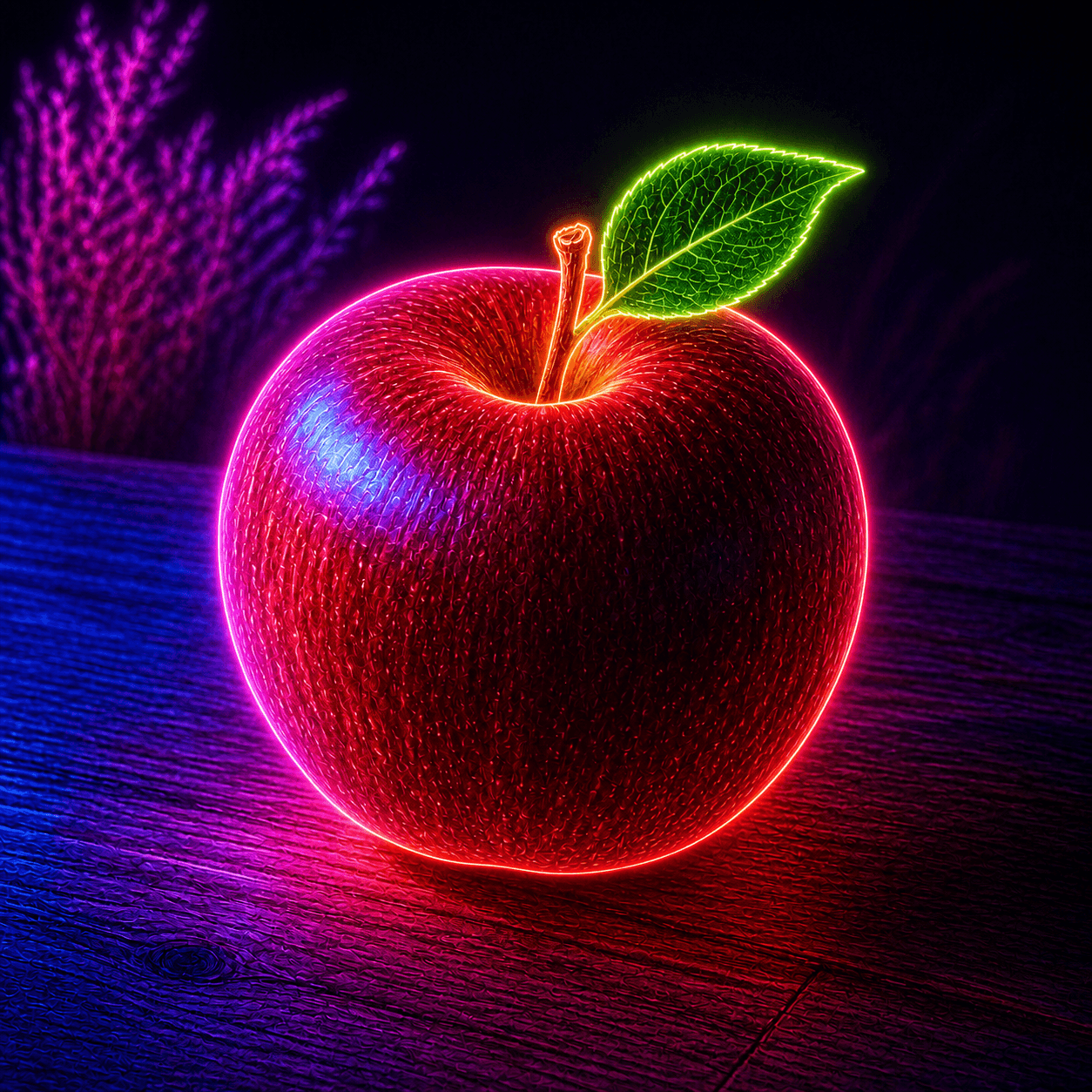
READ THE IMAGE
The apple is not outlined with a highlighter; it seems bent from makeable, heat-bearing luminous tubing
The bright line has stable width and plausible turning radius. The tube itself is brightest; a softer bloom spreads only onto darkness and nearby surfaces. Contour, stem, and sign-like symbol retain legibility.
- 01
Trace a continuous tube
Each lit segment should be imaginable as glass tubing or LED flex, not source-less glow.
- 02
Read bends and joints
Turning radius, breaks, crossings, and electrode-like joins give lettering and forms fabrication logic.
- 03
Let bloom depend on darkness
Colour bloom needs darkness and adjacent surfaces; an overbright field erases the tube contour.
- 04
Grade the colour roles
A key colour identifies the sign; small contrasts set hierarchy. Not every hue should be equally saturated.
In one sentence
Organise a luminous tube's continuous path,
night bloom, and sign readability into an image
Neon art grows from the material language of gas-discharge signage: glass tubes bend into letters, figures, and borders; when energised, they form a bright core and coloured bloom in darkness. Much contemporary “neon” is LED, but a neon visual still needs continuous path, bend scale, dark field, hierarchy, and reading distance—not merely saturated blue, violet, and pink.
VISUAL LANGUAGE
Luminous-tube DNA
Tube
Light follows a continuous path
Core
Keep a sharp luminous centre
The tube is the focus; blur cannot replace it.Bloom
Light disperses into darkness
Glow falls off with distance and lightly stains wall, haze, or metal nearby.Sign
Image must be readable
A sign first gives a name, direction, or symbol; ornament serves its reading order.Night
Darkness is a material
Negative space and low illumination make colour energetic and prevent bloom turning into grey fog.Where it came from
From gas-discharge lighting shown in Paris in 1910 to commercial streets, nightlife, and urban memory, neon turned technical light into readable night graphics
Georges Claude demonstrated neon lighting in 1910, and bent glass soon entered shops, theatres, and roadside branding. Mid-century argon and fluorescent coatings expanded its colours. LED has replaced many new installations, but the classic neon language of curve, flicker, bloom, and night visibility still shapes visual design.
Neon lighting appears in Paris
Georges Claude demonstrates the vivid discharge produced by energising rarefied gas.
Commercial signs spread across cities
Neon enters Paris, Los Angeles, New York, and other urban nightscapes.
Colour and giant signage mature
Argon, coatings, and animated sequences expand colour, scale, and street competition.
Revival and LED translation
Popular imagery renews neon desire; many new works simulate its language with LEDs.
ARTISTS & WORKS
Meet it through four cases
Georges Claude
Developed rarefied-gas discharge into displayable neon lighting, beginning the modern sign industry.Times Square signage
Text, scale, and night-time competition shape the density of a modern commercial street.Las Vegas neon signs
Exaggerated lettering, arrows, starbursts, and animated sequences turn road reading into city identity.Bruce Nauman
Moved neon text and looped gesture from commercial sign into contemporary art.How to recognise it
Confirm that light comes from traceable tubing, then see whether bloom, text, and night space construct one readable hierarchy
- ✓Can bright lines be understood as components with thickness, bend radius, and joints?
- ✓Do core, outer glow, and lit neighbouring surfaces have distinct layers?
- ✓Is darkness sufficient for key colour—not an all-white haze—to become focus?
- ✓Can lettering, symbol, or contour be read quickly from distance?
STYLE RELATIONS
Three languages of light at night
REFERENCES
Sources & image note
The apple is a neon-art teaching interpretation using continuous tube paths, bright cores, bloom, and darkness. It does not reproduce a historic sign or claim every glowing colour is actual neon gas.