
Photography
Realistic Photography
Realistic photography is not a promise of no processing. Viewpoint, lens, exposure, colour, depth of field, and editing jointly construct the fidelity a photograph appears to possess.
READ THE IMAGE
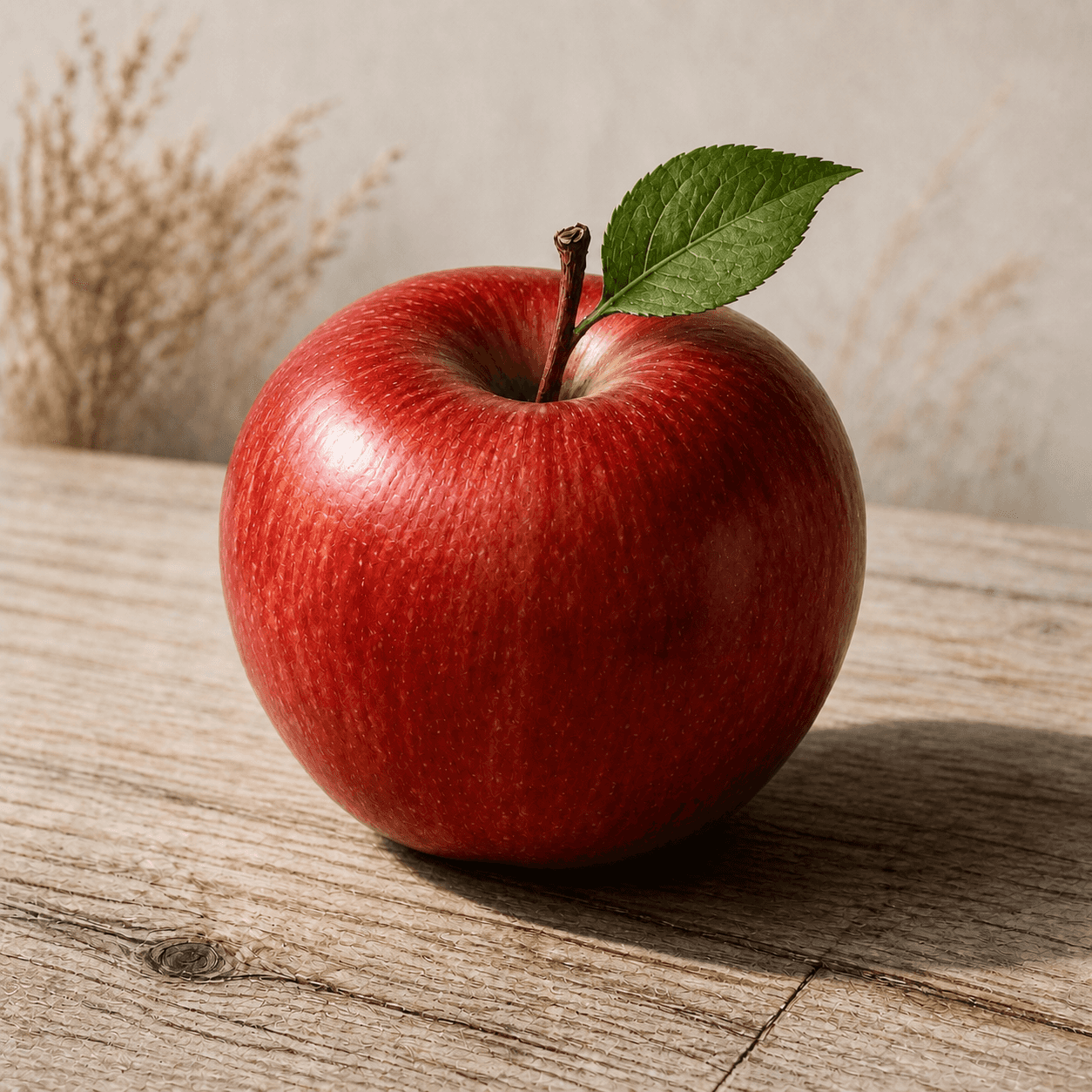
It seems simply to show an apple, yet every cue of credibility is a photographic decision
A key light from upper left shapes highlight and shadow. Leaf and skin hold focus while distant plants soften. Colour temperature, contrast, and range stay close to familiar vision.
- 01
Make light explain material
A broad highlight describes glossy skin while fine leaf texture and softer reflection retain another surface.
- 02
Use focus to order looking
Stem and leaf are sharp, background falls away; realism does not require equal clarity everywhere.
- 03
Expose to retain information
Highlight avoids empty white and shadow keeps red variation, containing a useful tonal range.
- 04
Keep perspective credible
A near-normal view and measured camera distance avoid theatrical distortion.
In one sentence
Describe with optical and temporal evidence—
while admitting that reality is always selected
Realistic photography favours recognisable subjects, coherent space, credible light, and differentiated material over conspicuous fantasy or collage. It may include development and colour correction; the question is whether treatment serves perceptible relations. A camera makes a causal optical record, but never guarantees completeness, neutrality, or truth.
VISUAL LANGUAGE
Credibility DNA
Light
Directional, contained
Focus
Selectively clear
Plane of focus and depth tell the viewer what matters and how space recedes.Exposure
Time-aperture negotiation
Shutter, aperture, and sensitivity trade motion, noise, and depth.Lens
View changes relation
Focal length and distance control perspective, compression, and background scale.Colour
Calibrated, not arbitrary
White balance, curve, and output gamut preserve plausible object colour and value.Where it came from
From nineteenth-century exact record to modernist straight photography and a digital rethinking of evidence
Photography announced in 1839 quickly served portrait, science, and archaeology through unprecedented detail. In the early twentieth century Paul Strand, Edward Weston, and peers rejected painterly softness for lens clarity and camera viewpoint. Digital editing and generation now move trust toward context, workflow, and ethics.
Photography appears as exact record
Daguerreotype and paper negative let light register detail while staging and retouching also begin.
Portable cameras enter daily life
Kodak simplifies camera and processing, turning moments and families into mass archives.
Straight photography and Group f/64
Strand, Weston, Cunningham, and Adams stress fine detail, tonal range, and medium specificity.
Authenticity shifts toward provenance
RAW development, compositing, and generation expand possibility while demanding context and disclosure.
ARTISTS & WORKS
Meet it through four photographers
Paul Strand
Shows that direct printing, exact composition, and ordinary subjects can join abstraction and social attention.Edward Weston
Makes vegetables, shells, and bodies intensely particular yet almost ideal, setting a modern still-life standard.Imogen Cunningham
Combines close botanical study, body, and portraiture with sharp detail and simplified form as a Group f/64 founder.Stephen Shore
Uses colour, large format, and everyday roads to test how apparently neutral description is organised by viewpoint and culture.How to recognise it
Test whether relationships remain credible—not merely whether the image looks photographic
- ✓Are source direction, highlight, reflection, and cast shadow consistent?
- ✓Do perspective, focus, and depth establish coherent space?
- ✓Do texture, colour, and value differentiate materials without plastic sharpening?
- ✓Can one still read the photographer's choices of place, moment, exclusion, and treatment?
STYLE RELATIONS
Three photographic orientations
Realistic Photography
Maintains credible optics, material, and space while acknowledging selection.CURRENTFilm Photography
Names a photosensitive chemical workflow that can serve realism, experiment, or any subject.↗Documentary Photography
Addresses real events and social relations with greater emphasis on time, context, and evidentiary ethics.↗REFERENCES
Sources & image note
The apple is a contemporary teaching example emphasising natural-looking side light, controlled dynamic range, and shallow depth. It demonstrates cues of credibility but cannot by itself prove scene, edit history, or object authenticity.