
Graphic Design
Art Deco
Machine-age speed and Jazz Age luxury meet in one object: geometric order, precious surfaces, and global motifs shape modern glamour.
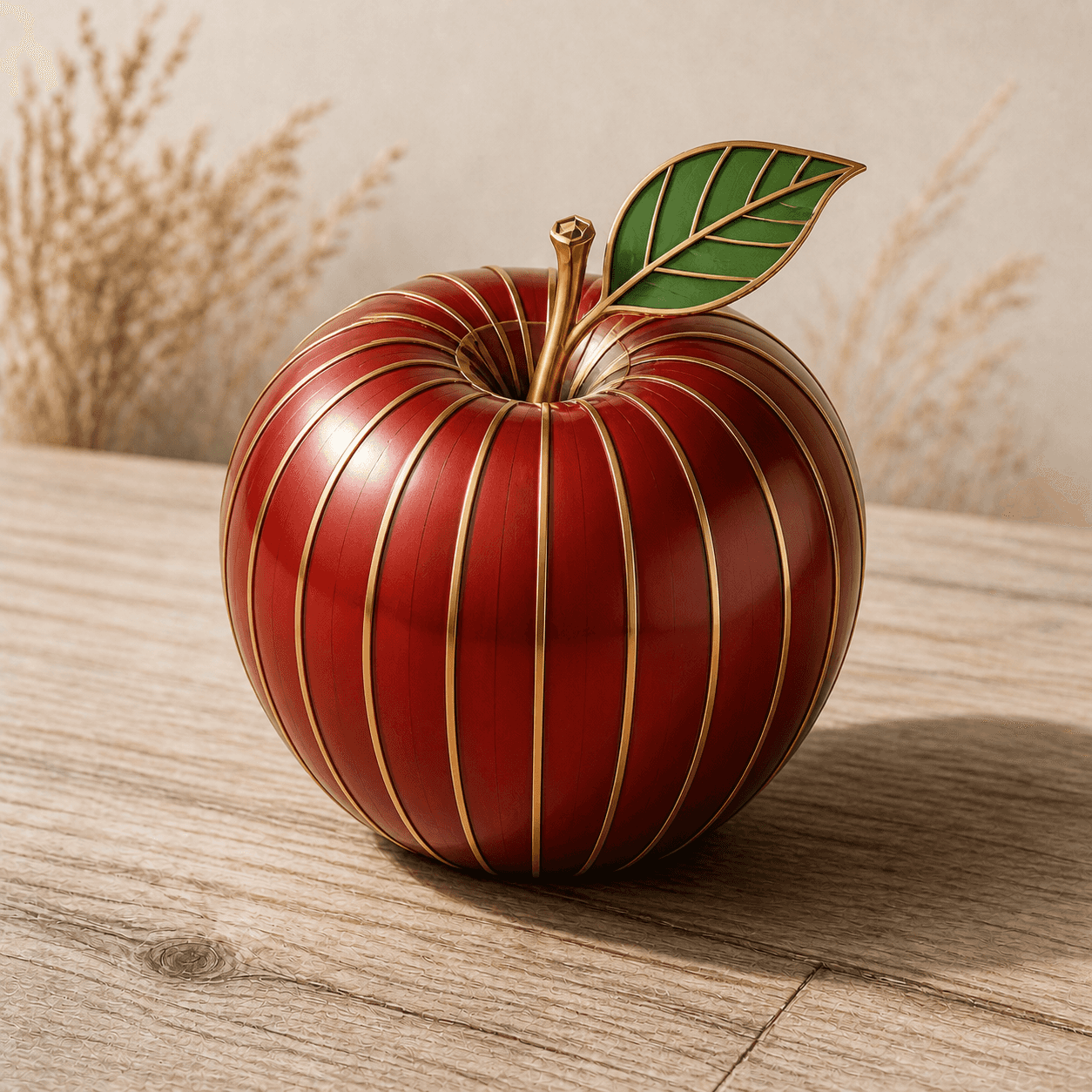
READ THE IMAGE
Read the segmentation, then ask how material produces modern luxury
Repeated gold ribs, symmetric veins, deep red lacquer, and jewel green cue Art Deco finish. They suggest elite craft, which must be read alongside later chrome, glass, plastic, and mass manufacture.
- 01
Follow the radiating divisions
Gold lines repeat from the stem like sunbursts, fans, and skyscraper setbacks, turning roundness into rhythm.
- 02
Read symmetry and contour
Fruit approaches axial order and the leaf is bound by metallic edging, making the outline precise and costly.
- 03
Notice the finish
Lacquer, metal, and jewel colour foreground reflection and touch; ornament and material are inseparable.
- 04
See nature geometrised
Vein and segment begin in plants but become repeatable patterns fit for inlay and manufacture.
In one sentence
Not every gold geometric object—
but a hybrid of traditional luxury and machine modernity
Art Deco is a retrospective name for varied modern decorative languages across architecture, interiors, dress, and products from after World War I through the 1930s. The 1925 Paris exposition was a decisive showcase. Designers mixed avant-garde geometry, motifs from ancient and non-Western cultures, precious craftsmanship, transport, and machine imagery; streamlined forms and new materials later reached broader markets.
VISUAL LANGUAGE
Decorative DNA
Geometry
Fan, zigzag, setback
Surface
Polished, inlaid, reflective
Lacquer, metal, glass, veneer, and enamel produce tactile luxury.Sources
Eclectic, global
Ancient and non-Western motifs are modernised amid colonial looking and appropriation.Machine
Speed, streamlining, height
Cars, liners, and skyscrapers supply modern fantasy.Market
Luxury to mass
Bespoke furniture and moulded plastic radios mark different phases and classes.Where it came from
From Paris luxury craft to global consumer modernity
Geometric Art Nouveau, Vienna Secession design, Ballets Russes, and avant-garde art supplied precedents. Archaeological enthusiasm and colonial trade supplied global motifs, while prosperity and media spread the look through cities, travel, and entertainment.
Precursors converge
Geometric Art Nouveau, Wiener Werkstätte, stage design, and Cubism reshape decoration.
Tutankhamun's tomb sparks Egyptomania
Lotus, scarab, gold, and stepped profiles enter dress, jewellery, and cinema.
Paris exposition
The international exhibition presents modern decorative and industrial arts through luxury interiors, craft, and national pavilions.
Streamlining meets mass goods
Aerodynamic curves, chrome, and plastics package speed into transport and domestic products.
ARTISTS & WORKS
Meet it through four designers
Émile-Jacques Ruhlmann
Defined elite Paris interiors through rare veneers, ivory detail, and attenuated proportions.René Lalique
Brought glass, plant and female motifs, and geometric repeat into jewellery and architectural decoration.A. M. Cassandre
Used geometric perspective, bold lettering, and transport machines to make advertising feel fast.Eileen Gray
Linked lacquer, furniture, and interiors to a distinct modern spatial intelligence.How to recognise it
Test geometry, material, and period imagination together
- ✓Do fan, zigzag, radial, setback, or streamlined geometries repeat?
- ✓Do materials and finish actively produce glamour or machine precision?
- ✓Are natural, ancient, or global motifs strongly geometrised and modernised?
- ✓Does the work belong to interwar cultures of consumption, travel, entertainment, and city life?
STYLE RELATIONS
Different decorative modernities
REFERENCES
Sources & image note
The apple foregrounds metallic edging, lacquer, and radial segmentation—Art Deco's luxury-object face. It cannot replace regional variation, streamlined mass production, or critical reading of cultural appropriation.