
Graphic Design
Art Nouveau
At the turn of the century, growing lines and natural structures rejected tired historicism and joined architecture, furniture, poster, and daily object into a whole.
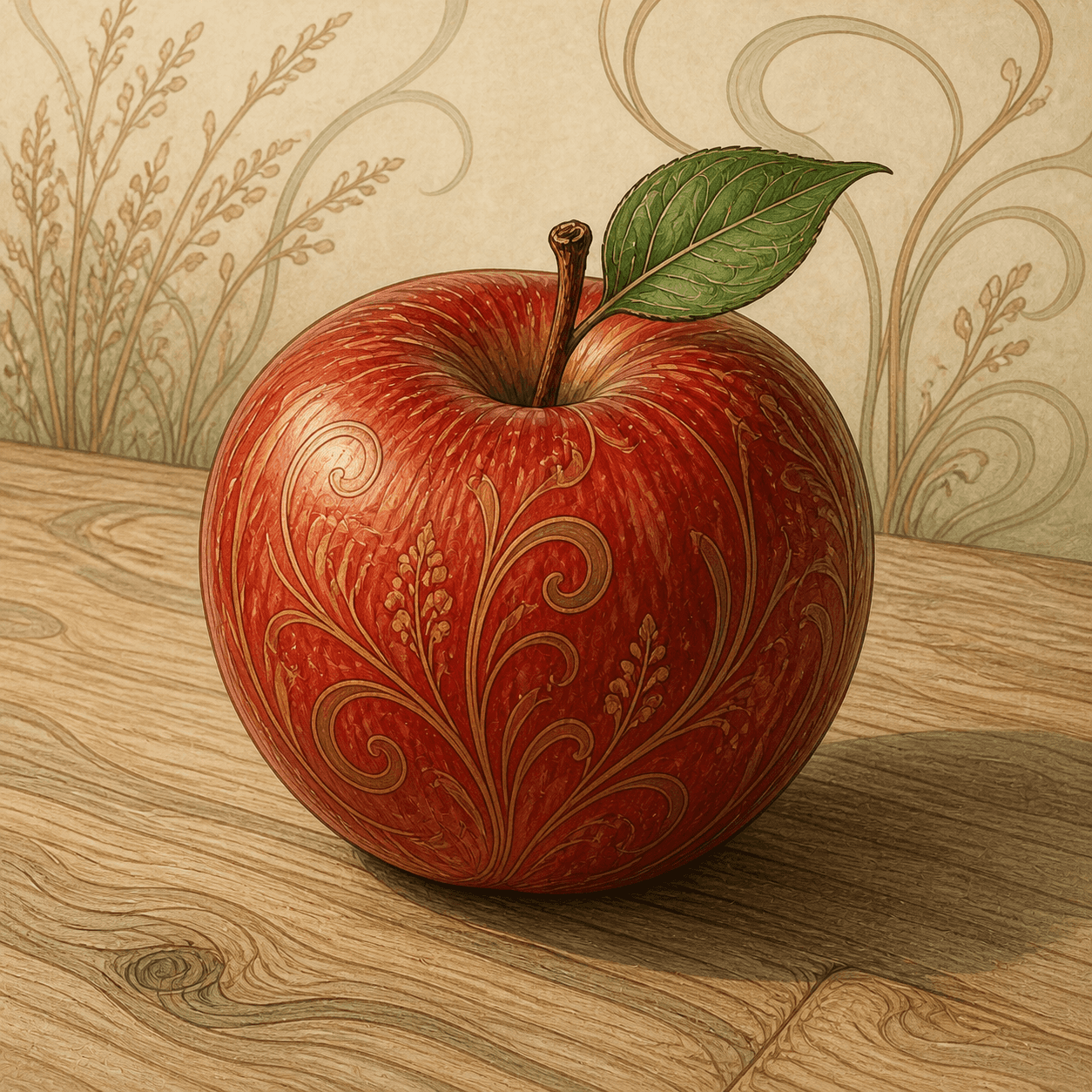
READ THE IMAGE
The curve is not applied ornament—it seems to keep growing from the fruit
Tendrils cross apple and background while vein, stem, and wood grain share one flowing rhythm. The image cues Art Nouveau's ambition to let structure and decoration permeate a total environment.
- 01
Trace the whiplash
S-curves tighten and release like vines, marine tendrils, and hair, pulling the eye continuously.
- 02
See nature abstracted
Bud, vein, and tendril are not botanical copies but structures translated across materials.
- 03
Watch boundaries dissolve
Pattern moves from fruit to wall, suggesting poster, furniture, railing, and room as one work.
- 04
Compare curve and geometry
Flowing line is famous, but Glasgow, Vienna, and other centres developed restrained geometric variants.
In one sentence
Not nostalgic floral decoration—
but inventing modern life through nature and total design
Art Nouveau emerged in several places in the late 19th century against academic historicism and hierarchies between fine and applied art. Designers drew on plants, biology, Japanese art, Arts and Crafts, and new materials, coordinating structure, ironwork, glass, furniture, type, and poster. The curvilinear Franco-Belgian language is only one among many regional forms.
VISUAL LANGUAGE
Growth DNA
Line
Whiplash, continuous, tense
Nature
Plant, insect, body
Observed forms are abstracted and translated into material and pattern.Whole
Building to handle
Interior, furniture, lighting, and graphics share rhythm.Material
Iron, glass, ceramic, wood
Industrial material and craft combine in organic structures.Variation
International, local
Curve, geometry, and vernacular tradition shift by city and language.Where it came from
A network of new arts across cities, not one French style
Arts and Crafts critiques of industry, Japanese prints, biological imagery, and urban technology supplied energy. Journals, department stores, world fairs, and railways carried the forms rapidly across borders.
Reform networks gather
Les Vingt, Arts and Crafts, and European journals challenge academies and revival styles.
Hôtel Tassel
Victor Horta coordinates iron, mosaic, stained glass, and furniture in one botanical rhythm.
Poster and metropolis spread the language
Mucha's lithographs, Guimard's Métro entrances, and the Paris exposition put new art in the street.
Geometrisation and decline
Vienna and Glasgow move toward geometry; war and functional Modernism displace the decorative wave.
ARTISTS & WORKS
Meet it through four designers
Victor Horta
Made iron frame, stair, stained glass, and furniture grow through complete interiors.Hector Guimard
Bent cast iron into vegetal structures and gave Paris Métro a civic identity.Alphonse Mucha
Used tall lithographs, halos, ornament, and flowing hair to transform public posters.Charles Rennie Mackintosh
Joined attenuated plant signs to disciplined lines in the restrained Glasgow variant.How to recognise it
Ask whether line joins structure to a total environment
- ✓Does curve behave like growth across contour, structure, and decoration?
- ✓Are plant, insect, or body forms abstracted rather than copied literally?
- ✓Do architecture, furniture, type, and detail share one language?
- ✓Can you identify a local variant rather than applying the Mucha-woman stereotype?
STYLE RELATIONS
Decorative languages around 1900
Arts and Crafts
Critiques industry through craft labour, material honesty, and medieval guild ideals.↗Art Nouveau
Uses natural line, material, and total environment to create an international modern style.CURRENTArt Deco
After the war, enters consumer modernity through geometry, luxury finish, and machine imagery.↗REFERENCES
Sources & image note
The apple foregrounds the Franco-Belgian whiplash and botanical pattern, only one branch of international Art Nouveau. Regional comparison and real architectural materials are essential.