
Illustration
Charcoal
Willow or vine heated without oxygen becomes an almost binderless black drawing material. It can mass darkness at speed, then be reshaped by hand, cloth, stump, and eraser.
READ THE IMAGE
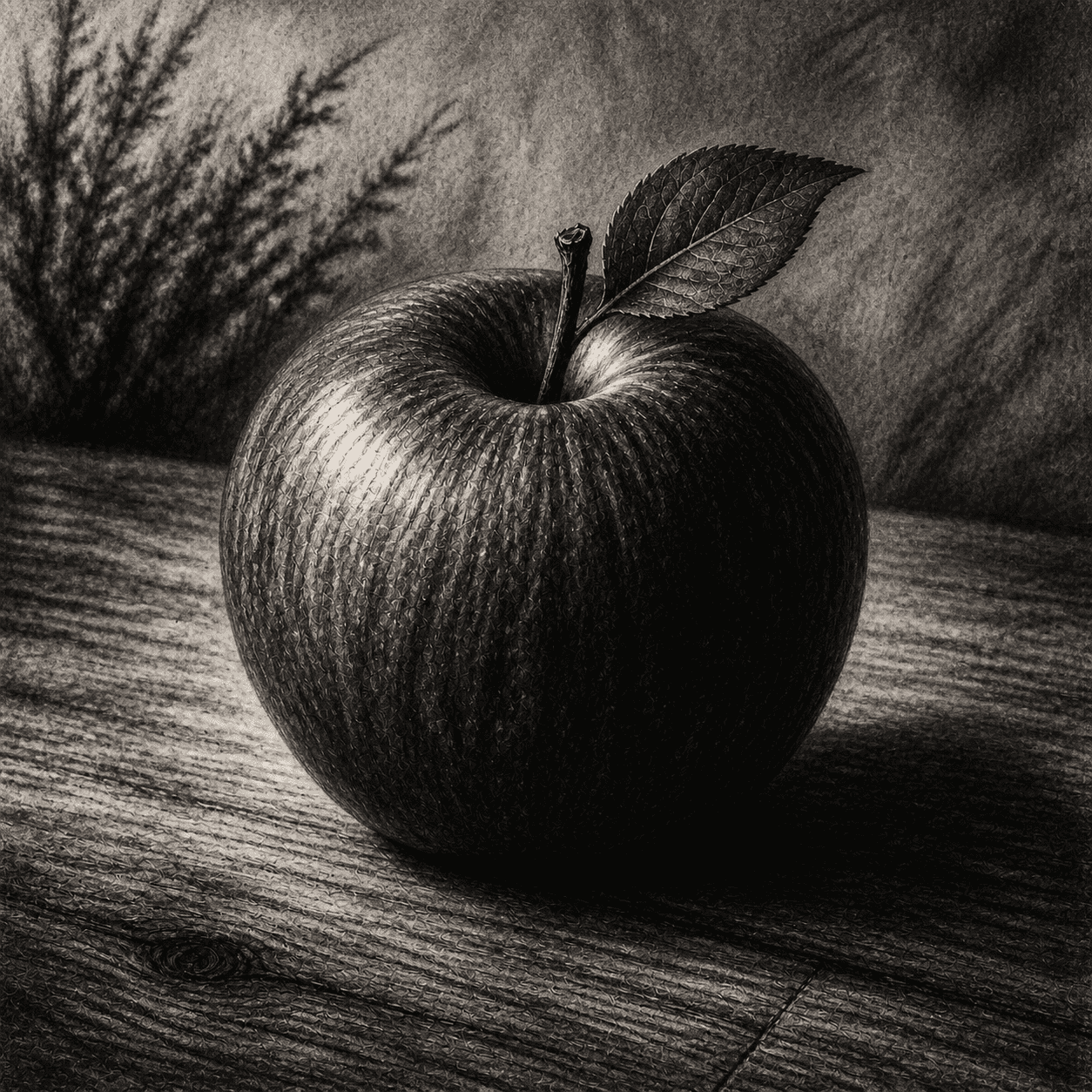
This apple is not a monochrome filter; carbon is added, moved, and removed
The fruit turns from reserved light into a dense dark flank, with short hatching locking to its curve. Side strokes and stumping enlarge background and shadow; pointed line and lifting recover the leaf veins and focus.
- 01
See where black accumulates
The dark flank is built from weighted line, layers, and rubbed deposits—not one flat fill.
- 02
See white reserved or retrieved
Paper remains in the highlight while kneaded eraser lifts bright traces from middle grey.
- 03
Let line and mass cooperate
Directional skin marks explain curvature; broad grey-black fields establish space and mood.
- 04
Make the cast shadow carry weight
A dense contact shadow spreads right and changes from hard to soft, grounding the apple.
In one sentence
Build black with carbon particle—
then find light again by rubbing, lifting, and scraping
Natural charcoal has large particles and no binder, so its mark is loose, deep, and readily displaced. The point draws line; the side lays a broad field. Finger, chamois, or stump spreads particles into halftone, while a kneaded eraser becomes a reverse drawing tool. Charcoal style is not merely monochrome; it is reversible modelling through value.
VISUAL LANGUAGE
Carbon DNA
Black
Matte, variable
Line
Swift, friable
Angle and force take a twig instantly from hairline to broad drag.Rub
Move, do not dissolve
Cloth, hand, or stump redistributes particle into atmospheric middle value.Lift
Light by subtraction
Eraser or scraper removes carbon for highlights and correction.Paper
Tooth holds dust
Rough support carries layers; the vulnerable finish needs careful glazing or fixative.Where it came from
From erasable Renaissance underdrawing to a finished nineteenth-century language of black
Carbon could mark surfaces much earlier, but in Western works on paper Renaissance studios chiefly used charcoal for ideas, shadows, and transfer. Fabricated charcoal in varied hardness arrived by the late eighteenth century. In the nineteenth, rubbing, scraping, wet powder, and fixative helped turn it into a finished medium.
A preparatory studio medium
Artists develop composition, shadow, and transfer grids; erasability serves revision.
Fabricated charcoal widens black
Recompressed powder in varied hardness makes line and dense tone more predictable.
Finished black drawing flourishes
French artists foreground paper, charcoal, Conté, stumping, and fixative as expressive matter.
Body scale and mixed media
Charcoal moves into monumental figures, abstract gesture, and installations, often beside pastel, graphite, or ink.
ARTISTS & WORKS
Meet it through four artists
Georges Seurat
Builds dim fields from carbon particle and paper tooth, letting figures emerge from dusk.Odilon Redon
Turns charcoal, Conté, coloured paper, and fixative into dreamlike noirs and psychological black space.Käthe Kollwitz
Uses compressed black-white, revision, and tight composition to carry poverty, grief, and bodily weight.Robert Longo
Makes large charcoal and graphite images that appear photographic yet retain particle and physical labour.How to recognise it
Read the surface of black and traces of revision—not merely the absence of colour
- ✓Are darks matte and particulate rather than metallic like graphite?
- ✓Do point line, side mass, stumped middle tone, and erased light coexist?
- ✓Does paper tooth cross the greys and hold more carbon in dense passages?
- ✓Do values organise volume and weight before detail tightens at the focus?
STYLE RELATIONS
Three dry drawing media
REFERENCES
Sources & image note
The apple is a contemporary teaching interpretation that heightens directional hatching, lifted highlight, and theatrical cast shadow. Actual charcoal can be faint, spare, or abstract; this image demonstrates one use of its broad value range and reversible modelling.