
Illustration
Pastel
Pastel forms highly concentrated pigment, pale filler, and a little binder into a dry stick. Colour reaches the support with almost no liquid transformation, making it exceptionally luminous—and exceptionally fragile.
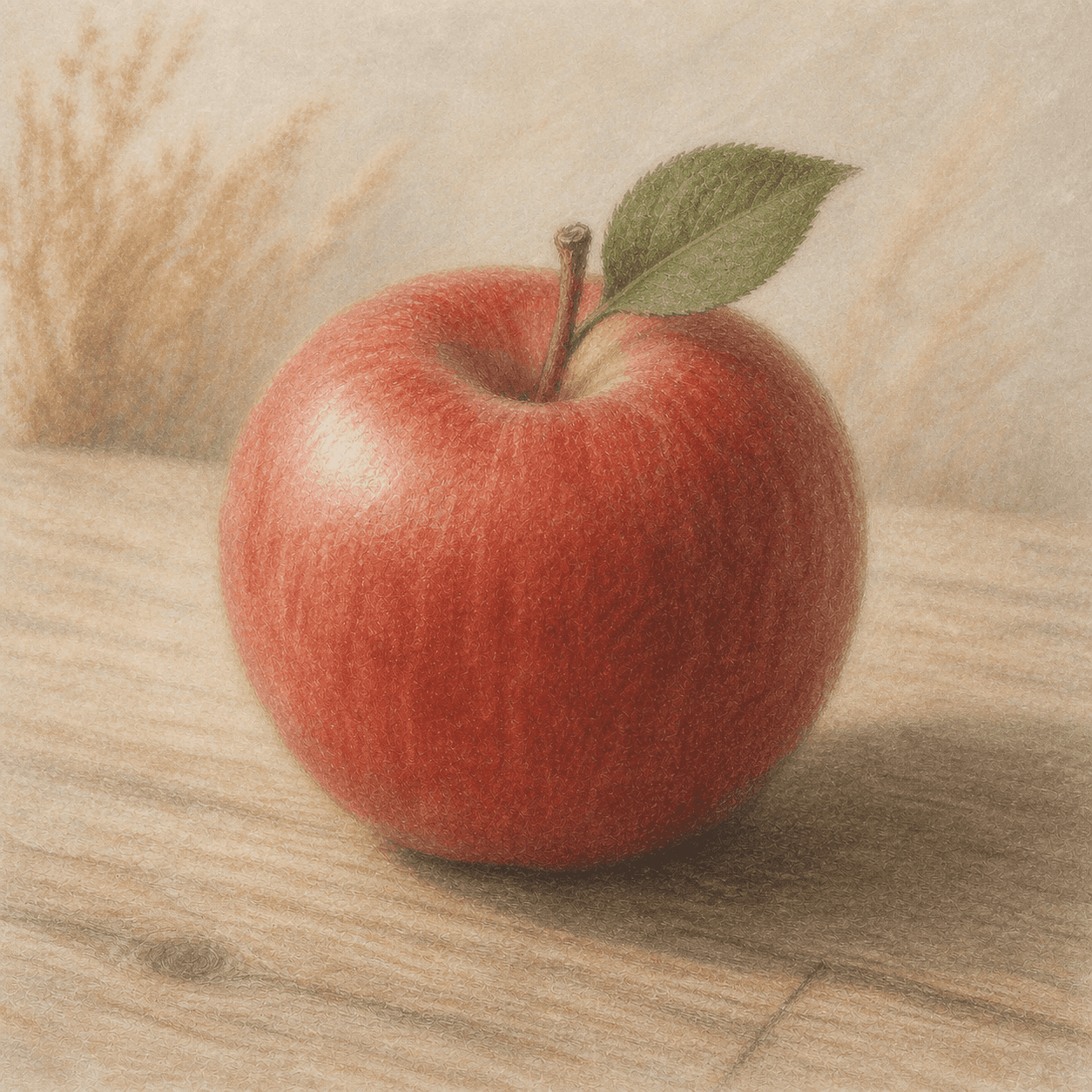
READ THE IMAGE
This softness is not a blur filter; it comes from powder meeting tooth
The stick's side opens broad fields while curled short marks remain on the skin. Background powder is rubbed into haze; the apple edge softens in light and tightens again toward shadow. Particle, ground, and edge make the air.
- 01
See particle scatter light
Minute grains give the red a matte, velvety brilliance rather than a varnished sheen.
- 02
Let the ground cross thin colour
Warm grey support appears through background and highlight, unifying the atmosphere.
- 03
Keep rubbing beside hatching
Backgrounds soften while fruit and leaf retain marks; blending everything would erase structure.
- 04
Shift edge through space
The lit contour merges, while dark side and cast shadow sharpen to build volume.
In one sentence
Hold near-pure pigment on the surface—
then draw and paint with line, side, and friction
Pastel works as a pointed drawing tool and as a broad painting stick. With little binder, pigment does not cure into a tough film; paper tooth or prepared ground holds it in place. That yields brilliant, diffusely reflecting colour and also sensitivity to rubbing, vibration, and light. Pastel style does not mean pale colours or photographic soft focus.
VISUAL LANGUAGE
Powder DNA
Colour
Direct, luminous
Mark
Point plus side
An edge carries structure while the stick's flank establishes a field quickly.Layer
Placed, not churned
Adjacent or overlaid complements vibrate when lower gaps remain.Edge
Rubbed, then restored
Finger, stump, or brush softens; fresh hatching can recover focus.Surface
Toothed, vulnerable
Rough ground traps powder, eventually fills, and remains unsafe to touch.Where it came from
From Renaissance coloured chalk to portrait fashion and modern colour experiment
Pastel appeared as a new coloured drawing material in the fifteenth century and first often aided painted studies. Eighteenth-century artists turned it into a highly finished portrait medium. In the nineteenth century, Impressionists and Degas used its speed, layering, and exposed mark to place it at the centre of modern painting.
Coloured chalk enters the studio
Artists such as Barocci use it to study flesh, light, and colour distribution for paintings.
Pastel portrait becomes fashionable
Rosalba Carriera and La Tour render skin, fabric, and metal with brilliant finish and immediacy.
Modern life revives the medium
Degas, Cassatt, and Whistler expand hatching, rubbing, and unconventional supports.
Study becomes abstraction and mixed media
Soft, hard, and oil pastel move across paper, sanded ground, prepared board, and diverse visual languages.
ARTISTS & WORKS
Meet it through four artists
Rosalba Carriera
Raises pastel from study material to an autonomous portrait medium, using light touch and coloured ground for translucent skin.Maurice-Quentin de La Tour
Uses dense layers to mimic satin, metal, and fleeting expression at the height of French eighteenth-century practice.Edgar Degas
Layers complementary hatching and manipulates powder with fingers, brushes, scraping, and steam, joining drawing to painting.Mary Cassatt
Pictures intimate modern life with broken pastel line, exposed paper, and cropped composition.How to recognise it
Do not seek pastel colours first; read how powder makes a surface
- ✓At close range, is there loose matte particle with tooth showing between deposits?
- ✓Do pointed line, broad side-stroke, and selective rubbing coexist?
- ✓Does colour stay bright through adjacency and layering rather than a uniform wet film?
- ✓Do edges change deliberately with focus, light, and space?
STYLE RELATIONS
Three dry media
Pastel
Uses high-pigment powder, broad side marks, and adjustable edges for velvety luminous colour.CURRENTColored Pencil
Builds exact detail and local burnish from a narrow, binder-rich core and cumulative hatching.↗Charcoal
Concentrates on structure and weight through black-grey carbon, erasure, and strong value contrast.↗REFERENCES
Sources & image note
The apple is a contemporary teaching interpretation emphasising warm ground, matte particle, rubbed background, and variable edge. Actual pastel ranges from finished eighteenth-century portraits through Degas's forceful hatching to abstraction; it is not uniformly pale or hazy.