
Illustration
Colored Pencil
Colored pencil puts pigment with wax- or oil-based binder into a sharpenable core. It can be as precise as line drawing and, through dozens of translucent layers, build composite colour approaching painting.
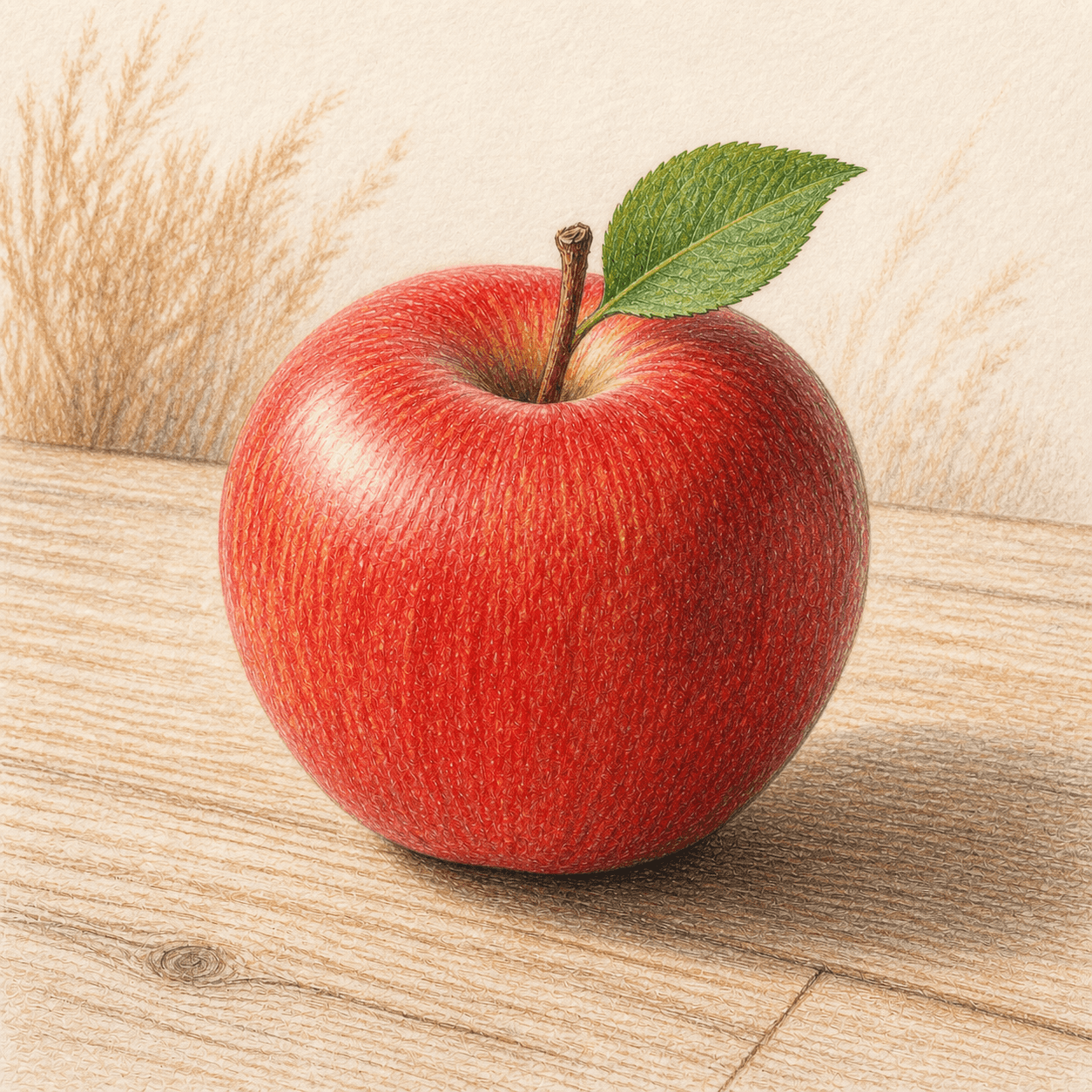
READ THE IMAGE
The apple is not filled once; it accumulates from directional lines
Red, orange, and violet-brown overlap along the fruit's curvature while white paper shows between marks. Leaf veins and timber use a sharper point. Volume emerges through direction, layer count, and pressure together.
- 01
Turn strokes with the form
Short arcs radiate from the cavity, making colour explain the curve.
- 02
Let paper tooth breathe
Tiny white gaps survive in middle values, breaking colour into airy grain.
- 03
Layer instead of choosing one red
Orange, ochre, and cool violet enrich red without simple black-and-white shading.
- 04
Change surface through pressure
Highlights stay light, darks gain layers and force, while a sharp point defines veins.
In one sentence
Let lines accumulate into colour—
then make colour follow form into touch
Colored pencil is a dry drawing medium whose core is chiefly pigment and binder, not ordinary graphite made colourful. Light pressure preserves paper tooth and transparent mixing; repeated layers raise saturation; heavy burnishing compresses particles into a smoother surface. The style is not one historical movement but a family of effects formed by material limits and gesture.
VISUAL LANGUAGE
Core DNA
Line
Visible, controlled
Layer
Thin, cumulative
Several hues mix optically instead of one heavy application.Pressure
Light to heavy
Force controls tooth, saturation, edge, and sheen.Paper
Toothed, active
Relief grips pigment and ground colour influences the mixture.Revision
Limited, planned
Dark, burnished passages resist full erasure, so lights are reserved.Where it came from
From colouring and map notation to an independent medium expanded by contemporary artists
Coloured dry sticks long served notation, teaching, and design. Industrial pencil manufacture made wooden colour cores consistent in the nineteenth century; school sets and professional ranges spread together in the twentieth. Artists now exploit intimate scale, slow layering, and exact control.
Coloured dry media serve design
Crayons and pencils mark maps, sketches, and technical drawings with portable precision.
Industry stabilises the core
Wood casing, pigments, and binders improve so sets become more consistent.
School and home use expands
Affordable colour pencils and crayons enter classrooms, creating their persistent association with childhood.
Artist-grade media gain recognition
Lightfast pigments and broader ranges support archives, portraits, narratives, and large meticulous drawings.
ARTISTS & WORKS
Meet it through four makers
John Marin
Uses coloured pencil in travel sketches to note architecture, shoreline, and colour relations quickly.Frédéric Bruly Bouabré
Builds a continuing archive of language, nature, and world knowledge on small cards with pencil and text.Annette Messager
Uses the medium's familiar intimacy in serial images connecting domestic classification, body, and social role.Jake Grewal
Layers figures into trees and water while retaining a dark, minute paper-bound way of looking.How to recognise it
Read tooth, stroke, and mixed colour—not a generic drawn look
- ✓At close view, do fine or crossed strokes follow structure?
- ✓Does middle value retain tooth while saturated areas show burnished smoothness?
- ✓Are shadows mixed from adjacent and complementary hues rather than simply blackened?
- ✓Do contour, texture, and field continue from one sharpenable core?
STYLE RELATIONS
Three dry colour media
REFERENCES
Sources & image note
The apple is a contemporary teaching interpretation emphasising directional hatching, paper tooth, and multi-hue layering. Actual practice ranges from rapid notation to full burnishing and need not share one meticulous realist finish.