
Chinese Art
Chinese New Year Print
A nianhua is not simply a festive illustration. It enters the home on schedule—renewing doors and shrines, telling drama and history, and making next year's safety, harvest, and prosperity visible.
READ THE IMAGE
Before seeing bright red, see how key line and colour blocks divide the work
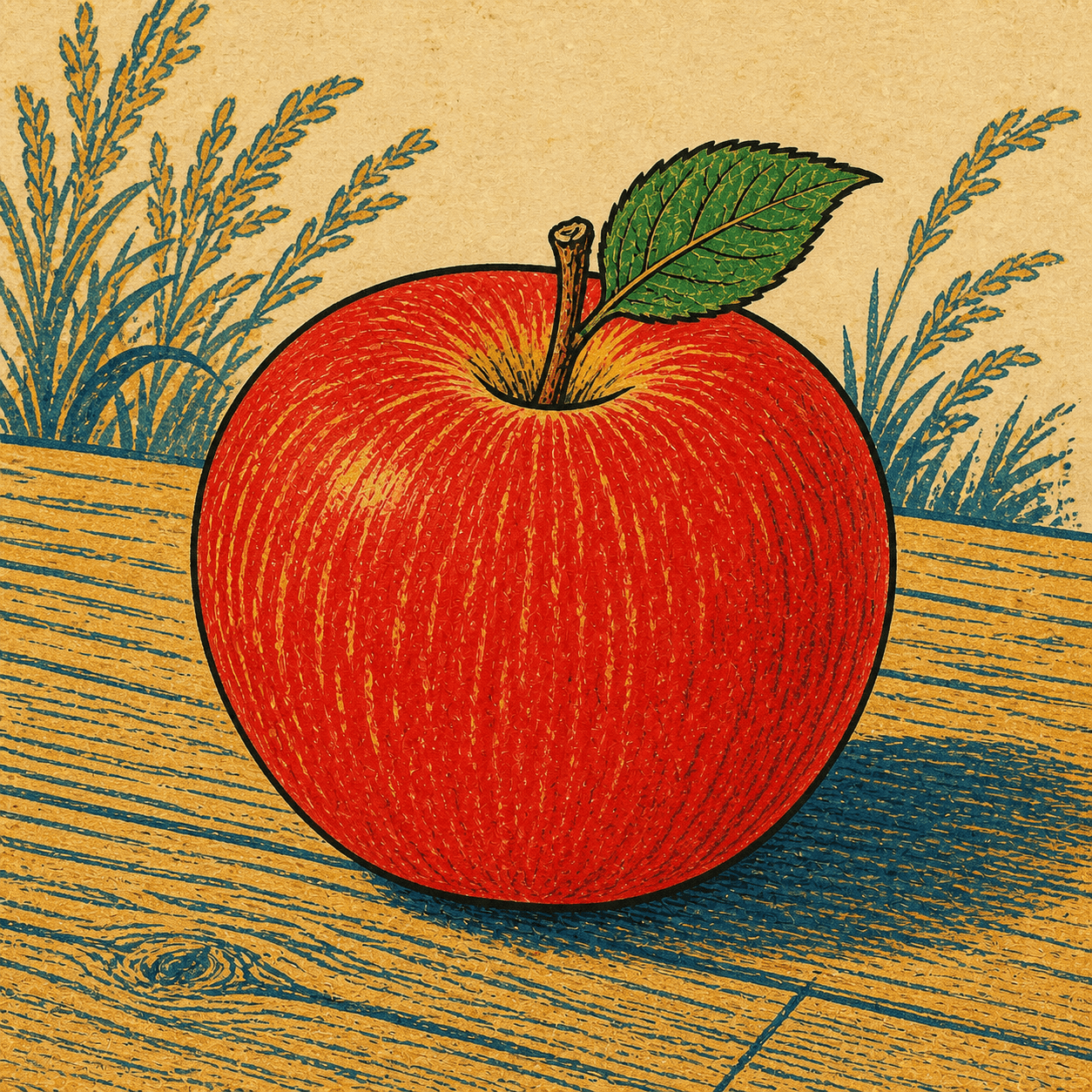
Bold black contour, flat red-green, blue setting, and yellow paper evoke popular colour woodblock. The apple is a contemporary stand-in for reading production.
- 01
See the key line fix form
Fruit, leaf, and stem are enclosed by sturdy black, like a key block shared by every colour layer and designed to remain clear at distance.
- 02
See colour as block, not gradient
Large red, green, and blue fields meet with small shifts and paper texture. Contrast, not naturalistic modelling, supplies force.
- 03
See why the composition is full
The apple nearly fills the centre while surrounding plants spread outward. A print on a busy festival wall must communicate quickly.
- 04
Read the apple as auspicious language
Red fruit, green leaf, and harvest grain suggest abundance and fruition. Traditional prints encode wishes through pun, symbol, and paired figures.
In one sentence
Not a decorative ‘Chinese red’ style—
but popular imagery defined by print, season, placement, and auspicious meaning
Nianhua are named for seasonal hanging, usually printed from woodblocks on paper, with regional practices that include part-printing and part-painting. Shops divided labour among design, carving, key-line printing, colour registration, and hand finishing for mass production. Door gods, Kitchen God, wealth deities, children, beauties, opera, fiction, farming, news, and good fortune all appear. Meaning depends on where an image hangs, when it is replaced, and whether it has a pair; fading, smoke, and annual removal belong to its brief, cyclical life.
VISUAL LANGUAGE
Visual DNA
Block
One block per colour builds the image
Line
Bold contour reads from the room
Compressed knife-cut form keeps deity, actor, and object clear at door-wall distance.Colour
High contrast produces festival energy
Flat red, yellow, green, purple, and other combinations vary with regional material and taste.Wish
Pun and symbol make desire visible
Fish, lotus, pomegranate, bat, peony, and child combine into prosperity, fertility, and surplus.Place
Hanging site determines identity
Door guardians, stove deity, hall picture, and narrow room panel perform different protective and narrative tasks.Where it came from
From seasonal door deities to an urban-rural image market, nianhua returned with each household year
‘Chinese New Year print’ contains many regional crafts. Yangliuqing, Taohuawu, Yangjiabu, Zhuxianzhen, Mianzhu, and others differ in line, registered colour, hand painting, and subject.
Festival markets and printed images expand
Records describe year-end sale of door gods, Zhong Kui, and spirit papers as woodblock puts divine and auspicious imagery into more homes.
Commercial publishing and regional workshops grow
Fiction, opera, print technique, and urban-rural trade interact as stable shops and design stocks develop around Suzhou, Tianjin, and elsewhere.
Regional centres and subjects reach a peak
Yangliuqing, Taohuawu, Yangjiabu, Zhuxianzhen, Mianzhu, and others circulate door gods, babies, opera, custom, and current events.
Lithography, calendar posters, and modern media transform the field
Machine print contracts woodblock markets while nianhua enters propaganda, fine-art collecting, and heritage preservation; some communities continue seasonal use.
ARTISTS & WORKS
Meet it through four regional practices
Yangliuqing ‘lotus child and fish’ pictures, Tianjin
A plump child, fish, and lotus organise wishes through puns; woodblock outline is often hand-coloured and the face carefully finished.Taohuawu city-view prints, Suzhou
Fine key line and bright registered colour join cityscape, opera, and current events within Jiangnan publishing and commercial visual culture.Yangjiabu ‘Ten Busy Men/Women’ pictures, Shandong
Sequential labour scenes arrange farming, weaving, and household ethics in full, quickly read compositions.Zhuxianzhen door gods, Henan
Paired warriors such as Qin Qiong and Yuchi Gong guard the entrance; bold line, dense colour, and exaggerated arms serve their actual protective site.How to recognise it
Ask how it was printed, when it hung, and where it worked before asking whether it is red and green
- ✓Can you distinguish key-line and colour blocks, registration, or hand finish rather than uniform digital outline?
- ✓Does design suit a particular door, stove, hall, or narrow panel and perhaps require a pair?
- ✓Do fish-lotus, deity, child, and opera gain protective or auspicious meaning through pun and custom?
- ✓Can regional methods of Yangliuqing, Taohuawu, Yangjiabu, Zhuxianzhen, or Mianzhu be kept distinct?
STYLE RELATIONS
Popular images reproduce and perform in different ways
Chinese New Year Print
Uses colour woodblock and New Year hanging to bring guardians, stories, and wishes into the home.CURRENTPaper Cutting
Creates positive-negative form through folding and cutting for window, decoration, and ritual.↗Shadow Puppetry
Uses pierced, coloured, jointed flat figures with light, manipulation, and song to perform stories.↗REFERENCES
Sources & image note
The apple demonstrates bold key line, limited registered colour, paper, and auspicious association. It is no traditional nianhua subject and does not represent one workshop's full process.