
Chinese Art
Chinese Paper Cutting
Paper cutting is not a shape coloured red. One sheet must survive the dialogue of cut and kept: every void is held by a paper bridge, binding pattern to window light, ritual, and the maker's hand.
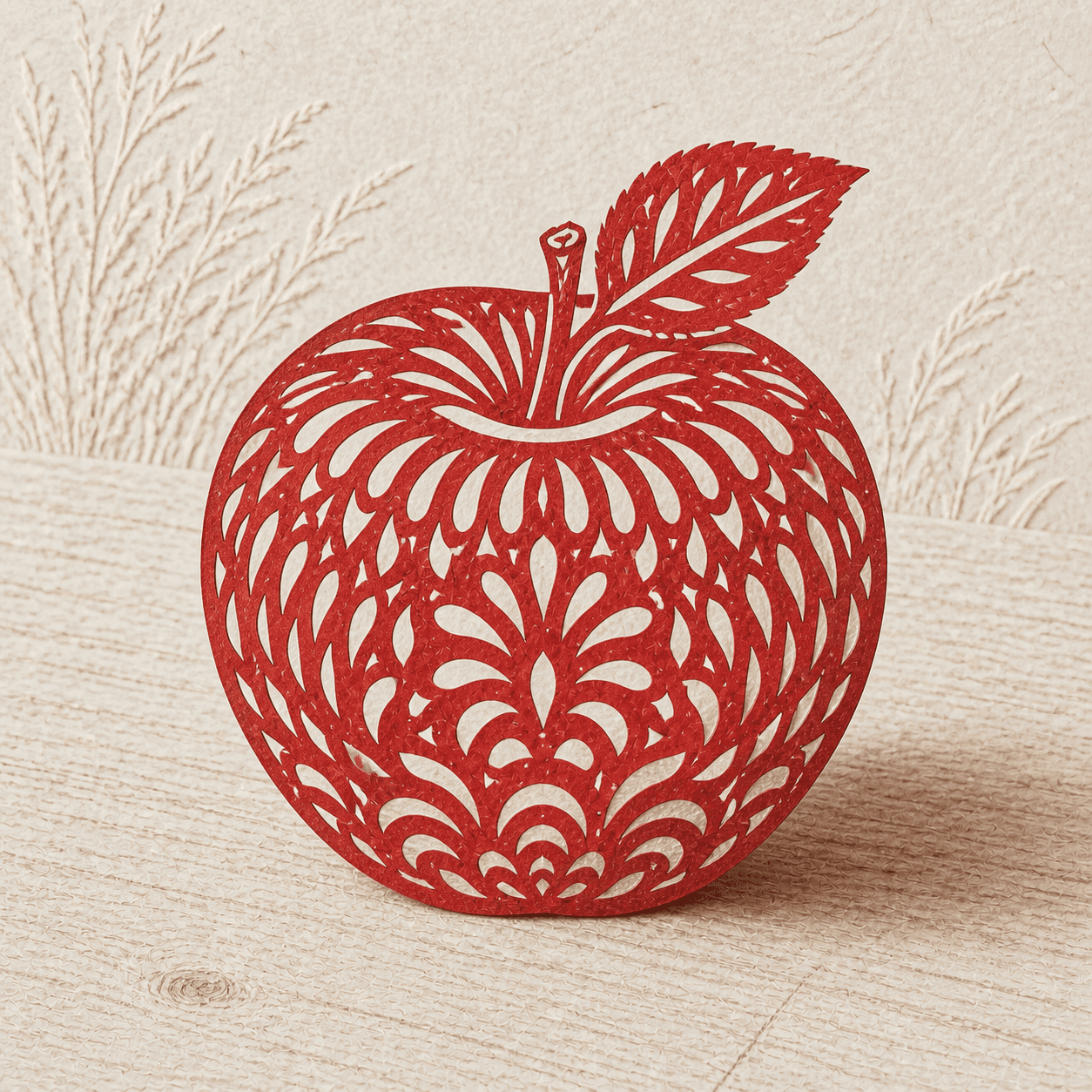
READ THE IMAGE
See the white that was removed before the red that remains
The apple becomes one self-supporting red sheet. White apertures, continuous bridges, and near-symmetrical floral structure reveal how paper cutting thinks in positive and negative.
- 01
See emptiness as form
White drops and petals are not background accidentally showing through. They are deliberately removed negative shapes composing together with red.
- 02
Find every unbroken bridge
Narrow red ligaments connect openings to the outline. A design must solve structure as well as image or it falls apart when opened or pasted.
- 03
See folding generate order
Near-axial symmetry and repeated leaf forms expand from the centre like units produced by one cut through folded paper.
- 04
See why handmade need not match perfectly
The two sides echo without mechanical mirroring, and edge widths vary. Improvisation and turning the scissors keep the pattern alive.
In one sentence
Not red lace ornament—
but a living skill organising space, relation, and wishes through removal and retention
Chinese paper cutting uses scissors or knife to create connected positive fields and incised negative lines. Paper may be folded, stacked, coloured, dyed, or collaged. Works attach to window, door, wall, lamp, gift, and ceremonial object for New Year, wedding, birth, longevity, ancestor rites, rain prayer, and protection. A motif may be improvised or transmitted through mothers and daughters, apprenticeship, smoke pattern, or template. It is not one national ‘red style’ but knowledge continually recreated by many communities.
VISUAL LANGUAGE
Visual DNA
Positive/negative
Kept and removed are equally active
Connection
Paper bridges hold the whole
Whisker, vein, branch, and border are image and structural engineering against fragmentation.Fold
Action generates repetition
Half, accordion, and radial folds duplicate one cut into bilateral flowers, medallions, and continuous borders.Tool
Scissors and knife make different rhythms
Scissors favour paper-turning and free curves; knives cut fine repeated motifs through stacked sheets.Use
Pattern joins rites of life
Child, fish-lotus, protective doll, zodiac, flower, and bird carry fertility, safety, harvest, and memory by region.Where it came from
Fragile paper leaves few early objects, but cutting grew through everyday display and women's transmission
Surviving old paper flowers cannot stand for the whole past. Many works were replaced after use; tradition lives more fully in movement, oral memory, patterns, and community occasions.
Early folded cuts and paper flowers leave material clues
Finds from Xinjiang and layered flowers from Dunhuang Cave 17 show folding, cutting, colouring, and pasting in funerary and religious decoration.
Paper windows, festivals, and rites widen daily use
Papermaking, urban festivals, and domestic display expand motifs; cuts also serve as patterns for embroidery, lantern, and object decoration.
Regional forms and life-cycle rites diversify
Northern window flowers, southern fine work, ethnic embroidery patterns, wedding, and sacrificial cuts develop distinct tools, subjects, and transmission.
Documentation, new art, and safeguarding proceed together
Folk-art surveys, revolutionary subjects, and design alter display. Since UNESCO inscription in 2009, community teaching grows alongside stage and commodity forms.
ARTISTS & WORKS
Meet it through four regional traditions
Ansai window flowers, northern Shaanxi
Makers narrate farm life through exaggerated people and animals; varied connected red shapes answer cave-dwelling window light and seasonal display.Yuxian coloured paper cuts, Hebei
Knives batch-cut intricate incised outlines, then artists spot-colour areas by hand—proof that paper cutting is not necessarily red and white.Yueqing fine-line cutting, Zhejiang
Extremely fine threads, sawteeth, and crescent cuts interlock in motifs such as dragon-boat flowers, dense yet structurally continuous.Zhangpu paper cutting, Fujian
Flower, bird, figure, and everyday story combine positive and negative cutting in intricate images for festival, wedding, and interior use.How to recognise it
Test whether it could truly be cut from paper, not merely whether the pattern looks right
- ✓Do positive and negative read together, with openings created by cutting rather than printed white motifs?
- ✓Do fine parts connect to the body so the sheet survives opening, lifting, and pasting?
- ✓Do symmetry and repetition correspond to folding, stacking, or turning actions and preserve tool rhythm?
- ✓Do subject and form belong to a particular region, ethnic group, festival, or life-cycle rite?
STYLE RELATIONS
Cut paper and pierced figures use light differently
Chinese Paper Cutting
Uses positive-negative form and connected sheets for window, festival, and life-cycle ritual.CURRENTChinese New Year Print
Reproduces line and colour through woodblock and gives the household seasonal guardians and wishes.↗Shadow Puppetry
Turns pierced hide into jointed characters that require lamp, manipulation, voice, music, and screen.↗REFERENCES
Sources & image note
The apple demonstrates positive-negative form, paper bridges, and folded order. Historical cuts are generally flat and thin; the upright apple is a contemporary teaching construction.