
3D Art
Clay 3D
Clay 3D brings the tactility of a malleable material into digital form: rounded volume is not perfect smoothness; dents, seams, asymmetry, and soft reflection make it feel hand-shaped.
READ THE IMAGE
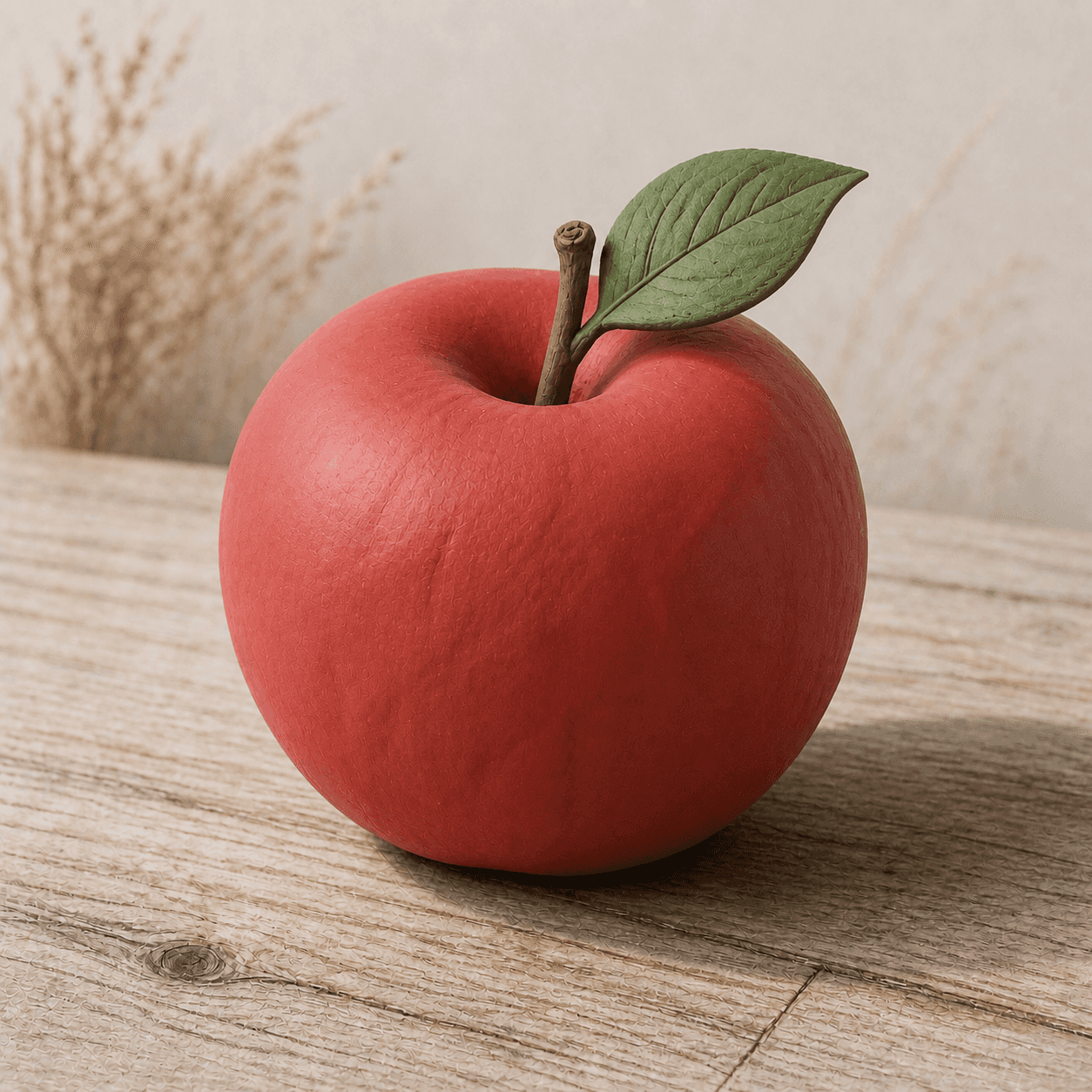
The apple feels credible because it seems possible to reshape it by hand
Its belly is not a machine-perfect sphere: the top is pressed in, edges yield slightly, and leaf and stem seem embedded as separate material. Highlights are broad and dull, while small marks share a hand-sized scale.
- 01
Give the outline softness
Curves swell, sag, and vary slightly rather than following identical CAD arcs.
- 02
Keep marks at hand scale
Presses, scrapes, and seams explain a forming action instead of becoming random noise.
- 03
Make it matte but volumetric
Clay generally uses broad highlights and soft turning—neither mirror nor dust.
- 04
Explain assembly
Leaf, stem, and body need an inset, seam, or gathered material at their join.
In one sentence
Treat a 3D form as soft matter that can be added, carved, pressed, and smoothed—
and let the making remain visible
Clay style is not a scan of one real clay recipe but a system of form rules: major masses feel hand-built, turns stay rounded, and local dents, buildup, smoothing, and seams remain legible. Digital work can achieve it with sculpting, displacement, and shading; stop motion makes real material, replacement parts, and frame-by-frame adjustment part of performance.
VISUAL LANGUAGE
Malleable-material DNA
Mass
Build compressible volume first
Press
Let actions create relief
Finger pressure, tools, and pushing leave directional wide or narrow changes.Join
Give parts connection logic
Attachments inset, wrap, or leave a seam rather than intersect invisibly.Matte
Restrain gloss
Broad highlights and soft reflection describe mass without turning it into plastic.Imperfect
Use variation with intention
Slight asymmetry and changing thickness feel hand-made; random grain does not.Where it came from
From sculpture and stop motion to digital sculpting and brand illustration, clay style turns the trace of a hand into a readable 3D language
Clay has long served models and prototypes because volume can be added and removed directly. Stop motion brought kneading, replacement faces, and frame-by-frame adjustment to the screen; digital sculpting later separated that workflow from physical matter, making it a warm language for games, shorts, and illustration.
Clay serves sculpture and maquettes
Soft material allows repeated addition, subtraction, flattening, and revision.
Clay animation enters film
Frame-by-frame photography makes hand-shaped figures move.
Stop motion gains a strong authorship
Fingerprints, replacement parts, and minute jitter become medium-specific charm.
Digital sculpting expands the metaphor
High-resolution sculpting and stylised rendering bring clay feeling into real-time 3D.
ARTISTS & WORKS
Meet it through four cases
Early clay animation
Frame photography proves that a malleable character can perform.Wallace & Gromit
Handmade clay, replacement expression, and comedy form a recognisable character world.Coraline
Physical puppets, fabric, and crafted surface make an intricate but unsettling stop-motion space.Digital clay illustration
Round proportion, matte material, and local marks make product and character imagery approachable.How to recognise it
Ask whether form looks changeable by hand, then whether every mark explains material and action
- ✓Does the outer form show weight, thickness, and slight asymmetry?
- ✓Do relief marks correspond to imaginable pressing, pushing, scraping, or adding?
- ✓Are highlights broad and controlled rather than shiny plastic or rough stone?
- ✓Do independent parts join the body through inset, seam, or gathered material?
STYLE RELATIONS
Three soft 3D languages
REFERENCES
Sources & image note
The apple is a digital clay teaching interpretation using soft contour, press marks, seams, and matte light. It does not depict a particular stop-motion studio or a literal clay recipe.