
3D Art
Toon Shading
Toon shading is not one filter that makes a model ‘animated.’ It deliberately compresses continuous light into finite bands, then uses silhouette, feature lines, and designed shadow to make a form read as drawn.
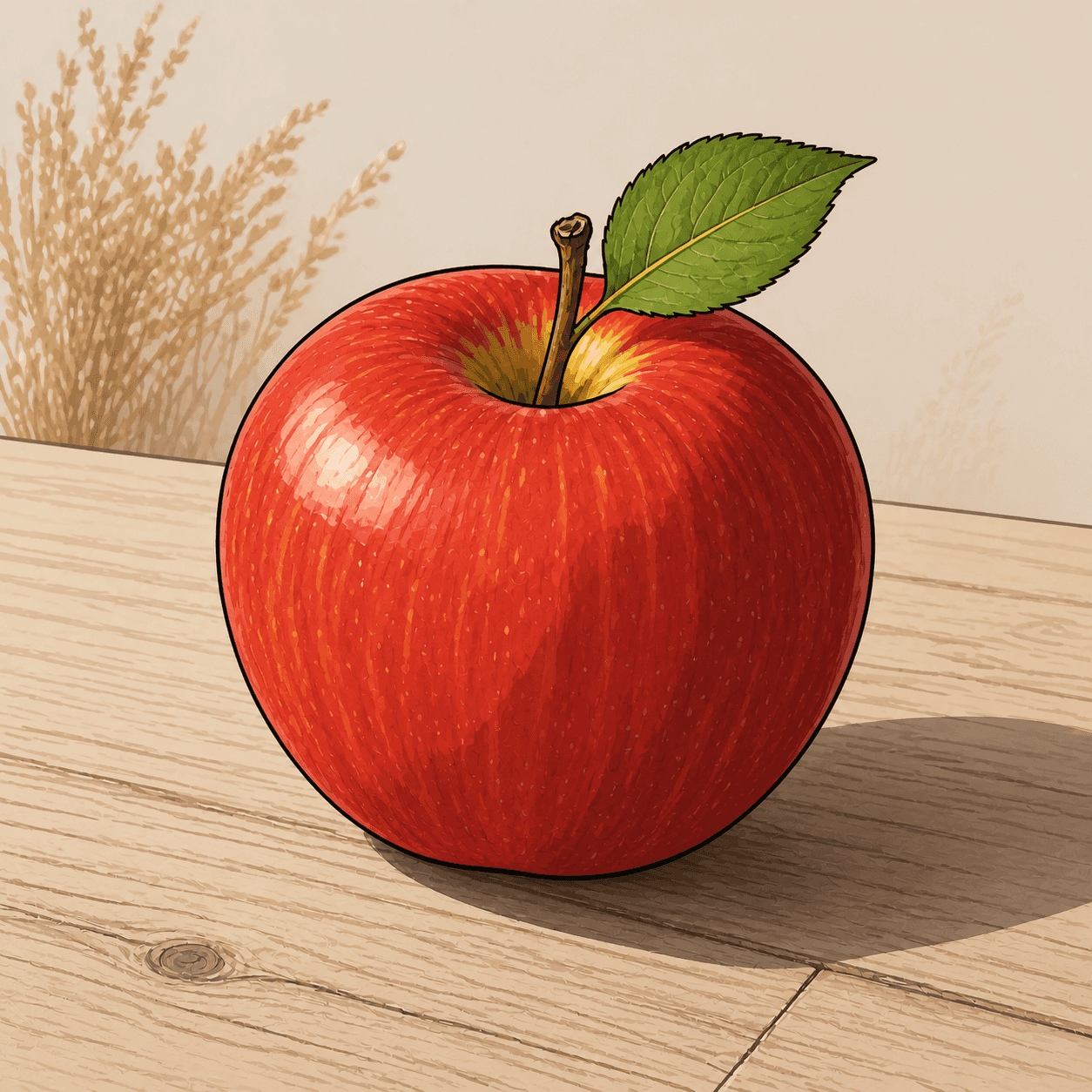
READ THE IMAGE
The apple's light does not blend smoothly—it is arranged in intentional planes
Highlight, lit side, and shadow jump at explicit thresholds; its outer silhouette and decisive turns are held by dark lines. Light still explains volume, but palette and line redraw it for clarity at a glance.
- 01
Quantise the light
Red moves through a few clear regions rather than the continuous, noisy gradient of realistic shading.
- 02
Choose which edges matter
Silhouette, occlusion junctions, and selected turns are darker and steadier; not every mesh edge deserves ink.
- 03
Design the shadow
Cast shape and contact darkness support composition and weight, often cleaner than a physically soft shadow.
- 04
Free colour from literal material
Background, table, and apple can separate through high saturation or complements without matching real spectra.
In one sentence
Rewrite continuous light, material realism, and geometric boundaries
into finite bands, selective line, and controlled graphic rhythm
Toon shading, often called cel shading, names a family of non-photorealistic methods. Ordinary shading changes continuously with normals and light; toon shading quantises that result through thresholds, ramps, or lookup bands, then selectively extracts silhouette, crease, or depth-discontinuity lines. It still needs models, lighting, and a camera—but replaces ‘like the real world’ with ‘like one consistent drawing system.’
VISUAL LANGUAGE
Non-photoreal light DNA
Band
Quantise continuous illumination
Line
Outline is a selected result
Extract by view, normal, depth, or object boundary; line weight and interruption need hierarchy.Colour
Palette precedes material realism
Local, shadow, and environment colours can be designed independently instead of flattening a PBR texture.Shadow
Make shadow compositional
Keep contact, cast, and turning darks that explain structure; discard noise that does not.Camera
The lens decides form first
Focal length, view, and silhouette matter enormously; clear pose and contour come before the shader.Where it came from
From cel animation's painted planes and ink lines to real-time thresholds and edge detection, toon shading gives 3D imagery a deliberately drawn logic
Traditional animation relied on layered colour planes, clear outlines, and limited shadow for repeatable, readable characters. From the 1990s, graphics translated such principles into light quantisation, ink lines, and post-process edge detection; games and animated films expanded them into diverse visual systems.
Cel animation establishes plane and outline
Layered drawing, ink, and limited shadow support reusable, legible characters.
NPR becomes a graphics field
Researchers explore how computation can render drawing, watercolour, comics, and technical illustration.
Real-time cel shading spreads
Programmable GPUs bring ramps, rim light, edge detection, and screen-space ink into game pipelines.
Stylised rendering becomes an art direction
Line, material, camera, effects, and animation timing are unified as a specific language rather than a post effect.
ARTISTS & WORKS
Meet it through four cases
The Wind Waker
Flat colour, emphatic contour, and simplified light turn a navigable 3D sea into an animated world.Jet Set Radio
Graffiti-like line, high-contrast colour, and exaggerated motion give its city a comic rhythm.Guilty Gear Xrd
3D models, hand-controlled frames, and shading rules emulate 2D fighting-animation pose and line.Spider-Man: Into the Spider-Verse
Halftone, offset line, and frame-rate variation bring a rendered film image close to printed comics.How to recognise it
First test whether light is intentionally discrete; then see whether line and shadow work with the form
- ✓Does light change at deliberate thresholds, rather than merely adding a saturated filter to realistic material?
- ✓Do outlines privilege silhouette and meaningful turns instead of tracing every mesh edge equally?
- ✓Do palette, cast shadow, and environment colour separate the character from its setting?
- ✓When motion and camera pause, does the silhouette still identify the object instantly?
STYLE RELATIONS
Three stylised 3D strategies
Toon Shading
Quantises light and selects ink so 3D surface becomes readable graphic planes.CURRENTStylized Realism
Keeps more continuous light and material, selecting mainly through proportion, detail, and colour.↗Low Poly
Simplifies form through visible facets and normals; it can also receive toon shading.↗REFERENCES
Sources & image note
The apple is a contemporary toon-shading teaching interpretation: finite light bands, selective dark contour, and graphic cast shadow work together. It represents no particular work and does not reduce all non-photorealistic rendering to black outlines.