
3D Art
Low Poly
Low poly is not an unfinished model. It turns a limited polygon budget into a visible design language. Every vertex serves silhouette, turn, or light; flat normals make each triangle a colour unit, and simplified form demands more—not less—accuracy in proportion and rhythm.
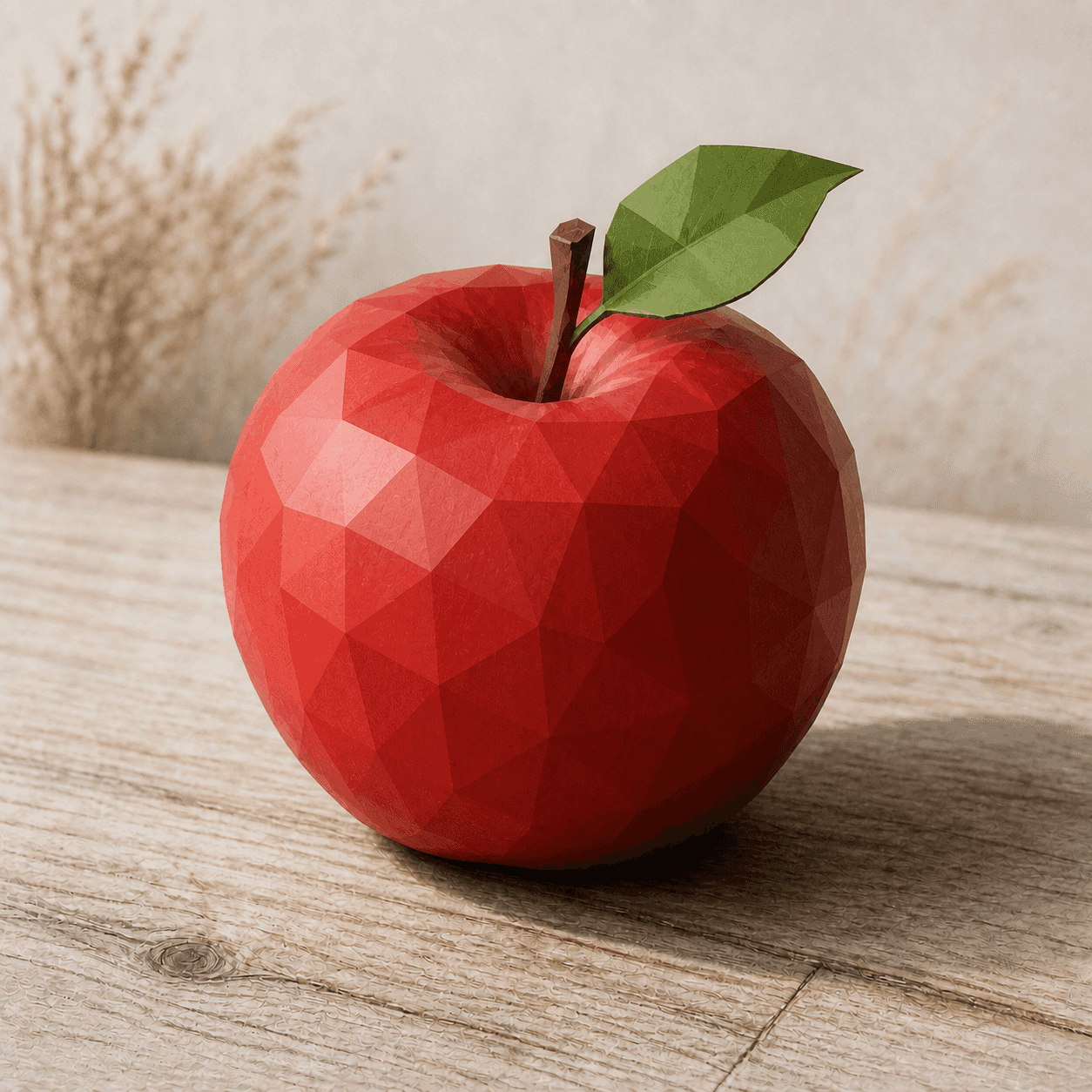
READ THE IMAGE
The apple's roundness is not blurred smooth; it is decomposed into selected planar turns
Large triangles establish silhouette and top dimple, lit faces use warmer bright red, and rear planes shift cool violet-red. Colour stays stable within a face and jumps as the normal changes. The leaf retains only axis, point, and a few folds.
- 01
Spend vertices on silhouette
Belly, top dimple, and leaf tip receive necessary turns while quiet interior regions use larger facets.
- 02
Direct facets around volume
Triangle edges follow apple latitude, longitude, and lighting turns instead of arbitrary triangulation debris.
- 03
Let flat normals step colour
Each face receives light by its own normal, producing a clear value ladder without painted fake shadow.
- 04
Replace detail with shape
Pores and wood grain disappear; stem, leaf, and cast shadow retain only recognition structures.
In one sentence
Allocate silhouette and turning with finite polygons—
and make geometry itself a visible colour language
Low poly first described real-time models constrained by hardware budgets and now also names a style that preserves simplified mesh and faceting. A triangle is always planar. Under flat shading, face-corner normals match the face normal and boundaries remain explicit. Under smooth shading, adjacent normals interpolate, making a polygonal silhouette appear continuous. Designed low poly chooses the former or planned sharp edges rather than merely decimating a dense model.
VISUAL LANGUAGE
Silhouette-budget DNA
Outline
Assign vertices to the cutout first
Facet
Area and direction make rhythm
Faces shrink near focus and dense curvature; broad planes let quiet regions breathe.Normal
Normals decide how light reads a face
Flat normals strengthen facets; split or custom normals control selected edges at low counts.Colour
Tone can be summarised per face
Vertex colour, face colour, or simple material compress gradients into finite warm-cool and value groups.Economy
Remove redundancy, not structure
Random reduction damages silhouette, joint, and UV; good simplification preserves identity and deformation.Where it came from
Low poly moved from a real-time necessity through console-era visual memory into a deliberate contemporary geometric aesthetic
Early 3D systems had little storage, CPU, or display capacity and approximated objects with very few polygons. Consoles and PCs made polygonal characters a mass experience in the 1990s; later hardware and subdivision sought smoothness. From the 2010s, independent games, information illustration, and mobile design reclaimed facets, pure colour, and clear silhouette.
Polygon count is a computation boundary
Wireframe, flat shading, and simplified objects establish spatial reading in research, simulators, and arcades.
Real-time 3D reaches mass games
Texture and vertex limits shape remembered characters and spaces on PlayStation, Nintendo 64, and PC.
Baking and subdivision hide the mesh
Normal maps, LOD, and Catmull–Clark surfaces let small control meshes produce detailed smooth results.
Constraint becomes an independent style
Creators retain flat normals, coloured facets, and clean silhouette for performance, nostalgia, or graphic clarity.
ARTISTS & WORKS
Meet it through four cases
Virtua Racing
Uses very few planes and clear colour to deliver fast real-time racing, making facet turns part of speed.Star Fox
The Super FX chip drives home-console polygon scenes whose pure geometry and strong silhouettes read at distance.Tomb Raider
Block-built body, segmented joints, and texture together define the action and identity of an early 3D character.Monument Valley
Combines simple geometry, isometric framing, and colour zones into spatial puzzles clearer than realistic material would be.How to recognise it
Low count is only the outcome; designed low poly makes every face work in silhouette, volume, and colour
- ✓Do scarce vertices first preserve silhouette, joint, and negative space?
- ✓Do facet size and direction vary with form and focus rather than random automated fracture?
- ✓Do normals keep intended edges sharp and related planes coherently grouped?
- ✓Do texture and light respect geometric simplification instead of hiding it beneath realistic noise?
STYLE RELATIONS
Three geometric abstractions
Low Poly
Displays finite facets and planar turns, centring silhouette budget and geometric rhythm.CURRENTVoxel Art
Builds with fixed 3D grid cells, producing stair-stepped contour and volumetric pixels.↗Realistic 3D
Uses continuous contour, micro-surface material, and physical light to conceal geometric discreteness.↗REFERENCES
Sources & image note
The apple is a low-poly teaching render using selective triangulation, flat normals, and per-face colour grouping. Quality is not claimed through an automatic polygon count, and the page image cannot show actual topology or LOD switching.