
3D Art
Voxel Art
A voxel is a volume element in a 3D data grid, not merely a cubic pixel. Voxel art exposes discrete space as design language: every cell holds position, volume, and attributes; outlines staircase with the grid while colour and light aggregate in blocks.
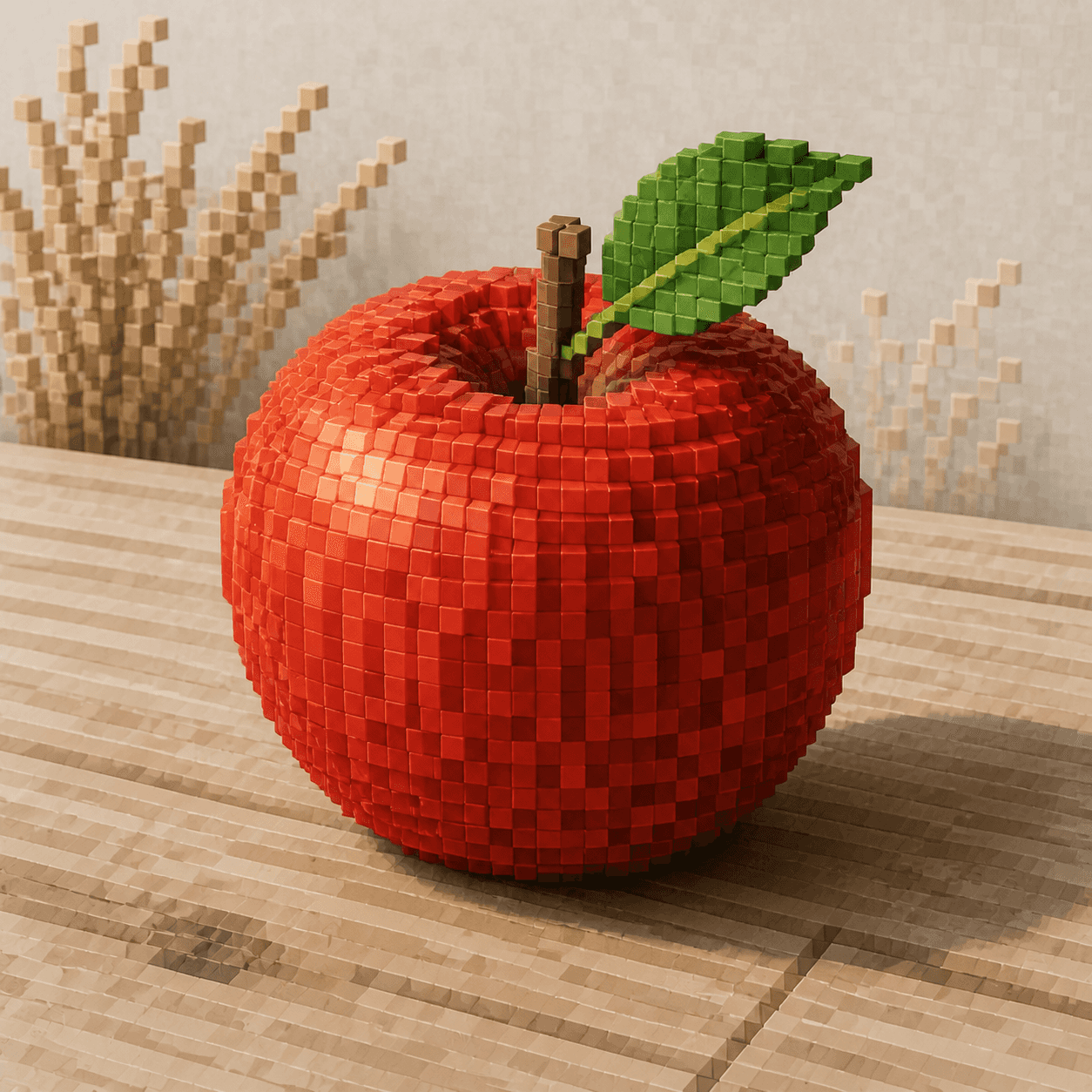
READ THE IMAGE
The apple is not a polygon shell chopped into cubes; it is occupied layer by layer inside a three-dimensional grid
Successive cross-sections expand and contract through the belly, the top dimple removes cells, and the leaf is only one or a few voxels thick. Brighter red groups face light, cool cells face away, and the ground shadow stairs across its grid.
- 01
Keep one grid across every outline
Fruit, leaf, and shadow share a cell step; no region suddenly uses half-blocks or a different pixel density.
- 02
Change cross-section continuously
Each layer grows from top through belly and contracts below with rhythm rather than becoming a random brick pile.
- 03
Use block colour, not blurred texture
Cell surfaces preserve clear colour groups, with finite steps between highlight and shadow.
- 04
Design both solid and void
Top dimple, leaf notch, and empty cells around the stem identify the form as much as occupied blocks.
In one sentence
Discretise three-dimensional space into regular samples—
and sculpt volume through occupancy, attributes, and void
Voxel derives from volume element, as pixel derives from picture element. Strictly, it is a data position or cell in a 3D grid and need not be a visible cube. Medical CT may store density, smoke extinction and temperature, and game terrain a block type. Voxel art often chooses nearest-neighbour cube display, while the same data may feed marching cubes for a smooth surface or ray accumulation for transparent volume.
VISUAL LANGUAGE
Three-dimensional-grid DNA
Grid
Resolution establishes world scale
Occupy
Presence and void both matter
Filled cells make mass while empty cells cut dimple, hole, and negative space.Neighbour
Six-face adjacency determines surface
Hidden internal shared faces can disappear, retaining exposed faces for efficient block boundaries.Value
Every voxel can carry properties
Colour, material, density, temperature, or distance controls shading, simulation, and rendering.Layer
Think in changing cross-sections
Checking area and centre of mass layer by layer prevents structures that work from only one view.Where it came from
Voxels began with medical and scientific volume data, entered terrain and simulation, and became a deliberate three-dimensional pixel aesthetic
Tomographic imaging and scientific computation produced regular 3D samples in the late twentieth century, and volume-rendering research accumulated colour and opacity along viewing rays. Graphics also used voxels for smoke, cloud, fluid, and destructible terrain. Block-world games and accessible editors later made the visible grid a broad artistic language.
Tomography drives volume visualisation
Medicine and science store 3D samples and explore slice, surface extraction, and direct volume rendering.
Sparse structures and real-time methods advance
Octrees, 3D textures, and GPUs reduce the memory and sampling burden of uniform volumes.
Voxels enter mass game language
Block building, editable terrain, and procedural generation merge discrete volume with play and aesthetics.
Art editors and hybrid pipelines mature
Tools such as MagicaVoxel popularise small scenes; voxel data converts to mesh, print, or real-time lighting.
ARTISTS & WORKS
Meet it through four cases
CT Volume Visualisation
Reconstructs density from body slices so internal structure can be read without first extracting one surface.Marching Cubes
Extracts an isosurface triangle mesh from scalar voxels, connecting discrete data to continuous renderable form.Minecraft
Combines block occupancy, gathering, and construction into world rules, making voxel-like grids globally familiar.MagicaVoxel
Lowers the entry to voxel modelling through direct placement, palette, and a small renderer, growing an illustration and asset culture.How to recognise it
Confirm that a three-dimensional grid organises volume, then ask whether cube display is a consistent design choice
- ✓Do steps in every direction share one voxel size and coordinate lattice?
- ✓When rotated, do back and interior retain coherent volume rather than reveal a front pixel board?
- ✓Do colour, material, and light change by cell or neighbourhood rules?
- ✓Does detail respect fixed resolution instead of mixing arbitrarily smaller cubes to fake complexity?
STYLE RELATIONS
Three discrete visual units
Voxel Art
A 3D grid element has volume and neighbourhood, with stair steps on all three axes.CURRENTPixel Art
A picture element belongs to a 2D image grid and has no inherent interior volume.↗Low Poly
Vertices, edges, and polygons describe a surface shell whose facets need not follow a regular lattice.↗REFERENCES
Sources & image note
The apple is a visible-cube voxel teaching interpretation using one grid, layered cross-sections, occupancy and void, and block colour. It demonstrates one reconstruction and does not imply that every scientific volume displays as cubes.