
Digital Art
Pixel Art
Pixel art treats every square as an intentional picture unit. It is not a low-resolution screenshot, but a way of arranging form, light, and rhythm inside a fixed grid, finite palette, and readable clusters.
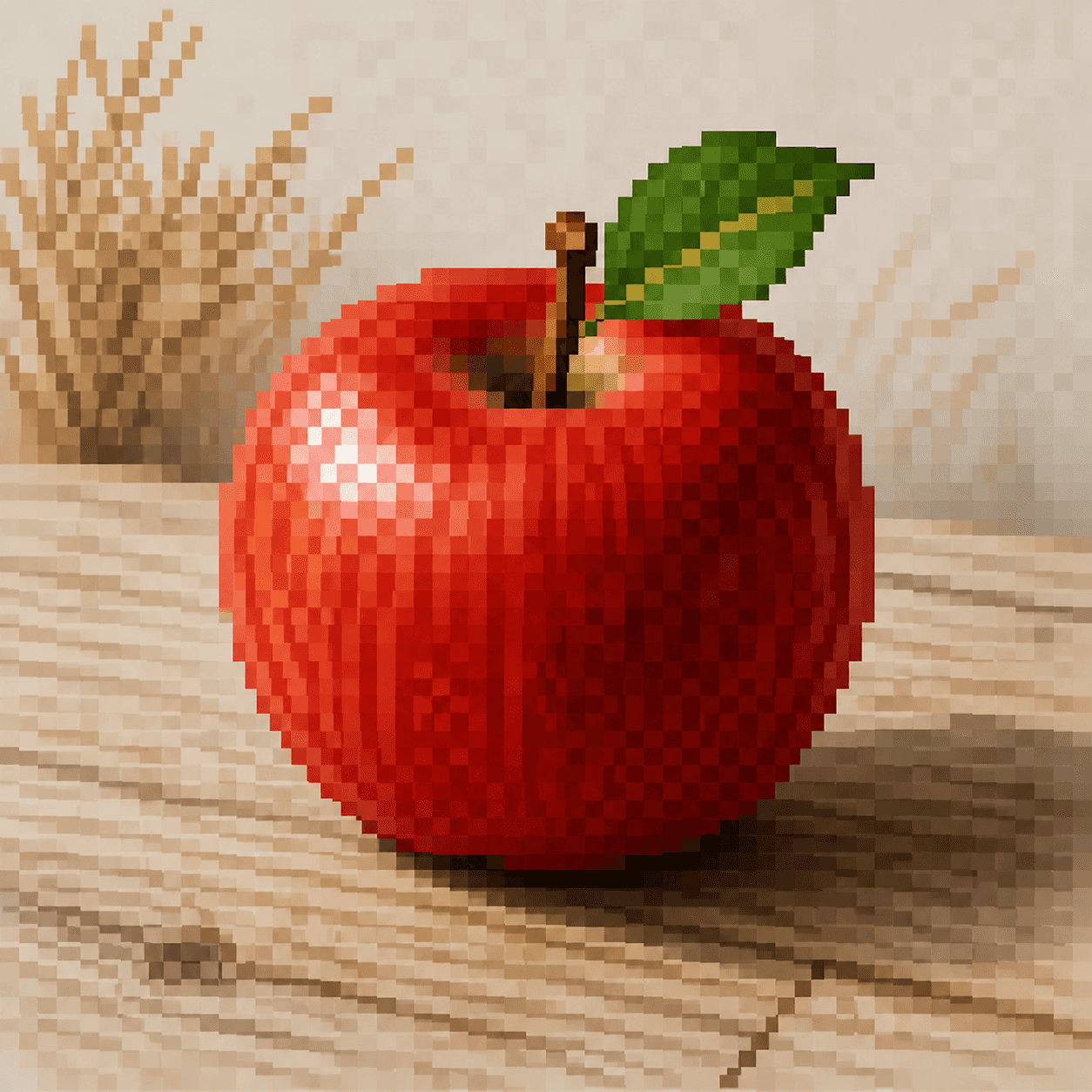
READ THE IMAGE
The apple is not mosaicked—it is built from readable pixel clusters
Stepped contour selects the form; highlights and shadows divide into a few grouped squares; each colour block has a job. Smooth scaling immediately destroys those relationships.
- 01
Build with clusters
Good pixels do not scatter alone; one colour makes readable short lines, planes, and steps.
- 02
Limit the palette
A controlled colour count gives neighbouring tones explicit jobs in volume, material, and focus.
- 03
Design the stair-step contour
A diagonal is not arbitrary jaggedness; repeated steps and turns describe direction.
- 04
Preserve the grid when scaling
Integer nearest-neighbour scaling keeps hard edges; interpolation destroys structure.
In one sentence
On a fixed two-dimensional grid,
compress visual information into finite colour and deliberate pixel clusters
Pixel art is not merely small drawing: it makes the discrete pixel the unit of form. Outline, shading bands, dithering, and antialiasing use few cells to imply volume, material, and motion. Hardware limits once encouraged these methods; now they can be chosen deliberately. Every cluster must answer to the same resolution and viewing distance.
VISUAL LANGUAGE
Two-dimensional-grid DNA
Grid
Resolution sets the language
Cluster
Like colour makes form
Blocks and short lines describe edge, plane, and texture more stably than random dots.Palette
Each colour has a role
Light, middle, dark, and accent serve volume, material, or focus.Step
Diagonals keep rhythm
Step size and repetition decide whether a line feels hard, soft, or noisy.Dither
Mixing is controlled
Interleaved pixels may suggest transition or texture, but excess muddies contour.Where it came from
From hardware limits in display, storage, and palette to an intentional language for independent games and digital illustration, pixel art turns compression into style
Early computer and console limits forced images to communicate character and space with few pixels. Developers refined outline, palette, and tile methods; after those limits disappeared, artists retained the rules for their clarity, rhythm, and historical memory.
Hardware limits define the image
Low-resolution displays and limited colour demand compact pictures.
Sprite and tile language matures
Characters, terrain, and interface share reusable grid assets.
Independent games choose pixels again
The method becomes an aesthetic of clarity, control, and memory rather than compromise.
Pixels enter illustration and motion
Grid, palette, and dithering inform posters, animation, and interface beyond old hardware.
ARTISTS & WORKS
Meet it through four cases
Space Invaders
Very few cells still make enemy outline and movement instantly legible.Super Mario Bros.
Character, brick, and terrain use one grid and palette to form a navigable world.Another World
Restrained palette and simplified silhouette make a cinematic pixel narrative.Celeste
Modern clusters, palette, and timing support precise control and emotion.How to recognise it
Confirm that grid is a design unit, then test whether palette, cluster, and scaling preserve it
- ✓Do key details obey one pixel density?
- ✓Do same-colour pixels form intentional clusters rather than random noise?
- ✓Do diagonal and curve steps keep a coherent rhythm?
- ✓Does enlargement retain hard edges without interpolated blur?
STYLE RELATIONS
Three discrete graphic units
REFERENCES
Sources & image note
The apple is a pixel-art teaching interpretation using one 2D grid, finite palette, clusters, and integer-scale logic; it is not a historic game screenshot.