
Digital Art
Glitch Art
Glitch art turns digital faults that would normally be repaired into picture events. Channel offset, compression blocks, lost frames, and tears make encoding, transfer, and display visible.
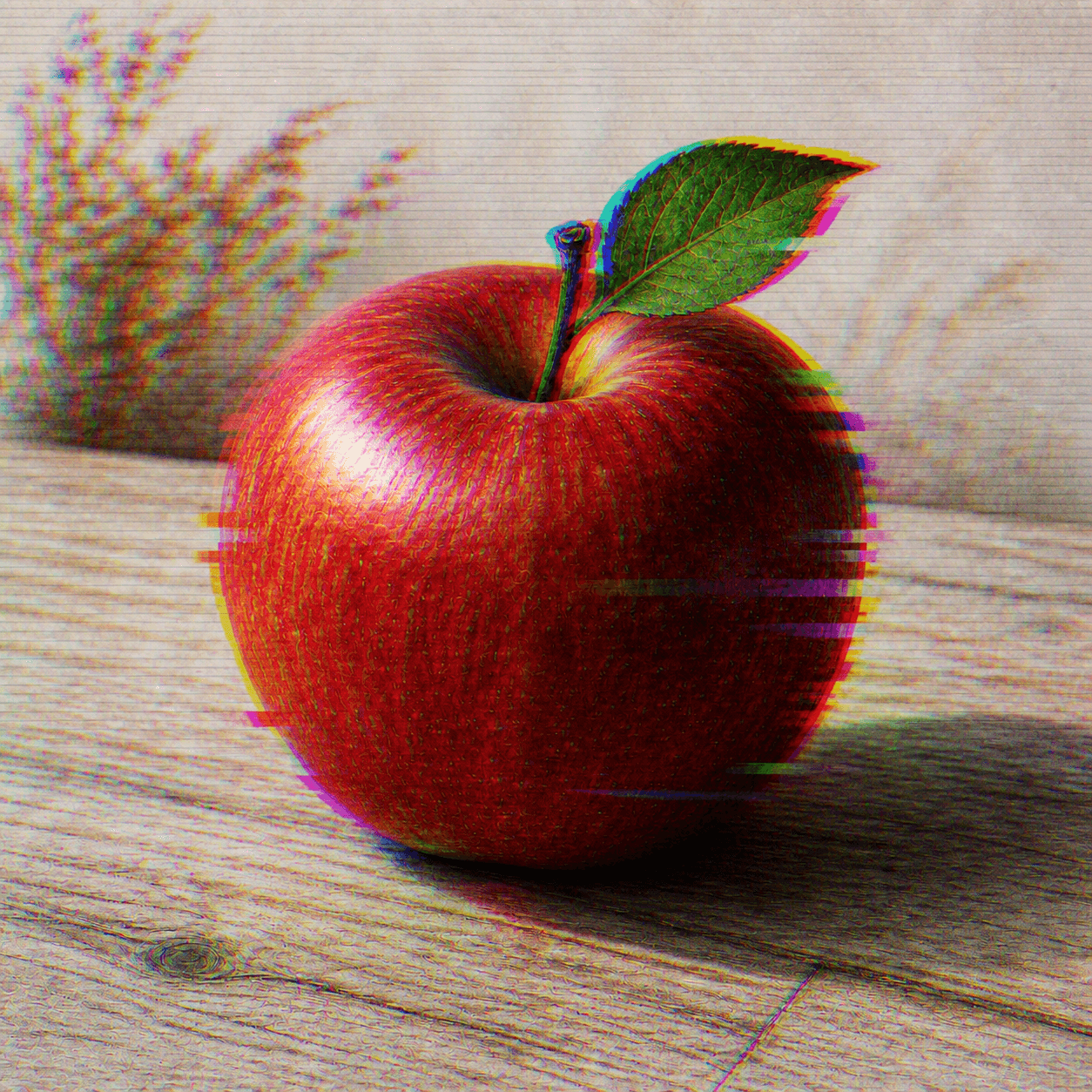
READ THE IMAGE
The apple is not randomly ruined; it behaves like an image that lost synchronisation in transit
Some horizontal strips slide away, RGB channels separate at edges, and a few compression blocks interrupt the surface. The silhouette remains because abnormality only reads against a baseline of normal image.
- 01
Localise the failure
Slices, blocks, and scan lines imply interruption; do not sprinkle equal noise everywhere.
- 02
Offset channels at edges
RGB separation reads strongly on contrast boundaries, making coloured afterimage and vibration.
- 03
Give damage rhythm
Repeated direction, bandwidth, and interval turn failure into composition.
- 04
Keep the subject legible
Enough apple, light, or spatial evidence must survive for distortion to mean something.
In one sentence
Turn mistakes in encoding, transfer, and display
into a visible structure of the image
Glitch art is not noise laid over a picture. It deliberately invokes or simulates system mismatch: when file data is changed, compressed images may degrade in strips and blocks; channel offset detaches colour from form; frame or line synchronisation can tear an image. The artist chooses extent, sequence, and intensity so malfunction becomes grammar.
VISUAL LANGUAGE
Mismatched-image DNA
Slice
Reorder image horizontally
Channel
Detach colour from form
Move RGB independently to make coloured edge afterimages.Block
Expose compression partition
Block loss reminds us that an image is encoded data, not seamless surface.Noise
Bound randomness
Grain and static need density and region, or they erase information.Baseline
Keep normal for contrast
Intact outline, text, or skin gives failure something to violate.Where it came from
From analogue interference and corrupted digital files to net art and design tools, glitch art brings technology's normally hidden behaviour to the front
Television static, tape distortion, and early compression were once defects to remove. Net artists began deliberately changing files, protocols, and display; later tools made channel shift and scan lines controllable, yet their force still comes from the logic of actual media error.
Analogue interference becomes memory
TV static, tape trails, and sync failure make signal error visible.
Digital file error is tested deliberately
Artists alter image and sound data to expose encoding structure.
Datamosh spreads online
Broken compression frame prediction makes moving images melt and trail.
Glitch becomes a controllable tool
Channel, wave, block, and scan effects enter posters and music visual, sometimes as empty decoration.
ARTISTS & WORKS
Meet it through four cases
Experimental television
Feedback, scan, and signal interference make electronic medium itself the subject.Datamosh video
Broken compressed-frame relations make motion melt and drag.Rosa Menkman
Uses glitch, compression, and resolution to question digital norms.Channel-offset posters
Local RGB shifts and slices suggest speed, anxiety, or technical friction.How to recognise it
Identify the system process behind an anomaly, then ask whether it has been controlled into a deliberate image relation
- ✓Do slices, blocks, or offsets imply scanning, compression, channel, or sync processes?
- ✓Are anomalies concentrated where they matter rather than spread evenly?
- ✓Does enough normal imagery survive to form contrast?
- ✓Do dispersion, noise, and tears share direction, bandwidth, or rhythm?
STYLE RELATIONS
Three digital disorders
REFERENCES
Sources & image note
The apple is a glitch-art teaching interpretation using local channel offset, slices, compression blocks, and scanning cues. It is not a genuinely corrupted file or a work by one artist.