
Internet Aesthetics
Glitchcore
Glitchcore pushes platform emotion, avatar, pop-up, pixel, and audio slice into overload: the frame feels like self-expression that cannot pause.
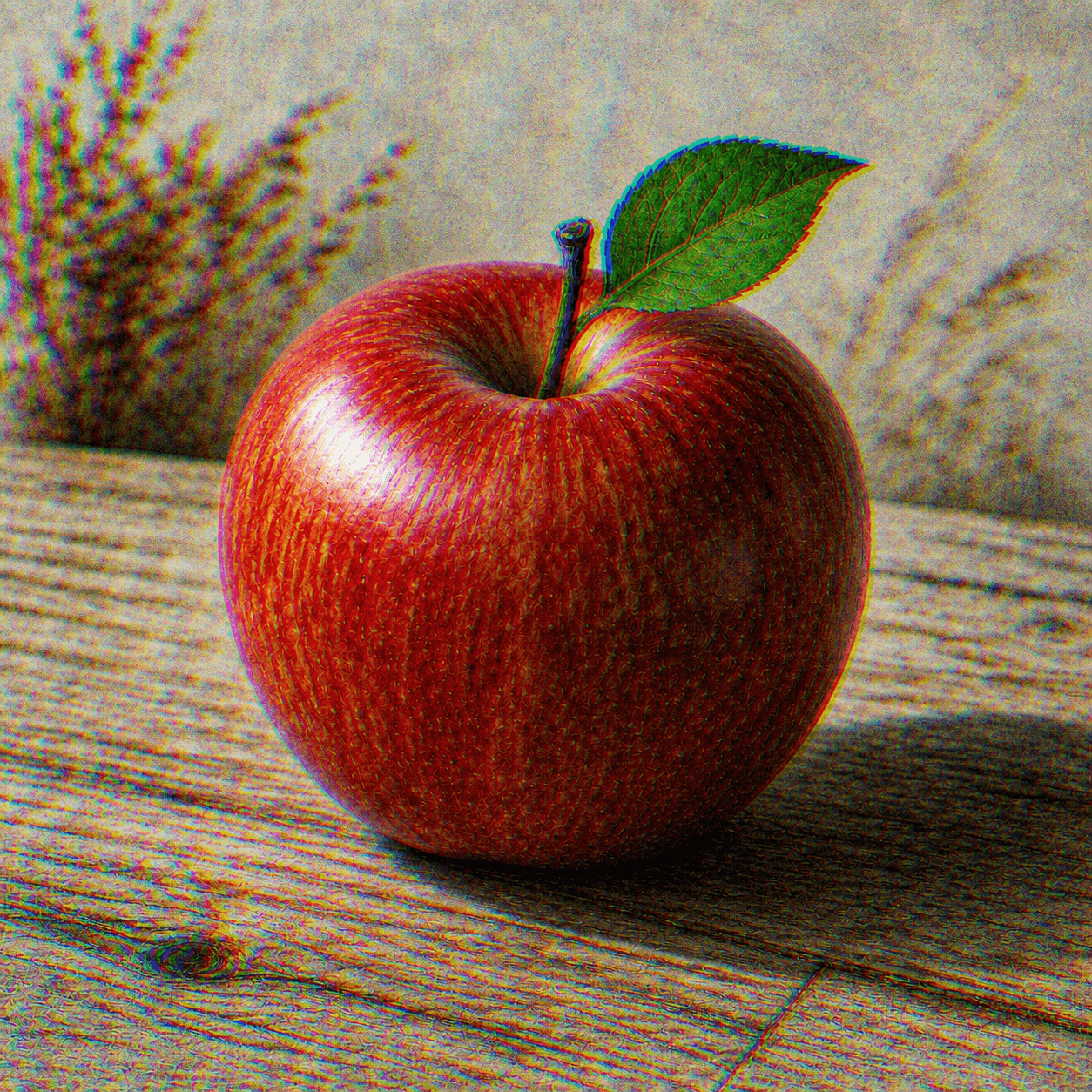
READ THE IMAGE
The apple is not quietly broken; information, filter, and beat rewrite it repeatedly
Its edge splits into colour channels while stickers, UI fragments, and compression noise cover its surface. Quick bright-dark jumps resemble music-video editing. The aim is a feeling of ‘too much,’ not a technical-error sample.
- 01
Read rhythm
Loop, dropped frame, flash, and text slice feel beat-timed rather than randomly dirty.
- 02
Read identity fragments
Avatar, sign, lyric-like phrase, and UI mark make a personal page.
- 03
Make error colourful
RGB offset, pixelation, and compression block create saturated conflict.
- 04
Keep an anchor
Even in density, contour or core text gives the eye somewhere to land.
In one sentence
Compress platform UI, emotion, music editing, and distortion filter into one frame
so digital overload becomes recognisable youth self-presentation
Glitchcore is a loose aesthetic label spreading through short video, music, and online fashion around 2020. It borrows offset, pixel, and compression artifact from glitch art but more often serves fast beat, exaggerated emotion, avatar symbol, and identity collage. It need not damage a file; its key is arranging platform noise into intense sharable feeling.
VISUAL LANGUAGE
Overload-expression DNA
Beat
Error follows rhythm
Self
UI is self-portrait
Handle, sticker, emoji, and phrase make identity fragment.Colour
Split channels intentionally
RGB offset and clashing block feel more forceful than grey noise.Full
Push information forward
Window, scanline, and texture make saturation without eliminating hierarchy.Pause
Keep a reading anchor
Main contour, word, or colour prevents total loss of focus.Where it came from
From glitch art’s aesthetics of failure and early-web image to algorithmic short-form editing, glitchcore turns media error into wearable, performable emotion
Research on internet aesthetics notes their few conventions and openness to individual reinterpretation; platform research links algorithmic microtrends with self-identity. Glitchcore is therefore not a closed genre but a temporary, recognisable network scene combining music, filter, animation, makeup, and text.
Digital error becomes resource
Compression, pixel, scanline, and game UI enter music and web image.
Glitch art expands failure aesthetics
Artists turn system error into critique, experiment, or stage visual.
Short video and hyperpop push glitchcore
Fast edit, coloured distortion, and emotional text become avatar and music visual.
The tag keeps mixing
It borrows across digicore, scene, anime, and game imagery with fluid boundary.
ARTISTS & WORKS
Meet it through four cases
Glitch-art practitioners
Turn encoding, display, and transmission artifact into intentional material.Hyperpop micro-scenes
Heavily processed vocal, abrupt structure, and bright cover provide beat context.TikTok editors
Transition, text, filter, and loop make a short clip into emotional identity card.Digicore communities
Music, avatar, game, and web-symbol crossover push dense visuals.How to recognise it
Find beat-timed distortion and identity fragments first, then test whether overload still has designed reading order
- ✓Do flash, jitter, and slice relate to beat or reading?
- ✓Do UI, sign, or text point to personalised platform expression?
- ✓Do RGB shifts and compression serve emotion rather than merely simulate damage?
- ✓Does a contour or word remain legible at high density?
STYLE RELATIONS
Three distorted languages
REFERENCES
Sources & image note
The apple is a glitchcore teaching interpretation using colour channels, UI fragments, and beat-timed overload. It copies no creator video or avatar.