
Modern Art
Color Field Painting
Letting colour cease to fill objects and become an enveloping space, light, and emotional condition.
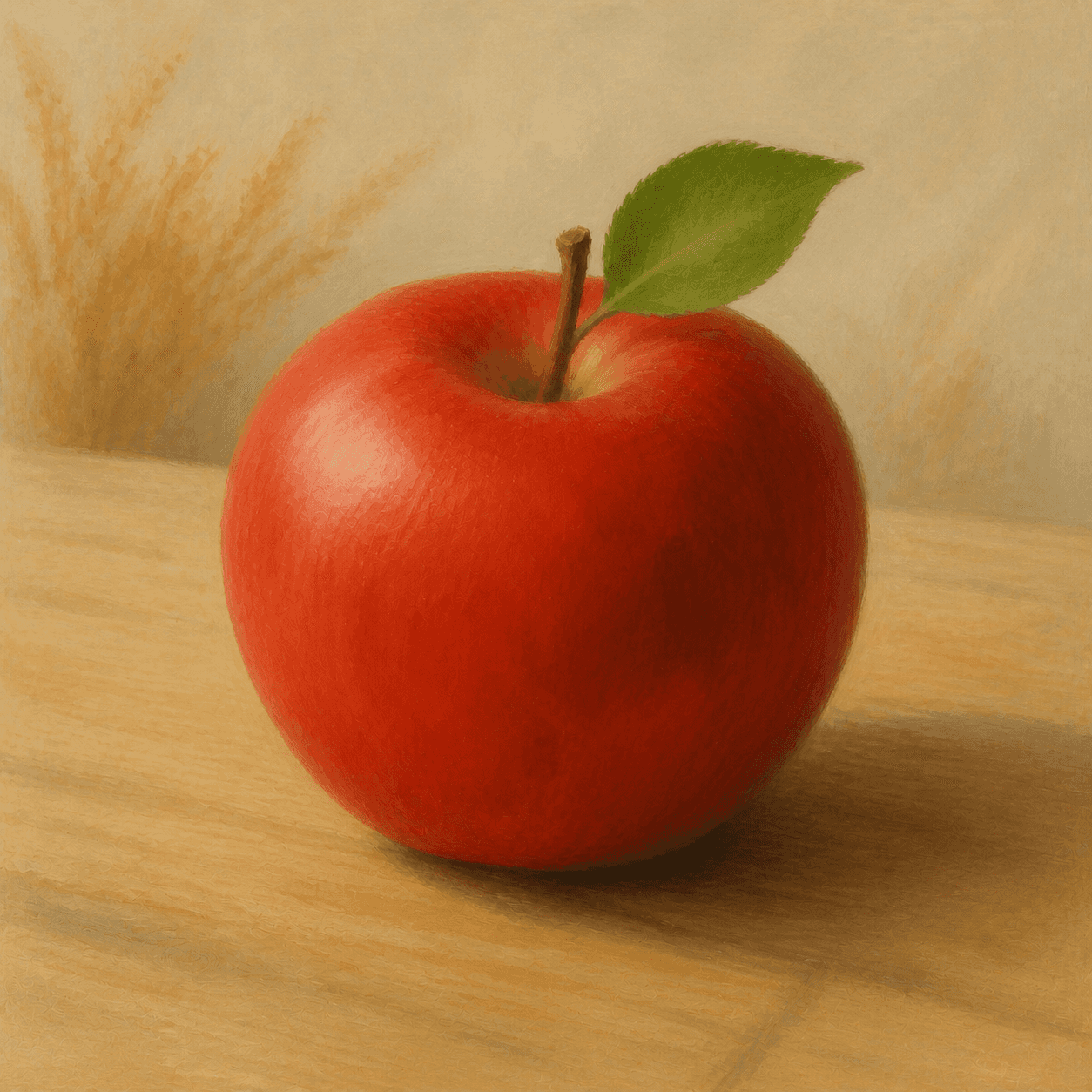
READ THE IMAGE
Before naming the apple, notice how much space colour occupies
This teaching image remains a figurative still life and only hints at colour-field relationships through broad red, ochre, and pale gold. Historical Color Field painting is usually wholly abstract and bodily in scale.
- 01
See continuous colour
The apple's red unfolds as a broad area rather than assembling from many small marks.
- 02
Watch edges breathe
Contour and value transitions soften, so colour seems to seep into atmosphere rather than behave like cut paper.
- 03
Read the low-contrast ground
Pale-gold wall and table compete little for focus, allowing red to become a place for sustained attention.
- 04
Imagine it enlarged
If this red occupied a wall, viewing would shift from naming an apple to being surrounded by colour—the more relevant historical experience.
In one sentence
Colour is not form's clothing—
but the subject and environment of the painting
Color Field painting describes abstract work of the 1950s and 1960s characterised by broad areas of colour, limited tonal contrast, and little defined focus. It can include expansive fields by Abstract Expressionists such as Rothko and Newman and the stained canvases of Frankenthaler, Morris Louis, and the Washington Color School. What joins generations is not one method but a commitment to colour itself.
VISUAL LANGUAGE
Visual DNA
Field
Broad, continuous
Focus
Dispersed or removed
No single centre commands attention across the whole field.Edge
Soft, soaked, or split
Rothko's haze, Newman's zip, and staining organise fields differently.Surface
Flat, low-gesture
Brushwork seldom dominates; canvas and colour meet more directly.Viewing
Slow, immersive
Large scale turns colour into an emotional environment around the body.Where it came from
Within Abstract Expressionism, action gives way to colour
Rothko, Newman, and Still reduced recognisable imagery in the late 1940s, pursuing contemplation and the sublime through large colour areas. In 1952 Frankenthaler soaked thinned paint into raw canvas, influencing Morris Louis, Kenneth Noland, and others who emphasised flatness.
Classic fields appear
Rothko moves toward floating rectangles; in 1948 Newman organises an expanse with a vertical ‘zip’.
Mountains and Sea
Frankenthaler pours thinned paint into floor-laid raw canvas, fusing colour with fibre.
A Washington direction
Morris Louis and Kenneth Noland develop staining, veils, stripes, and centred structures.
The boundary expands
Color Field neighbours Post-Painterly Abstraction and hard edge; Sam Gilliam frees stained canvas from the stretcher.
ARTISTS & WORKS
Meet it through four artists
Mark Rothko
Layered soft-edged rectangles to invite close, slow, emotionally charged looking.Barnett Newman
Used narrow vertical ‘zips’ to divide and activate vast fields at once.Helen Frankenthaler
Soaked thinned paint into raw canvas so colour and support became one plane.Sam Gilliam
Hung and folded stained canvas, moving colour into real space beyond the rectangle.How to recognise it
Remember field, scale, and no single centre
- ✓Does colour occupy broad continuous areas rather than fill many small forms?
- ✓Is a single focal point weakened so vision moves across the whole field?
- ✓Do edge, soaking, or narrow bands organise intervals between colours?
- ✓Does scale make you feel positioned before colour, not merely inspecting composition?
STYLE RELATIONS
Different aims in large-scale abstraction
REFERENCES
Sources & image note
The apple uses continuous red and quiet fields only as an entry point. Its figurative volume intentionally differs from historical Color Field painting, where abstraction, scale, and material are central.