
Modern Art
Abstract Expressionism
When the canvas becomes an arena of action: scale, body, material, and colour preserve the event of painting.
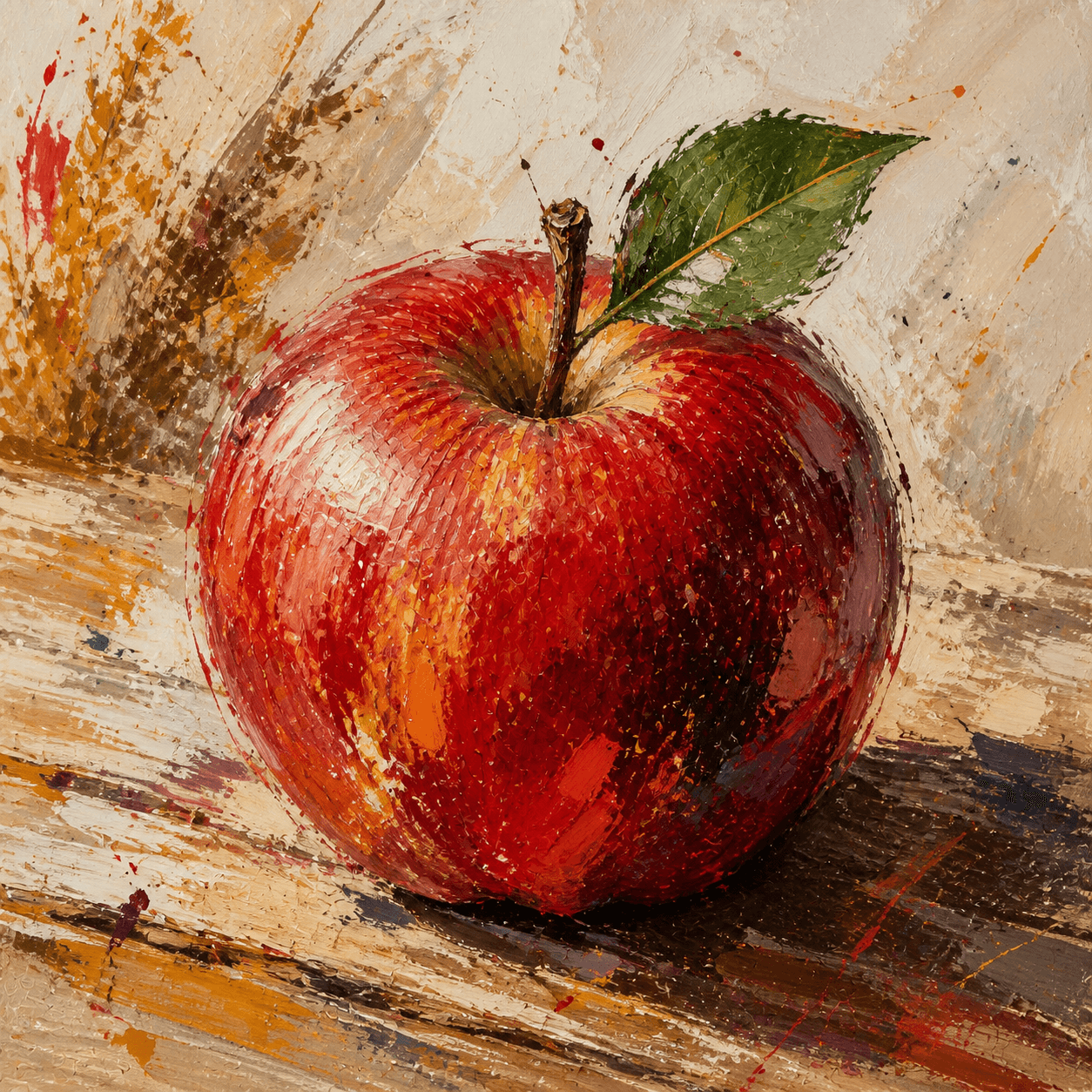
READ THE IMAGE
The apple remains legible, but paint's behaviour becomes the subject
This teaching image retains a still-life contour while using impasto, scraping, splatter, and strokes crossing boundaries to suggest action painting. Historical works are usually more abstract and often much larger.
- 01
Follow action beyond the contour
Red, brown, and black marks surge from apple into background instead of merely filling an object.
- 02
Read thickness
Built paint, scraped passages, and exposed ground record pressure and sequence.
- 03
Sense whole-body scale
Broad sweeps and splashes imply arm, shoulder, and movement around a support—not wrist-sized description.
- 04
Balance chance and control
Drips appear free yet maintain tension with volume, shadow, and pictorial weight; spontaneity is not lack of control.
In one sentence
Not emotional random painting—
but making the act of creation part of the content
Abstract Expressionism names diverse, informally connected practices centred in New York in the 1940s and 1950s. Artists emphasised large scale, abstract imagery, personal commitment, and process. Pollock and de Kooning became known for dynamic marks; Rothko and Newman built contemplative colour fields. Action and colour field are useful tendencies, not sealed camps.
VISUAL LANGUAGE
Visual DNA
Scale
Monumental, enveloping
Process
Trace made visible
Dripping, flinging, scraping, staining, and covering turn sequence into image.Composition
All-over or expansive
Gesture can spread without a centre; colour fields envelop through broad chromatic zones.Materials
Experimental, direct
Commercial paint, house brushes, and raw or unstretched canvas disrupt easel convention.Content
Personal, seeking the universal
Abstraction addresses psyche, myth, memory, and the sublime.Where it came from
War, exile, and a regrouping of art in New York
European modernists arrived in the United States around World War II while local artists absorbed Surrealist automatism, Cubist structure, mural scale, and Indigenous ideas. New York became an international centre, though heroic-national narratives long obscured women, Black artists, and transnational participants.
A loose community forms
Artists connect through studios, galleries, Federal Art Project experience, and émigré networks.
Breakthrough languages mature
Pollock develops poured painting on floor-laid canvas as Newman and Rothko establish expansive colour structures.
The Ninth Street Show
An artist-organised exhibition brings first-generation figures and younger painters into one public field.
The New American Painting tours
MoMA's multi-country European exhibition extends international influence while fixing a selective canon.
ARTISTS & WORKS
Meet it through four artists
Jackson Pollock
Worked around floor-laid canvas, dripping and flinging dense networks without one focal point.Lee Krasner
Continuously remade her language through cut-and-reassembled paintings, forceful touch, and shifts of scale.Mark Rothko
Suspended soft-edged chromatic rectangles to invite slow, contemplative looking.Norman Lewis
Turned calligraphic marks, city experience, and racial reality into interwoven fields of light and dark.How to recognise it
Read scale, process, and the mode of viewing together
- ✓Are drips, sweeps, stains, scraping, or revisions left visibly active?
- ✓Does scale ask the eye or body to move rather than inspect one depicted object?
- ✓Is the field all-over, or built from broad zones of enveloping colour?
- ✓Does abstraction carry psychic, mnemonic, or sublime ambition rather than decorative pattern alone?
STYLE RELATIONS
Separating neighbouring abstract languages
Expressionism
Often retains figures or landscapes while distorting form and colour for modern psychology.↗Abstract Expressionism
Centres monumental scale, process, gesture, or colour field as an embodied viewing event.CURRENTMinimalism
Suppresses personal touch and psychological expression in favour of repetition, objecthood, and real space.↗REFERENCES
Sources & image note
The apple is a contemporary teaching interpretation of the action-painting tendency; it does not represent colour field and retains an image for comparison. Historical works are often more abstract and physically enveloping.