
Modern Art
Expressionism
No longer asking whether the subject looks correct, but making colour, contour, and touch say how it feels.
READ THE IMAGE
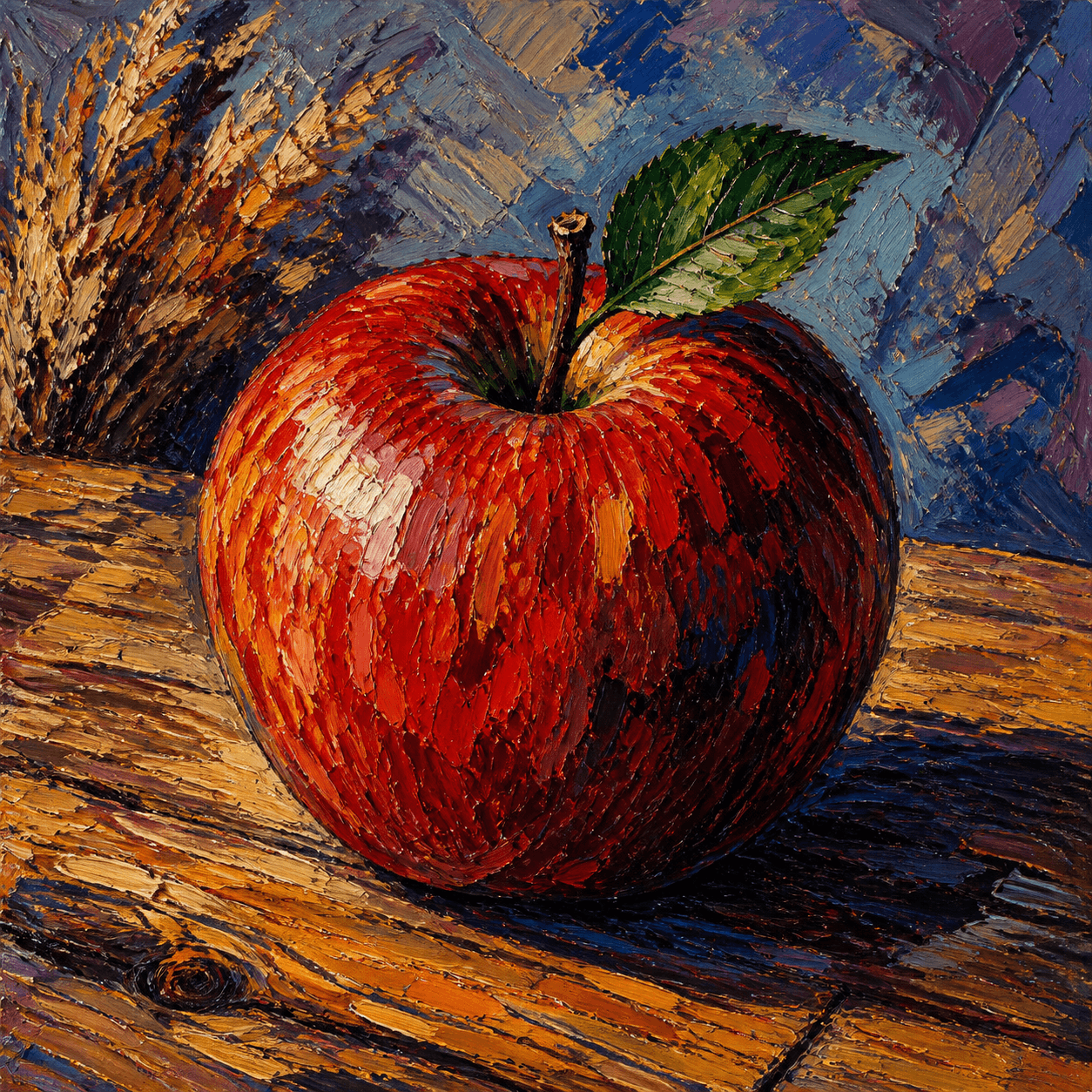
Feeling has pushed this apple away from nature
Heavy touch, violent warm-cool contrast, and an unstable setting turn an ordinary still life into psychological pressure. Accuracy matters less than emotional conviction.
- 01
Find the distortion
The contour is not perfectly even; tightened and tilted passages make the form feel compressed by inner tension.
- 02
Read the collision
Scarlet, deep blue, and orange meet directly; shadow is driven toward near-black blue-violet rather than smooth modelling.
- 03
See the touch
Thick short strokes retain scraping and buildup, making the act of painting palpable.
- 04
Test the space
Diagonal background strokes and the forceful shadow deny the tabletop any quiet stability.
In one sentence
Not recording how the world looks—
but exposing how it feels
Expressionism is a broad term for early-20th-century practices centred on intense personal expression, especially in Germany and Austria. Artists used simplified or distorted forms, exaggerated and sometimes clashing colours, and roughened line to face the city, nature, war, and anxiety. There is no single Expressionist look; the constant is form reshaped by subjective experience.
VISUAL LANGUAGE
Visual DNA
Form
Simplified, distorted
Colour
Exaggerated, clashing
Hue carries emotion and tension rather than explaining observed light.Line
Angular, rough
Contour and incision keep a direct, sometimes uneasy handmade force.Space
Compressed, tilted
Extreme angles and flattened forms undermine stable perspective.Themes
Modernity in conflict
Urban excitement, isolation, nature, war, and social criticism recur.Where it came from
The speed of modern life—and its anxiety
Expressionists drew on the subjective colour of Van Gogh, Munch, and Gauguin, and on woodcut, folk art, and non-Western art encountered through colonial museum collections. Understanding those borrowings today also means recognising the period's primitivist prejudice.
Die Brücke forms in Dresden
Kirchner, Heckel, Schmidt-Rottluff, and others seek a bridge between inherited culture and art of the future.
Der Blaue Reiter gathers in Munich
Kandinsky, Franz Marc, and others extend Expressionism through colour, spirituality, and moves toward abstraction.
War transforms the subjects
World War I and its aftermath bring trauma, death, politics, and social fracture into prints and paintings.
The paths divide
Some artists move toward New Objectivity; subjective distortion continues through film, theatre, and later painting.
ARTISTS & WORKS
Meet it through four artists
Ernst Ludwig Kirchner
Rendered urban crowds through angular contour, high colour, and tilted spaces charged with tension.Wassily Kandinsky
Treated colour and form as forces of inner resonance and moved progressively toward abstraction.Franz Marc
Used non-natural colour and simplified animals to seek a spiritual relation with nature.Käthe Kollwitz
Addressed poverty, war, mourning, and solidarity in prints and drawings—showing that Expressionism need not be brightly coloured.How to recognise it
Remember: feeling changes form
- ✓Is form simplified, stretched, or distorted for emotional force?
- ✓Does colour leave natural light behind to create psychological conflict?
- ✓Do line and touch retain an angular, rough, or urgent action?
- ✓Does the image take a strong subjective position toward city, nature, or people?
STYLE RELATIONS
Separating neighbouring languages
Fauvism
Centres colour autonomy, decorative order, and sensuous intensity during a brief group phase.↗Expressionism
Uses distortion, conflicting colour, and rough line to carry psychological and social experience.CURRENTAbstract Expressionism
Emerges in 1940s America with larger scale, greater abstraction, and an emphasis on gesture or colour field.↗REFERENCES
Sources & image note
The apple is a contemporary teaching interpretation of recurring Expressionist devices. This broad movement spans painting, print, and distinct political positions; one image cannot represent it all.