
Modern Art
Fauvism
Releasing colour from the task of looking correct: building emotion through saturation, collision, and broad touch.
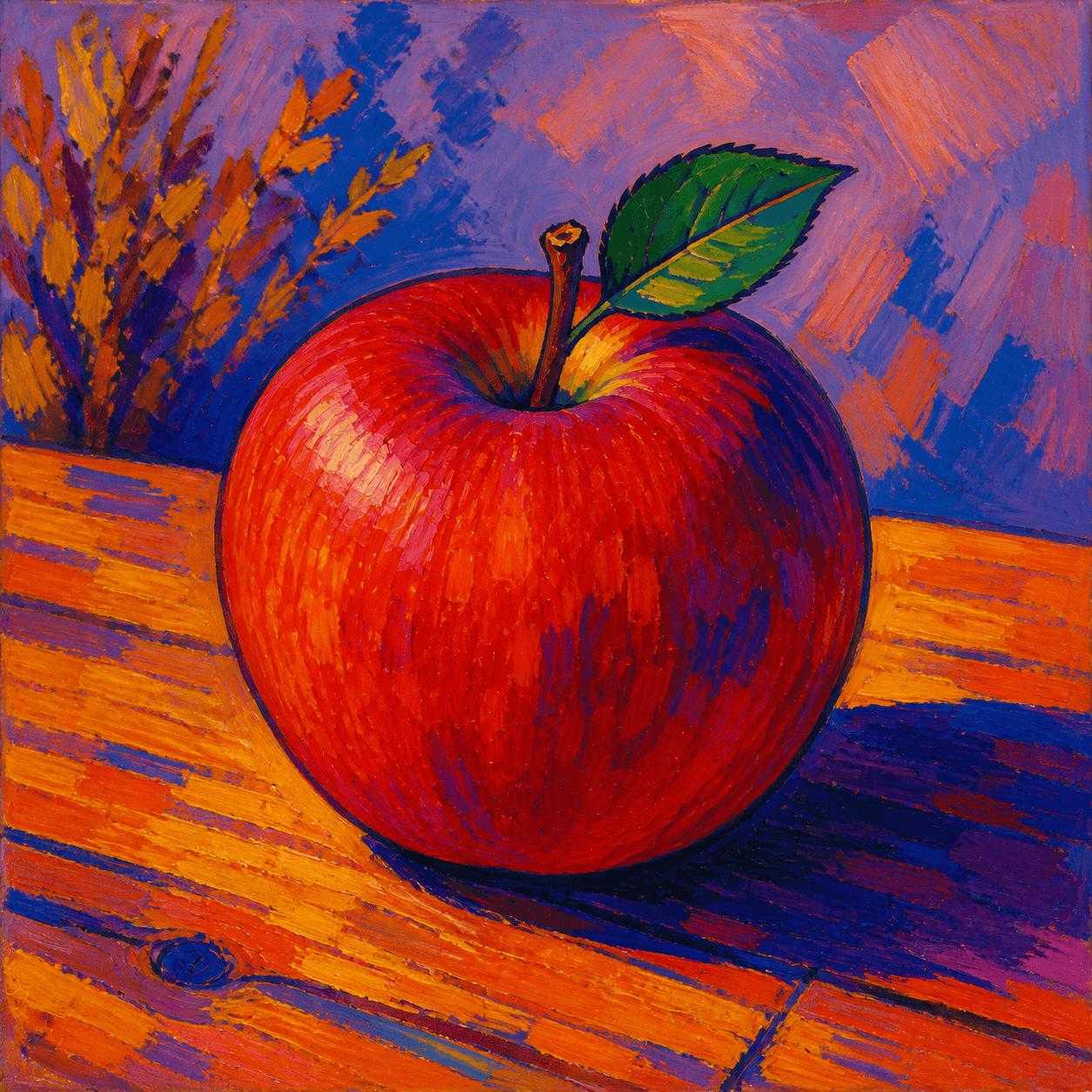
READ THE IMAGE
The apple remains an apple; colour no longer obeys it
This teaching image pushes red, orange, violet, and blue toward high intensity. Fauvism is recognised by how colour actively rewrites the subject—not brightness alone.
- 01
Find non-natural colour
The violet-blue background and forceful orange table build pictorial tension rather than imitate observed light.
- 02
See complementary collision
Orange and blue, red and green intensify one another through adjacency.
- 03
Read the broad strokes
Direct, coarse marks keep gesture visible; colour advances in planes rather than polished gradients.
- 04
Follow the contour
Dark outlines stabilise apple and leaf so high-intensity colour can remain structurally clear.
In one sentence
Not simply brighter colour—
but colour taking control
Fauvist painters freed colour from naturalistic description. Matisse, Derain, Vlaminck, and others used intense non-natural hues, broad touch, and flattened planes. A critic's hostile “wild beasts” label at the 1905 Salon d'Automne stuck. The loose group lasted only briefly, but it made colour an independent structural and expressive force in modern art.
VISUAL LANGUAGE
Visual DNA
Colour
Saturated, non-natural
Relation
Complementary, clashing
Red-green and orange-blue contrasts push planes against one another.Touch
Broad, direct
Application keeps speed and gesture visible instead of hiding the hand.Space
Flat, decorative
Perspective and modelling recede so colour and contour dominate the surface.Form
Simplified, distorted
Subjects remain legible while proportion and contour yield to colour rhythm.Where it came from
“Wild beasts” in one exhibition room
Fauvism absorbed colour lessons from Van Gogh, Gauguin, Seurat, and Neo-Impressionism and also drew on African sculpture. It was never a formal organisation, but a brief label around shared exhibitions and related colour practices.
Colour experiments converge
Matisse encounters Neo-Impressionist practice in southern France and turns regular division toward freer, stronger planes.
The Salon d'Automne supplies a name
Non-natural high colour by Matisse, Derain, Vlaminck, and others causes a scandal; the “wild beasts” label takes hold.
The group disperses
Members move into distinct practices, while Fauvist colour continues to shape Expressionism and modern painting.
ARTISTS & WORKS
Meet it through four artists
Henri Matisse
Made colour a pictorial structure through planes, contour, and decorative order.André Derain
Used forceful complements in Collioure and London, turning landscape into colour construction.Maurice de Vlaminck
Brought violent touch and high-purity reds and blues to more confrontational surfaces.Raoul Dufy
Developed a light, linear colour language from his Fauvist beginning.How to recognise it
Remember: colour before realism
- ✓Does colour visibly depart from the subject under natural light?
- ✓Do broad complementary areas produce strong tension?
- ✓Is brushwork direct and visibly gestural?
- ✓Is space flattened so contour and colour matter more than perspective?
STYLE RELATIONS
Different logics of strong colour
REFERENCES
Sources & image note
The apple is a contemporary teaching interpretation highlighting Fauvist colour relationships, not a historic work by any artist.