
Modern Art
Pointillism
Moving colour mixing from the palette to the viewer's eye: pure dots combine across distance into light, volume, and atmosphere.
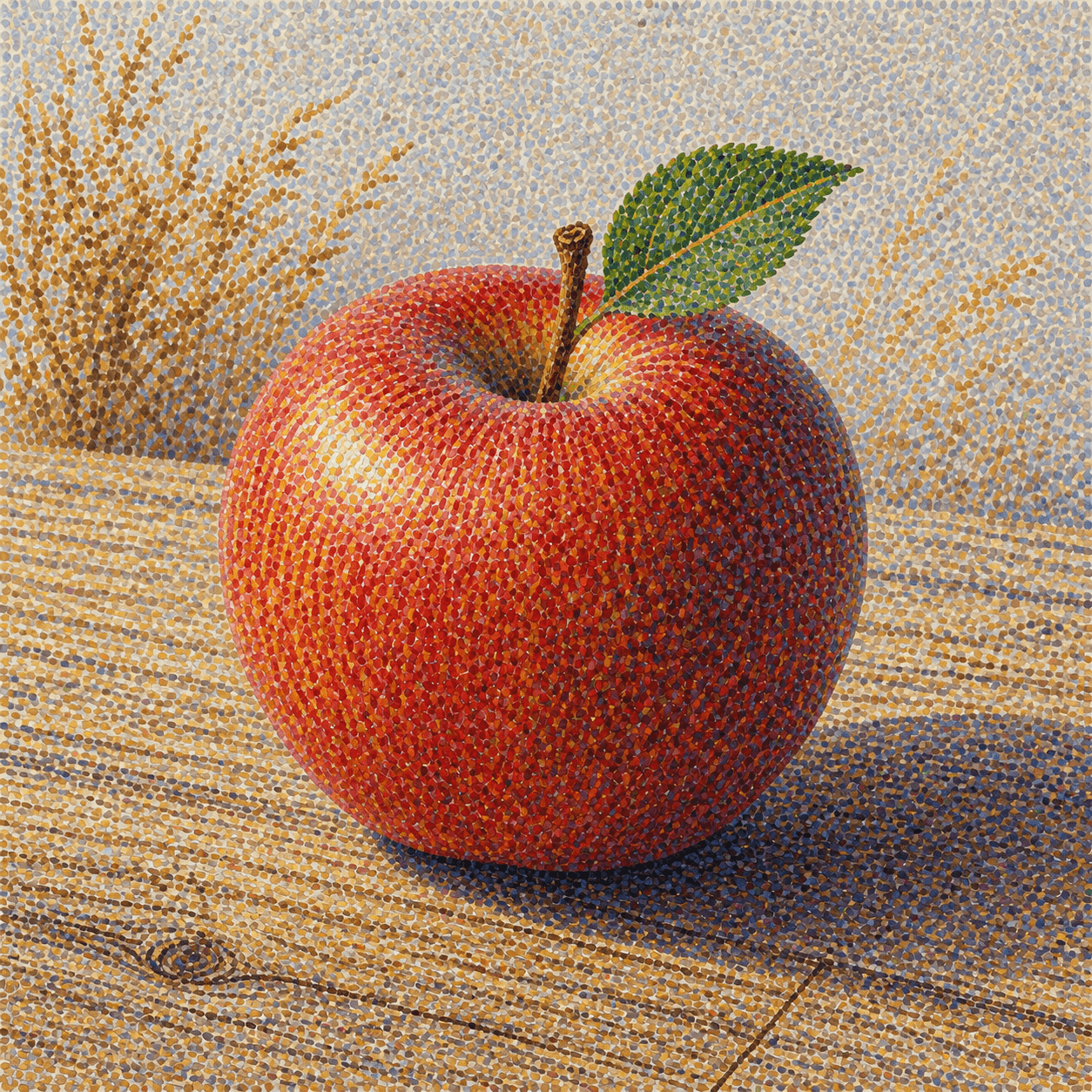
READ THE IMAGE
Step back and the colours begin to mix
Pointillism is not only about dots. The crucial event is how adjacent marks combine through viewing distance into colour and luminosity.
- 01
See separate marks
Reds, oranges, and yellows remain as small adjacent touches instead of being fully mixed on a palette.
- 02
Find complements
Warm and cool complementary hues cross light and shadow, creating vibration without relying only on white and black.
- 03
Change your distance
Up close the marks stay discrete; farther away they cohere into volume, background, and cast shadow.
- 04
Notice the order
The marks follow form, value, and composition. This is not random dotting.
In one sentence
Not outlining with dots—
but asking the eye to mix colour
Developed by Seurat, Signac, and others in 1880s France, Pointillism belongs closely to Neo-Impressionism. Relatively pure colours are separated into small adjacent marks so composite tones form in perception. Its colour theory, planned composition, and slow construction differ from Impressionism's emphasis on immediate sensation.
VISUAL LANGUAGE
Visual DNA
Unit
Small, separate
Colour
Adjacent, complementary
Pure neighbours mix optically and intensify one another.Distance
Dots near, form afar
The viewer's position helps composite colour and volume emerge.Composition
Planned, stable
The technique often supports carefully designed contour, rhythm, and space.Light
Even, vibrating
Dense marks keep the surface active without foregrounding rapid gesture.Where it came from
Turning Impressionist colour into a method
Seurat and Signac joined Impressionist colour with contemporary optical and colour theories to build a more systematic Neo-Impressionist practice.
Independent exhibition takes shape
Seurat, Signac, and others help establish the Société des Artistes Indépendants, offering exhibitions without an official jury.
The method enters public debate
Seurat exhibits A Sunday on La Grande Jatte at the eighth Impressionist exhibition, where its regular marks provoke intense discussion.
The practice travels
Signac, Cross, Van Rysselberghe, and others develop divided colour in France and Belgium.
ARTISTS & WORKS
Meet it through four artists
Georges Seurat
Joined divided colour, stable composition, and modern-life subjects in a rigorous system.Paul Signac
Promoted Neo-Impressionist theory and opened the marks into brighter harbour and coastal scenes.Henri-Edmond Cross
Enlarged touches and heightened colour, helping prepare the ground for Fauvism.Théo van Rysselberghe
Brought divided colour into portraits and group scenes and spread the approach in Belgium.How to recognise it
Remember: division, distance, order
- ✓Is the surface built from many separate dots or small touches?
- ✓Do neighbouring colours use complementary or warm-cool contrast?
- ✓Do the marks cohere into stable forms when viewed from farther away?
- ✓Is the composition planned rather than random or mechanically screened?
STYLE RELATIONS
Three different kinds of colour mark
REFERENCES
Sources & image note
The apple is a contemporary teaching interpretation highlighting adjacent dots and optical mixture, not a historic artwork.