
Modern Art
Impressionism
Painting the sensation of a passing moment: flickering light, colour shaped by atmosphere, and modern life moving before the eye.
READ THE IMAGE
Begin with this apple
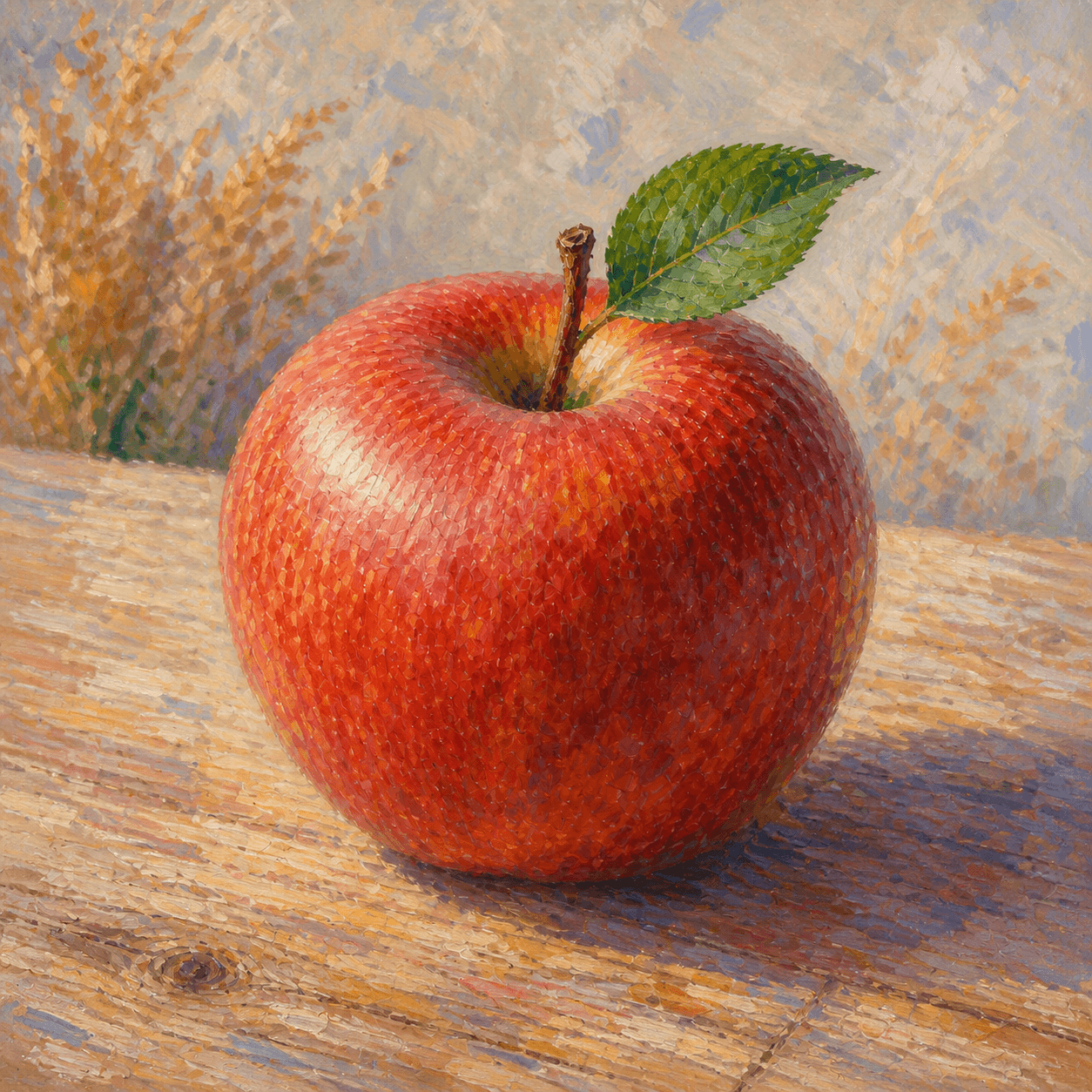
This is a contemporary interpretation of Impressionist visual language—not a historic work, but a tool for practising how to look.
- 01
Look at the brushwork
Short, visible strokes remain across the apple and table instead of disappearing into a polished surface.
- 02
Look at the colour
Light and shadow are built from neighbouring oranges, reds, greens, and blue-violets—not simply white and black.
- 03
Look at the edges
Contours loosen in the surrounding light, connecting the subject to its atmosphere.
- 04
Look for the moment
The image prioritises a passing effect of light over a fixed, exact account of the apple's structure.
In one sentence
Not blurred painting—
but painting how light reaches the eye
Impressionist artists sought to preserve the freshness of direct vision. They often painted landscapes, streets, cafés, theatres, and leisure using luminous colour and visible brushwork to describe changing light. The artists differed greatly, so Impressionism was never one rigid technique shared by everyone.
VISUAL LANGUAGE
Visual DNA
Colour
Luminous, adjacent
Brushwork
Broken, visible
Strokes remain legible, conveying speed, light, and the material presence of paint.Light
Fleeting, changing
Weather, time, and atmosphere transform the colour of the same subject.Subjects
Modern, everyday
Cities, outings, dances, theatres, and ordinary landscapes become worthy subjects.Space
Cropped, mobile
Compositions can feel like a passing glimpse rather than a stable academic arrangement.Where it came from
A group of artists stepped outside the official Salon
The official Salon and its jury long dominated the French art world. Monet, Renoir, Degas, Morisot, Pissarro, Sisley, and others wanted to decide what and how they painted—and to meet viewers outside official channels.
A new way of seeing develops
Outdoor study, modern city life, and freer brushwork reshape what young painters consider a finished work.
The first independent exhibition
On 15 April, the group opens an exhibition in the former Paris studio of photographer Nadar. Monet's Impression, Sunrise is among the works shown.
An insult becomes a name
First used mockingly, “Impressionist” is taken up by the artists and gradually becomes the group's name.
The eighth and final exhibition
The group holds its last joint exhibition; its artists move in distinct directions as new forms of modern art emerge.
ARTISTS & WORKS
Meet it through four artists
Claude Monet
Repeatedly observed the same motif under changing light.Berthe Morisot
Painted domestic life, figures, and outdoor scenes with agile brushwork.Pierre-Auguste Renoir
Explored sociability, dance, and dappled light across figures.Edgar Degas
Favoured theatres, dancers, and indoor city life, often with cropped compositions.How to recognise it
Remember: light, colour, stroke, moment
- ✓Are brushstrokes visible rather than completely smoothed away?
- ✓Do shadows contain blues, violets, or greens?
- ✓Does the picture capture a particular time, weather, or passing action?
- ✓Does its subject come from modern life or an ordinary scene?
STYLE RELATIONS
Do not confuse them
Realism
Often stresses direct observation of social reality and everyday life, with steadier forms and more subdued colour.↗Impressionism
Centres changing light and immediate sensation, with looser strokes and a brighter surface.CURRENTPost-Impressionism
Begins from Impressionism but pushes structure, symbolism, or subjective colour; it is not one unified style.↗REFERENCES
Sources & image note
The apple is a contemporary teaching interpretation, not a historic artwork, and cannot represent every Impressionist artist's individual practice.