
Modern Art
Post-Impressionism
Taking Impressionist colour and brushwork in new directions: toward structure, emotion, symbolism, and colour theory.
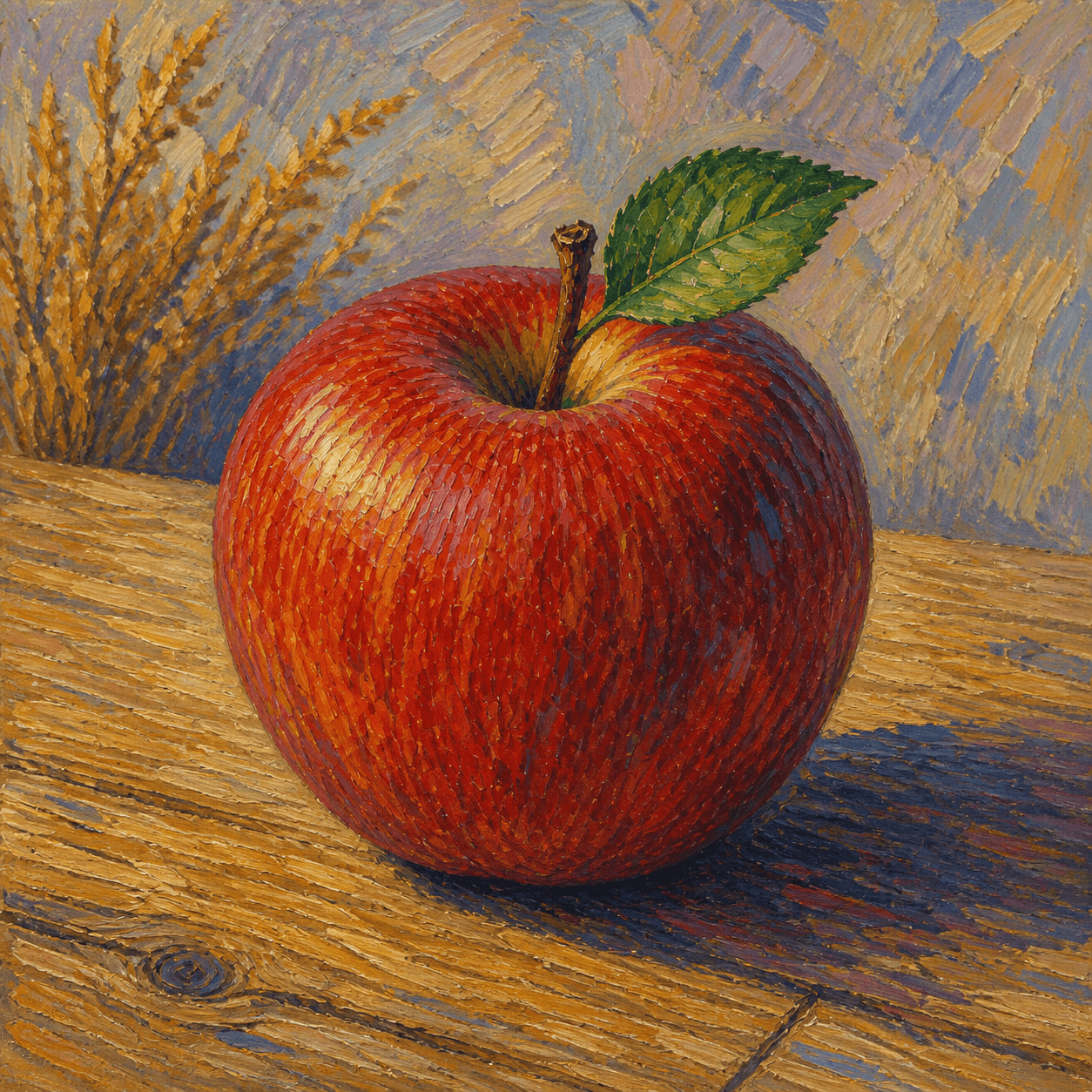
READ THE IMAGE
Visible strokes—but no longer only a passing moment
This teaching image keeps broken brushwork while giving direction, colour, and form a stronger structural and emotional role.
- 01
Follow the direction
Strokes wrap around the apple in bands, reinforcing volume rather than merely recording flickering light.
- 02
Read the colour
Reds, oranges, and blue-violets are intensified subjectively; shadow need not follow natural colour.
- 03
Find the structure
Apple, table, and background each have an organised direction, producing a more deliberate construction.
- 04
Feel the temperament
Repeated, rhythmic marks give the still life an authored intensity rather than neutral observation.
In one sentence
Not one style after Impressionism—
but several roads into modern art
Post-Impressionism is a later umbrella term, not a shared manifesto. Cézanne, Van Gogh, Gauguin, and Seurat knew Impressionism but pursued structure, emotion, symbolism, or colour science. Their common ground was a refusal to let painting stop at fleeting optical sensation.
VISUAL LANGUAGE
Visual DNA
Structure
Made solid again
Colour
Subjective, symbolic
Colour can carry emotion or spiritual and decorative meaning.Brushwork
Personal, rhythmic
Artists develop markedly different directions, densities, and textures.Space
Constructed or flattened
Cézanne builds spatial tension; Gauguin tends toward flat decorative fields.Range
Plural, not uniform
The term contains sharply different individual practices rather than one technique.Where it came from
When Impressionism was no longer enough
By the late 1880s, artists still drew on luminous colour and liberated brushwork but sought firmer structure, stronger emotion, or symbolic meaning.
The Impressionist exhibitions end
The eighth and final group exhibition takes place; Seurat's Neo-Impressionist method also attracts attention.
Individual paths diverge
Cézanne, Van Gogh, Gauguin, and Seurat develop structural, expressive, symbolic, and scientific approaches.
The name arrives afterward
British critic Roger Fry uses “Post-Impressionism” for a London exhibition, grouping highly different artists historically.
ARTISTS & WORKS
Meet it through four artists
Paul Cézanne
Rebuilt form and space through colour patches and shifting viewpoints.Vincent van Gogh
Made line, touch, and non-natural colour carry psychological intensity.Paul Gauguin
Used flat colour, contour, and symbolic imagery to seek spiritual and decorative order.Georges Seurat
Systematised optical colour through Neo-Impressionist dots and division.How to recognise it
Ask: structure, emotion, or symbol?
- ✓Does brushwork reinforce form or feeling rather than only changing light?
- ✓Does colour depart from nature to create symbolism or mood?
- ✓Is the composition more firmly structured, decorative, or systematic?
- ✓Does the work express an individual system rather than one shared formula?
STYLE RELATIONS
From impression toward structure and expression
REFERENCES
Sources & image note
The apple is a contemporary teaching interpretation. Post-Impressionism is a broad historical label; no single artist represents the whole.