
Classical Art
Realism
Realism was radical not simply because it looked true, but because it refused to divide the present into noble and base: ordinary people, labour, and local experience could occupy the largest canvas.
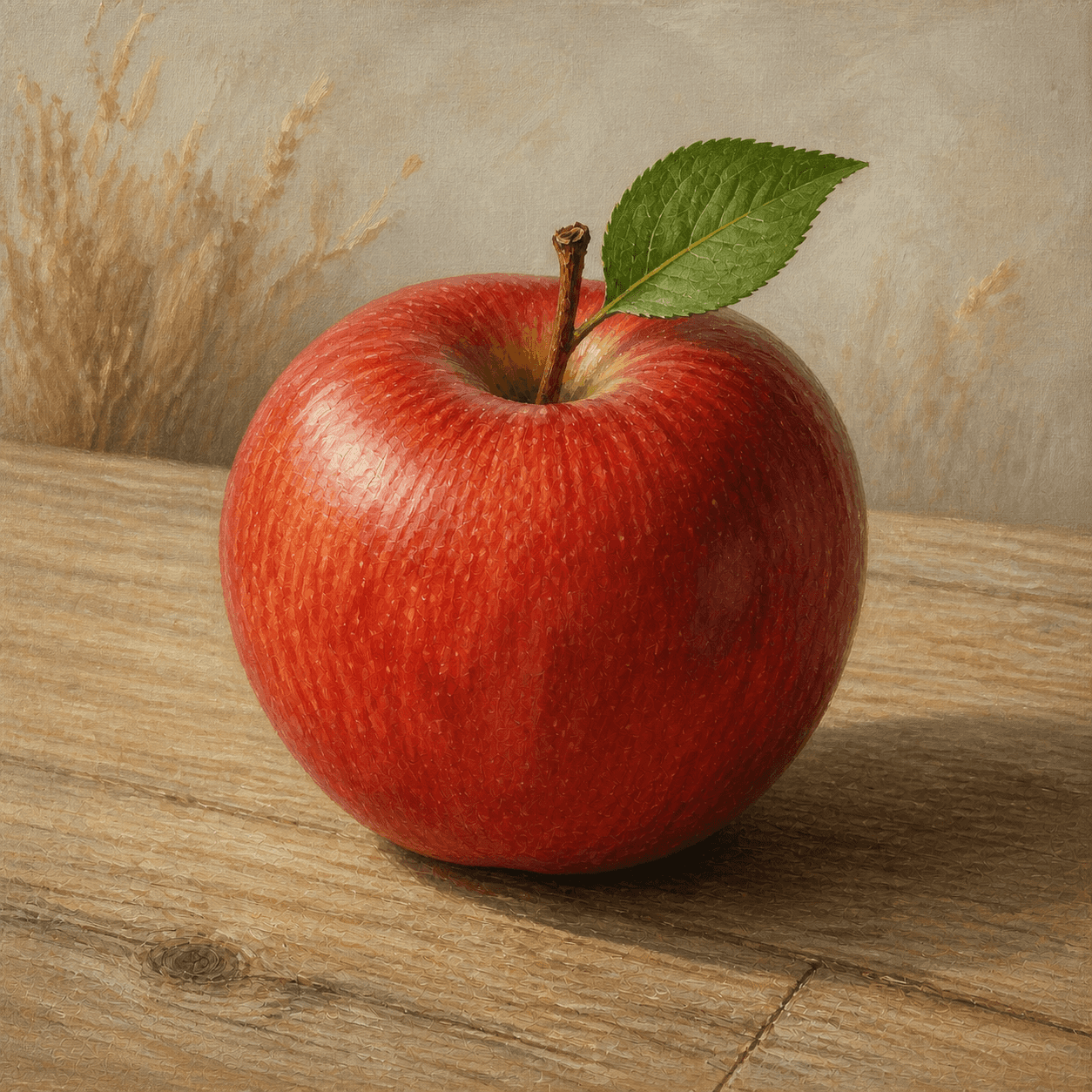
READ THE IMAGE
No spectacle: an apple occupies the table with its own weight
Ordinary daylight, frontal distance, and an unstaged wooden table suggest Realism. This teaching image borrows a nineteenth-century language but is not a historical work.
- 01
Read ordinary light
Stable light from the left explains skin, leaf, and table without acting as miracle, sublime event, or theatrical climax.
- 02
Feel actual weight
The apple presses into a clear contact shadow and remains slightly irregular; credibility comes from gravity and matter, not flawless ideal form.
- 03
See surfaces left visible
Short strokes, wood grain, spots, and wall texture remain present; paint need not disguise itself as a transparent window.
- 04
Notice an equal viewing position
The viewpoint feels seated and everyday, the subject frontal without a grand setting; an ordinary thing receives complete attention.
In one sentence
Not neutral photographic copying—
but a redistribution of what deserves to be seen
Mid-nineteenth-century Realism opposed the academic hierarchy that placed myth, religion, and ancient history above contemporary life, and resisted Romantic exotic escape and heroic drama. Courbet claimed the world of his own time, moving village funerals, stone breakers, and the artist's social world onto monumental canvases. Realism was both a politics of subject and a material method: visible handling, heavy paint, local faces, and unidealised bodies challenged ‘noble’ finish. It could carry political force without forming one party programme.
VISUAL LANGUAGE
Visual DNA
Subject
Contemporary, ordinary, specific
Scale
Enlarging low-ranked subjects
Dimensions once reserved for history painting are granted to anonymous villagers and workers.Body
Unidealised, marked by labour
Posture, clothing, age, and fatigue preserve social identity and material condition.Surface
Brush and paint remain visible
Impasto, palette knife, deep black, and rough texture oppose smooth academic glazing.Position
Observation is never neutral
Framing, scale, and inclusion always carry judgements about value.Where it came from
Revolution, industrialisation, and mass exhibition changed art's public
Around 1848, political upheaval, rural-to-urban movement, and print culture sharpened awareness of the contemporary. Photography changed expectations of fact and detail, but Realist painting did not imitate the camera: it selected subjects, enlarged scale, and exposed making to contest public visibility.
Contemporary life becomes serious subject
Barbizon landscape, satirical print, and social fiction attend to place, labour, and urban publics through different routes.
Revolution brings Realism into open conflict
Courbet's Stone Breakers and Burial at Ornans give workers and villagers history-painting scale, exposing class prejudice in Salon criticism.
The Pavilion of Realism challenges official display
After rejection from the Universal Exposition, Courbet funds his own venue and manifesto, making independent exhibition a modern artistic strategy.
Realisms diverge and travel
Millet paints rural labour, Daumier watches urban class, and Bonheur studies animals and professions as regions redefine reality through local concerns.
ARTISTS & WORKS
Meet it through four works
Courbet, The Stone Breakers
An old and young worker turn into repetitive labour; torn clothes and stones deny heroic pose. The original was destroyed in World War II.Courbet, A Burial at Ornans
Anonymous villagers stretch life-size across a huge canvas, giving ordinary ritual the public weight of history painting.Millet, The Gleaners
Three bent women gather remnants after harvest, their repeated posture joining labour, poverty, and the order of land.Daumier, The Third-Class Carriage
Crowded passengers, tired bodies, and an unfinished surface make modern transport a site of class proximity rather than a triumph of progress.How to recognise it
Ask whom the image grants dignity, then inspect how it handles matter
- ✓Does the subject come from the artist's own time, place, and observable life?
- ✓Do anonymous workers or daily events receive a scale once reserved for history and myth?
- ✓Do body, clothing, and setting preserve age, fatigue, damage, and class evidence?
- ✓Do handling, thickness, and framing actively construct reality rather than pretend to have no position?
STYLE RELATIONS
From emotional storm to social present, then instant vision
Romanticism
Intensifies subjective experience through emotion, sublime nature, and historical trauma.↗Realism
Rewrites subject hierarchy through contemporary ordinary life, material surface, and social position.CURRENTImpressionism
Turns further toward modern city and outdoor light, analysing instant vision and conditions of looking.↗REFERENCES
Sources & image note
The apple interprets Realism through ordinary daylight, frontal address, and rough material. Realism is not a fixed brown appearance but a dispute over contemporary subject, social visibility, and the material fact of painting.