
Classical Art
Romanticism
Romanticism is not a soft filter for love: amid revolution, war, nature, and the unknown, it makes fear, desire, memory, and individual feeling central.
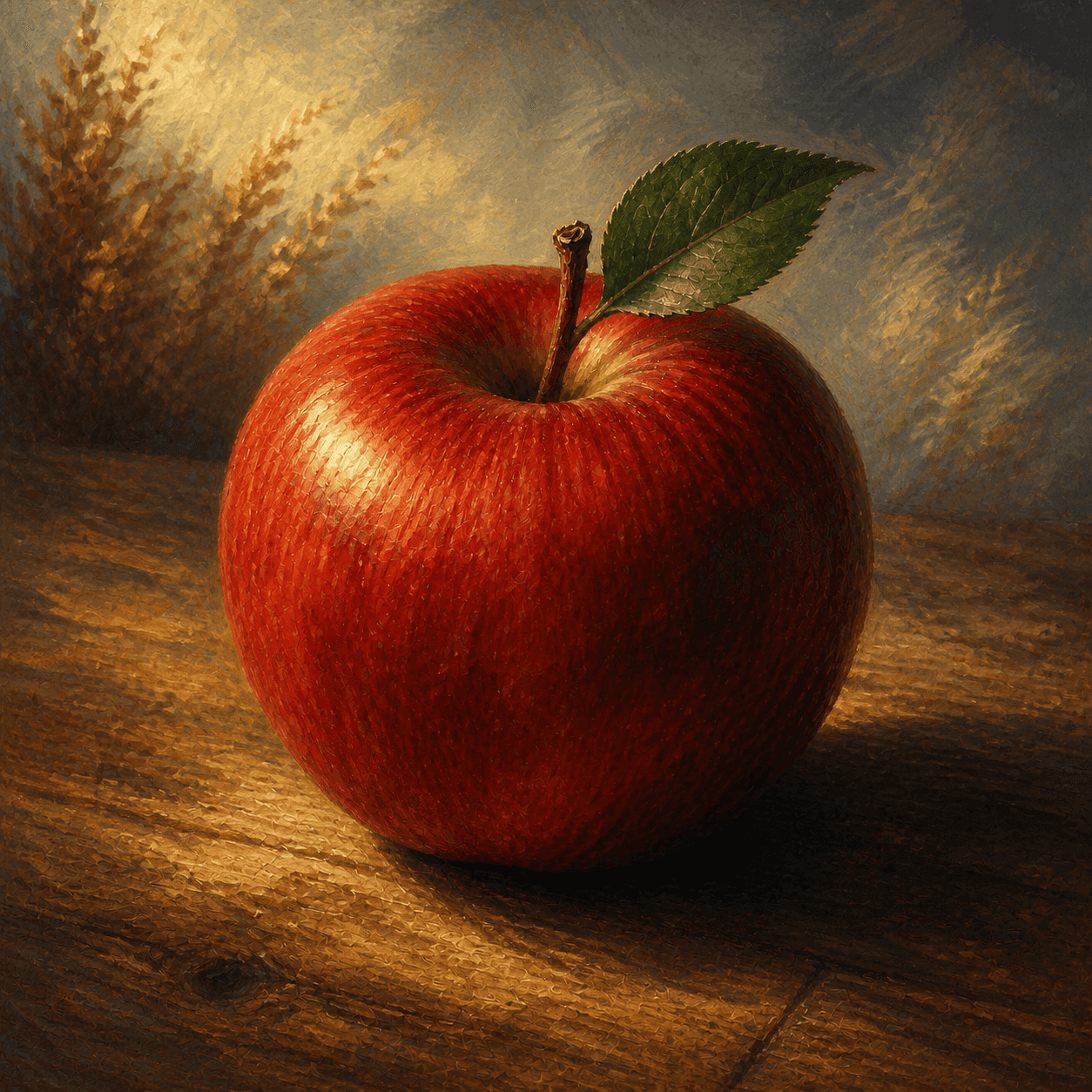
READ THE IMAGE
Light no longer explains an object; it turns the ordinary into an encounter
A storm-like sky, burning highlight, and form sinking into shadow suggest the Romantic sublime. This teaching image condenses several clues, not one style shared by every region.
- 01
See light arrive suddenly
Gold light breaks from upper left while half the apple disappears into shadow; event replaces even explanation.
- 02
Feel the subject advance
The apple nearly fills the foreground, denying safe distance as scale and weather intensify around the viewer.
- 03
Follow mobile brushwork
Marks change direction across sky, wood, and skin, making pigment feel like wind, fire, or moving cloud.
- 04
Hold beauty and unease together
Saturated red and gold attract while grey sky and black shadow weigh down the scene; the sublime joins pleasure to threat.
In one sentence
Not the opposite of reason—
but a refusal to let reason monopolise human experience
Romanticism crossed literature, music, and visual art rather than forming one unified school. Amid the French Revolution, Napoleonic wars, industrialisation, and imperial expansion, it privileged emotion, imagination, dream, religion, national history, and uncontrollable nature. Free handling, intense colour, extreme weather, and contemporary catastrophe challenged academic order. Yet fascination with the medieval, distant, and ‘Oriental’ could also turn others into objects of European desire and colonial power.
VISUAL LANGUAGE
Visual DNA
Emotion
Intensity before calm example
Nature
Sublime, boundless, uncontrollable
Shipwreck, mountain fog, storm, and ruin make human scale feel precarious.Handling
Visible, fluid, untamed
Colour and pigment carry speed, temperature, and psychic disturbance instead of merely filling contour.History
Present disaster and national memory
Revolution, war, oppression, and medieval pasts are remade as questions of identity and politics.Subject
The artist's singular response
Originality, genius, and inward experience increasingly challenge academic formula and universal rule.Where it came from
Enlightenment endured, but catastrophe made its promise of order insufficient
Romanticism inherited eighteenth-century debates about sublime, sensibility, and imagination, then answered post-revolutionary disillusion. German artists spiritualised nature; British landscape tested light and weather; French painters confronted politics and bodily crisis; Goya moved from Enlightenment critique into war and nightmare.
Sublime and imagination gain a vocabulary
Burke and others ask how terror, vastness, and force produce feeling beyond beauty as literature and music elevate personal emotion.
Revolutionary hope meets war and violence
The French Revolution, Napoleonic wars, and Spanish resistance fracture heroic history; Goya records reason entangled with cruelty and dream.
Landscape and current events become monumental
Friedrich, Turner, Géricault, and Delacroix give solitary nature, shipwreck, weather, and revolt the scale of history painting.
Romanticism travels and exposes contradictions
National revivals, abolition debates, colonial campaigns, and Orientalism expand subjects while raising who may view, name, and represent others.
ARTISTS & WORKS
Meet it through four works
Goya, The Third of May 1808
A lantern isolates the condemned man's white shirt and open arms; an anonymous firing squad makes war modern violence without heroic rescue.Friedrich, Monk by the Sea
A tiny figure faces nearly empty sea and sky; scale, silence, and uncertainty turn landscape into spiritual experience.Géricault, Raft of the Medusa
A pyramid of bodies rises between waves and a distant ship, carrying political scandal, despair, and frail hope onto a Salon-sized canvas.Turner, Snow Storm: Hannibal and his Army Crossing the Alps
A vortex of weather engulfs army and hero, reducing history before nature's incalculable force.How to recognise it
Do not just find a storm—see how feeling becomes a form of knowledge
- ✓Do composition, light, colour, or handling privilege emotional intensity over lucid order?
- ✓Does nature seem vast, dangerous, mysterious, or spiritual, destabilising human scale?
- ✓Does the subject come from present disaster, dream, literature, the medieval, or national past rather than only Classical example?
- ✓When depicting distant places and peoples, does the work also participate in tourism, empire, or Orientalist power?
STYLE RELATIONS
From universal order to subjective intensity, then the social present
Neoclassicism
Uses clear contour, stable composition, and ancient example to establish judgeable public order.↗Romanticism
Expands individual experience through emotion, imagination, sublime nature, and historical trauma.CURRENTRealism
Turns to contemporary labour, class, and daily life, rejecting ideal heroes and exotic escape.↗REFERENCES
Sources & image note
The apple is a contemporary teaching interpretation of sharp contrast, mobile brushwork, and sublime atmosphere. Historical Romanticism crosses countries, politics, and media and cannot be reduced to one ‘dramatic style.’