
Classical Art
Neoclassicism
Neoclassicism made antiquity modern: archaeology, reason, and public virtue shaped its language, while revolution and empire gave it conflicting political roles.
READ THE IMAGE
Begin with contour: everything is made clear, stable, and judgeable
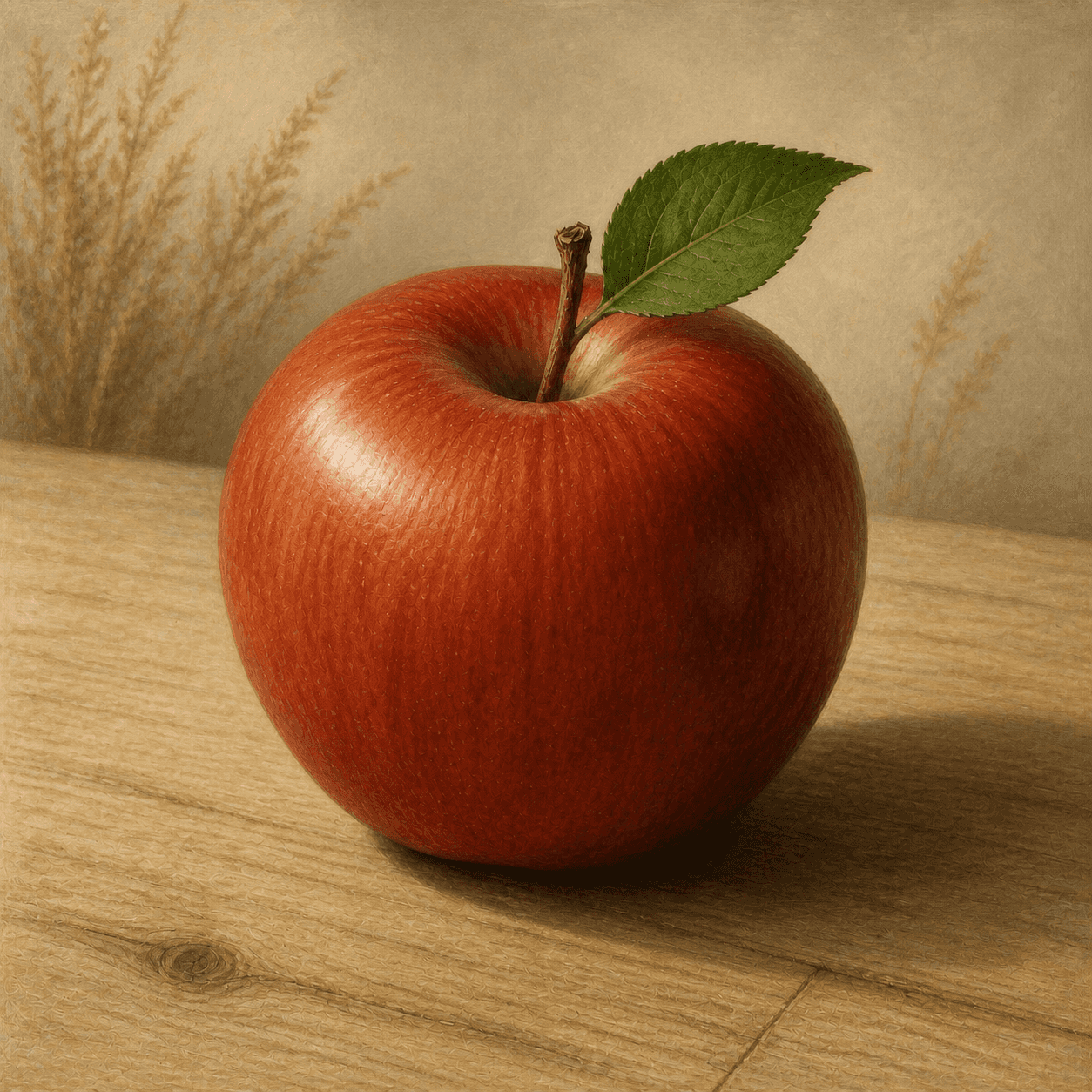
Smooth finish, central balance, and shallow space suggest Neoclassical order. This teaching image is not a historical work and cannot stand in for the movement's contested politics.
- 01
Read the clear contour
The edge remains continuous and brushwork recedes behind form; Neoclassical drawing often makes bodies legible like sculpture.
- 02
Read stable geometry
A centred subject and horizontal table hold balance; the leaf adds a diagonal without producing Baroque rotation or escape.
- 03
Read controlled light and colour
Warm red, stone grey, and olive stay within a limited range; even light explains volume instead of staging sensory drama.
- 04
Read a relief-like stage
The apple sits forward against quiet shallow depth, like actions arranged across the foreground of a history painting.
In one sentence
Not a copy of ancient art—
but an imagined Classical world used to debate modern order
From the mid-eighteenth century, excavations at Herculaneum and Pompeii, antiquarian study in Rome, travel, and publication made ancient objects newly abundant. Artists opposed Rococo lightness with clear contour, smooth surface, stable proportion, and Classical subjects, turning self-command, sacrifice, and civic duty into visible examples. Yet the same language served Enlightenment reform and revolution, monarchies, colonial republics, and Napoleon's empire; it never carried one fixed politics.
VISUAL LANGUAGE
Visual DNA
Contour
Drawing first, boundaries clear
Composition
Stable, axial, shallow
Horizontals and verticals order figures; decisive actions often unfold across a relief-like foreground.Surface
Smooth, restrained, sculptural
High finish suppresses traces of making so body, drapery, and object appear solid and ideal.Subject
Ancient history as moral choice
Roman republic, Greek myth, and heroic sacrifice become mirrors for modern citizenship.Institution
Academy, Salon, state
History painting, public sculpture, and architecture enter civic life through rankings and official display.Where it came from
Archaeology made antiquity evidence; revolution and empire made it political language
Neoclassicism emerged through an international network of antiquarians, collectors, travellers, academies, and publishers who selected and reconstructed ‘the Classical.’ Their admiration for white marble mistook lost pigment for ancient intention; Greek and Roman sculpture and architecture were widely coloured.
Herculaneum and Pompeii expand the ancient world
Sites, frescoes, and objects circulate in prints and books, grounding Classical knowledge in observation as well as texts.
Rome becomes an international laboratory
Winckelmann, antiquarianism, and the Grand Tour promote noble simplicity, proportion, and Greek models as academies privilege drawing and history painting.
Public virtue enters an age of revolution
David and others use Roman oath, sacrifice, and martyrdom to debate loyalty, state, and the civic body as political meanings change rapidly.
Empire rewrites republican Classicism
Napoleon borrows emperor, triumph, and monument for legitimacy; sculptors such as Canova work between ancient type and modern celebrity.
ARTISTS & WORKS
Meet it through four works
David, Oath of the Horatii
Arches separate three groups; male straight lines oppose female curves, compressing family grief into a public oath.Kauffman, Cornelia Presenting Her Children as Her Treasures
Restrained gesture and a Roman interior turn motherhood and education into a woman-centred example of republican virtue.David, Death of Marat
Few objects, clear contour, and an altar-like composition recast a contemporary political murder as Classical martyrdom.Canova, Pauline Borghese as Venus Victrix
Polished marble joins an ancient goddess type to modern portraiture, showing Neoclassicism serving imperial elites and sensual display.How to recognise it
See how form clarifies moral choice—then ask whom that clarity serves
- ✓Are figures and objects defined by firm contour, smooth finish, and restrained colour?
- ✓Do horizontal, vertical, symmetry, or a shallow relief-like stage create order?
- ✓Do ancient dress, architecture, and story debate modern sacrifice, law, nation, or identity?
- ✓Was the patron an academy, revolutionary government, monarch, or empire—and what political work does the form perform?
STYLE RELATIONS
From intimate decoration to public order, then subjective sublime
Rococo
Uses pastel, asymmetrical curve, and continuous interiors for intimate sociability and sensory play.↗Neoclassicism
Uses clear contour, ancient example, and stable composition to debate modern virtue and power.CURRENTRomanticism
Lets emotion, nature, historical trauma, and individual experience strain universal reason.↗REFERENCES
Sources & image note
The apple is a contemporary teaching interpretation of contour, balance, shallow space, and restrained colour—not a Neoclassical still life. The style also requires archaeology, academic institutions, and shifting political uses to be read together.