
Modern Art
Minimalism
Reducing image, gesture, and metaphor so object, material, repetition, and actual space meet directly.
READ THE IMAGE
There is little in the image—but that does not mean little content
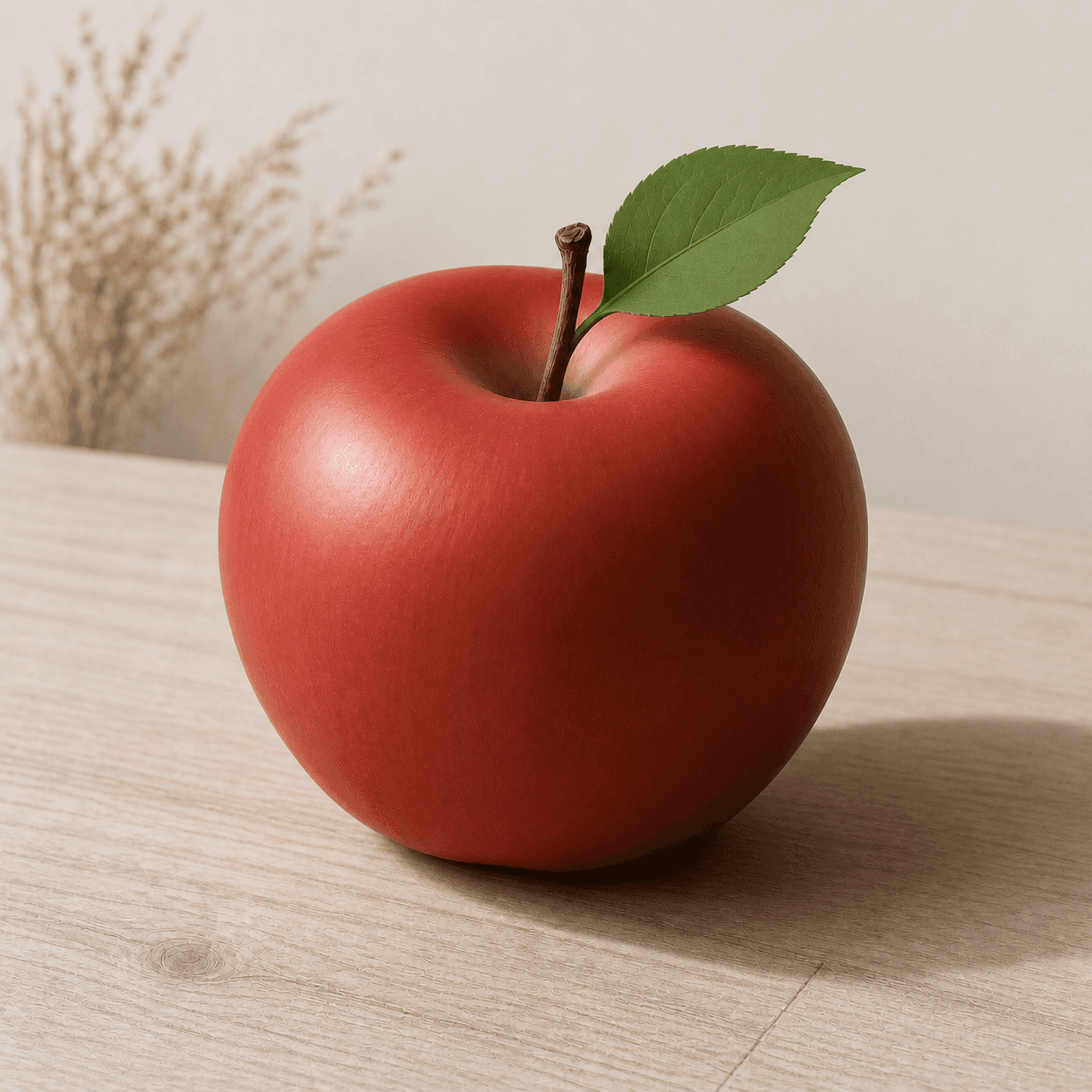
This teaching image uses one apple, restrained colour, and broad emptiness to suggest reduction. Historical Minimalism is less a clean look than an encounter among industrial objects, serial order, space, and the viewer's body.
- 01
Read one volume
The apple appears as a whole continuous mass, without pattern or narrative distraction.
- 02
See touch subdued
A smooth surface and minimal brushwork make the form resemble a manufactured object.
- 03
Treat emptiness as active
Pale surrounding space determines scale, interval, and isolation rather than merely backing the apple.
- 04
Count limited relations
Red, green, off-white, and one shadow form a few clear variables; reduction makes each difference legible.
In one sentence
Not ‘less means more tasteful’—
but returning attention to object and space
Minimalism was a primarily American movement of the 1960s. Simple nonrepresentational geometry, industrial materials, commercial fabrication, and mathematical series challenged traditional craft, uniqueness, and artistic self-expression. Rather than narrating beyond itself, a work asks viewers moving around it to register scale, interval, light, material, and architecture. ‘Minimalism’ was largely a critical label many artists resisted.
VISUAL LANGUAGE
Visual DNA
Form
Basic, nonrepresentational
Structure
Repetition, series
Identical units follow simple rules and reduce compositional taste.Material
Industrial, literal
Steel, aluminium, Plexiglas, fluorescent tubes, and house paint remain recognisably themselves.Making
Fabricated, low-touch
Commercial production displaces carving and the mythic master's hand.Space
Completed by the viewer
Work, room, light, and a moving body form one situation.Where it came from
A refusal of expressive painting and traditional sculpture
Minimalists responded to Abstract Expressionism's heroic gesture while drawing on Constructivism, Bauhaus, and Duchamp's readymade. Anne Truitt and Agnes Martin also remind us that reduction need not exclude feeling, handwork, or subtle variation.
Black Paintings signal a shift
Frank Stella's regulated stripes and shaped canvases refuse illusion and lyrical touch.
Industrial objects and essays
Flavin uses commercial fluorescent light; Judd's Specific Objects describes work beyond painting and traditional sculpture.
Primary Structures
A major Jewish Museum exhibition gives new geometric sculpture public visibility.
Body and site enter debate
Morris, Serra, and others foreground weight, place, time, and movement—along with institutional and safety questions.
ARTISTS & WORKS
Meet it through four artists
Donald Judd
Ordered fabricated metal or Plexiglas units by lucid intervals and series, calling them specific objects.Dan Flavin
Used standard fluorescent tubes as both objects and light sources, rewriting corners and rooms in colour.Anne Truitt
Hand-coated upright wooden columns repeatedly, joining restrained form with colour, scale, and memory.Robert Morris
Used simple volumes, mirrors, and felt to investigate viewer movement, gravity, and place.How to recognise it
Look beyond simplicity to how an object occupies a site
- ✓Is the form basic and nonrepresentational, avoiding overt story and symbol?
- ✓Do repeated units follow a serial, grid, or plainly stated rule?
- ✓Do materials retain industrial specifications rather than imitate something else?
- ✓Does perception change with distance, movement, light, and architectural placement?
STYLE RELATIONS
Different purposes for reduction
REFERENCES
Sources & image note
The apple can only cue singular form, restrained surface, and negative space. It remains a representational image and cannot replace Minimalist sculpture's real scale, architecture, and bodily movement.