
Modern Art
Conceptual Art
A work can begin as a question, instruction, or relation; the object is one temporary landing place for the idea.
READ THE IMAGE
Do not mistake low-poly form for a fixed Conceptual style
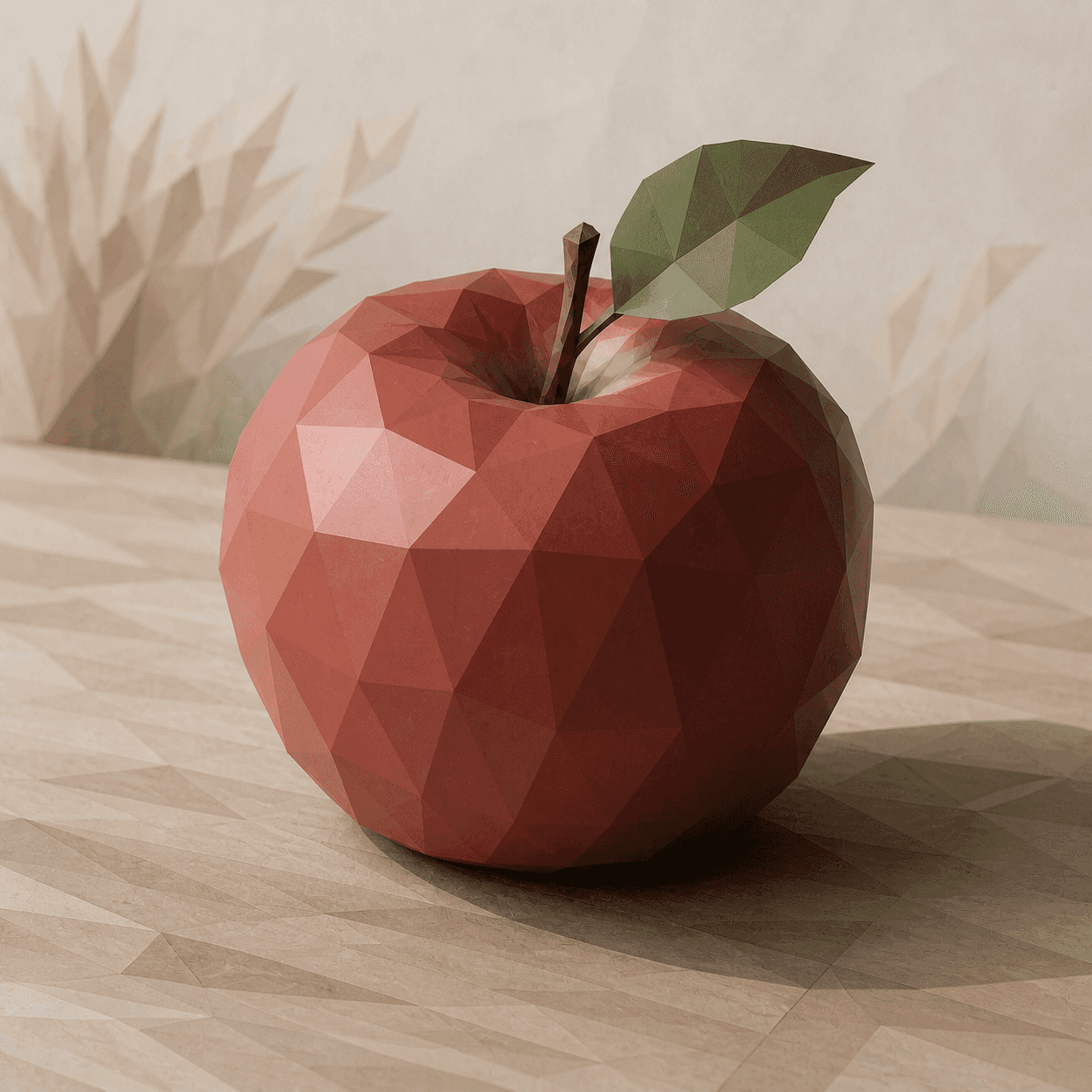
Conceptual art has no single appearance. This image can be read as the result of an instruction—‘construct an apple from a limited set of triangular planes.’ The relation between rule and execution matters more than the facets.
- 01
Imagine the instruction first
If a work can be described by a rule, this image may be only one of many valid realisations.
- 02
Separate concept from result
Colour, angle, and polygon count may vary while the proposition ‘discretise a continuous object’ remains.
- 03
Locate the executor
The artist need not make every plane; fabricators, software, or viewers may realise a scheme.
- 04
Question the display system
How would the same file be named in a studio, browser, or museum? Context participates in the work.
In one sentence
Not form disappearing—
but the idea determining why form exists
Conceptual art became an international practice in the late 1960s, treating ideas, propositions, and theoretical processes as potentially more important than traditional objects. Artists used language, instructions, photographic records, maps, data, performance, and temporary materials to ask what art is, who makes it, how it circulates, and how museums and markets confer value. Physical things remain, often as evidence, documents, or repeatable versions.
VISUAL LANGUAGE
Method DNA
Core
Idea, proposition
Medium
Language, document
Text, photographs, diagrams, and archives replace or explain conventional objects.Making
Instruction, delegation
Plan and execution can separate; others may remake a work later.Value
Dematerialising tendency
Temporary acts and cheap paper challenge the unique precious object.Critique
Institution, authorship
Works expose how naming, collecting, display, and power define art.Where it came from
When art's centre shifted from object to proposition
Duchamp's readymades, Dada language, and Minimalist systems formed important precedents. Artists of the 1960s moved documents, ideas, and communication networks to the centre, though ‘dematerialisation’ never fully escaped matter, labour, markets, or institutions.
Fountain poses a precedent
Duchamp's selection, signature, and submission of an ordinary object force institutions to answer what counts as art.
One and Three Chairs
Kosuth sets object, photograph, and dictionary definition together as three representational systems.
Paragraphs on Conceptual Art
Sol LeWitt argues that an idea can operate like a machine generating art and can be executed by others.
Exhibitions and publishing networks expand
When Attitudes Become Form, Art-Language, and Seth Siegelaub's projects circulate propositions beyond gallery objects.
ARTISTS & WORKS
Meet it through four artists
Joseph Kosuth
Juxtaposed definitions, objects, and images to study how language constructs meaning and the concept of art.Sol LeWitt
Wrote rules for walls and structures that others could execute, separating conceptual design from physical making.On Kawara
Used date paintings, postcards, and telegrams to register existence, time, and everyday information systems.Adrian Piper
Used text, action, and self-presentation to test race, gender, identity, and viewers' social judgement.How to recognise it
Begin with the question the work poses
- ✓Can the work exist as a proposition, rule, or instruction and be executed again?
- ✓Are text, archive, or photography evidence and systems rather than decoration?
- ✓Does an object question authorship, originality, value, or art's definition?
- ✓Do venue, institutional label, and viewer participation alter how the work exists?
STYLE RELATIONS
Shifting weight from object to idea
Minimalism
Brings simplified objects, materials, and embodied viewers together in actual space.↗Conceptual Art
Places proposition, language, rule, and institutional critique before the object.CURRENTInstallation Art
Builds a situated experience from multiple spatial elements and need not privilege ideas first.↗REFERENCES
Sources & image note
The apple is not a historical Conceptual style but a teaching hypothesis for separating rule and realisation. Conceptual art cannot be recognised by appearance alone; titles, instructions, documents, and context are essential.