
Graphic Design
Constructivism
After revolution, artists sought to move from representing the world to building life: material, production, and communication became artistic tasks.
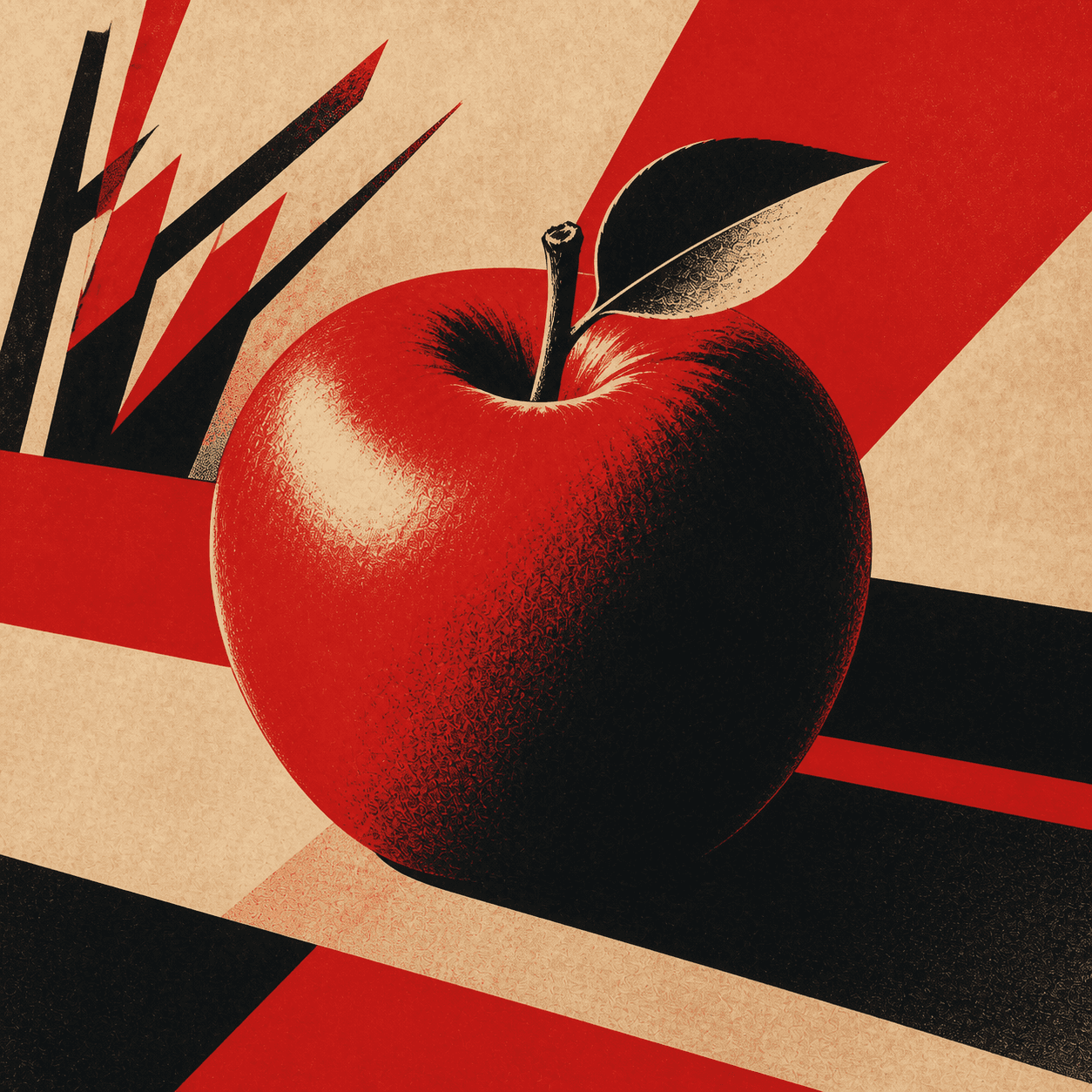
READ THE IMAGE
The diagonals act less like backdrop than a communication machine
Red, black, and buff, forceful diagonals, an enlarged apple, and rough print texture cue Constructivist graphics. Historical Constructivism also concerned actual material, spatial construction, and Productivism—not poster appearance alone.
- 01
Travel along the diagonal
Red and black bands cross the image with direction, speed, and conflict instead of quiet central symmetry.
- 02
Read limited, reproducible colour
Few high-contrast inks and a granular surface recall economical mass printing.
- 03
See scale collide
The huge apple overwhelms background geometry as photomontage uses abrupt proportion for direct informational impact.
- 04
Ask whether form can act
Circle, wedge, and line behave like parts that could be cut, suspended, printed, or put into production.
In one sentence
Not a red-black diagonal poster look—
but recasting the artist as a social producer
Constructivism developed around the Russian Revolution through Vladimir Tatlin, Aleksandr Rodchenko, Liubov Popova, Varvara Stepanova, and others. It opposed art as individual emotion or representation in favour of material, structure, technology, and social use. Debates around 1921 led some artists away from easel painting into spatial construction, books, photography, advertising, textiles, theatre, and daily objects, though their ideals never aligned neatly with state reality.
VISUAL LANGUAGE
Action DNA
Structure
Construct, do not depict
Direction
Diagonal, rotating, crossing
Strong axes give static surfaces mechanical and social motion.Material
Wood, metal, glass, print
Material properties replace precious mass and traditional sculpture.Communication
Type, photomontage
Word and image compress into rapid, forceful public messages.Role
Artist-engineer
The maker ideally enters production for collective life.Where it came from
From material experiment toward Productivism
Tatlin's counter-reliefs put wood, iron, and glass directly into corners. After revolution, INKhUK and Vkhutemas debated objective principles for art. A brief laboratory phase turned toward design and communication under changing political and economic pressure.
Tatlin shows counter-reliefs
Industrial matter crosses the corner, replacing sculptural mass with real space and material property.
Monument to the Third International
A spiralling steel proposal joins engineering, communication, and world revolution in an unrealised monument.
First Working Group and 5×5=25
Constructivism gains organised form as Rodchenko and peers declare painterly experiment exhausted.
Productivism enters everyday media
Textile, photomontage, magazine, advertising, and stage redirect experiment toward social use.
ARTISTS & WORKS
Meet it through four practitioners
Vladimir Tatlin
Established material culture and construction through counter-reliefs and the tower proposal.Aleksandr Rodchenko
Moved from monochrome painting into suspended structure, photography, books, and advertising.Liubov Popova
Developed intersecting planes as architectonic construction, then entered textile and stage production.Varvara Stepanova
Applied geometry, type, and photography to clothing, textile, magazines, and mass communication.How to recognise it
Connect appearance, material, and social task
- ✓Does geometry express construction, force, or spatial relation rather than ornament?
- ✓Do diagonal axes, contrast, and scale shifts accelerate communication?
- ✓Does practice move into print, photography, textile, stage, or industrial material?
- ✓Can the work be situated in Russian revolutionary and Productivist debates of the 1910s–20s?
STYLE RELATIONS
Different directions in geometric avant-gardes
REFERENCES
Sources & image note
The apple borrows the high-contrast graphic language of Constructivist communication rather than representing the movement as a whole. Counter-relief, spatial construction, Productivism, and Soviet institutions remain essential.