
Graphic Design
Bauhaus
It was first a school: a place where art, craft, technology, and social life were made to meet through courses and workshops.
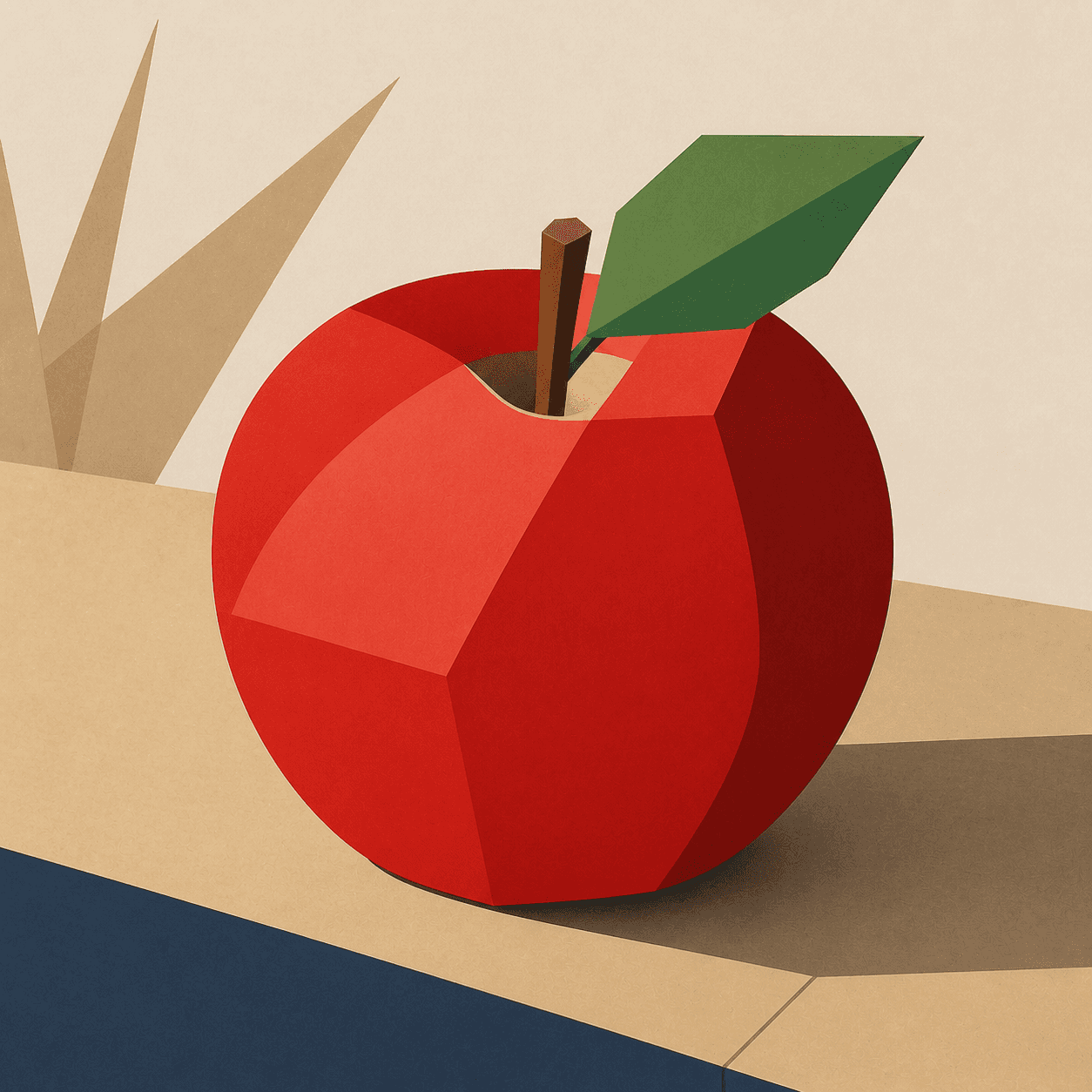
READ THE IMAGE
Break an object into relations, then construct it again
This teaching image reduces apple, leaf, table, and shadow to circles, facets, diagonals, and limited colour fields. It cues exercises in form, colour, material, and space rather than reproducing a historical Bauhaus work.
- 01
Find the geometric armature
The apple approaches a sphere and the leaf a folded polygon: reduction clarifies structure without erasing identity.
- 02
Read the limited colour
Red, green, ochre, and blue divide against warm white; colour carries hierarchy and direction.
- 03
Balance plane and volume
Crisp fields establish flat order while tonal facets keep fruit and leaf spatial.
- 04
See functional organisation
Diagonals, edges, and empty areas guide attention; ornament is compressed into legible structure.
In one sentence
Not a red-yellow-blue geometric look—
but a method linking learning, making, and life
The Bauhaus was an art and design school founded by Walter Gropius in Weimar in 1919, moved to Dessau and Berlin, and closed under Nazi pressure in 1933. A preliminary course introduced material, colour, and form before workshops in weaving, metal, furniture, print, stage, and more. Across three directors and shifting faculties, it repeatedly renegotiated art, craft, industrial production, architecture, and society rather than prescribing one appearance.
VISUAL LANGUAGE
Method DNA
Foundation
Experiment before specialism
Composition
Geometry, proportion, grid
Circle, square, line, and interval create explicit relations.Making
Workshop, prototype, collaboration
Material tests and producible prototypes put design under pressure.Media
Across categories
Architecture, furniture, weaving, photography, type, and stage inform one another.Aim
Modern life
Teaching and production address housing, communication, and social need.Where it came from
Across fourteen years, reality repeatedly rewrote the school's aims
After World War I the school began with a utopian union of art and craft. In industrial Dessau it leaned toward standards and production; Hannes Meyer stressed social need, while Mies concentrated the curriculum on architecture. Politics shaped every phase.
Founded in Weimar
Gropius joins an art academy and craft school around the horizon of collective building.
Art and technology become a new unity
The programme turns toward industrial collaboration and workshop prototypes for replication.
Move to Dessau
The new building, type, furniture, photography, and stage form a visible cross-media environment.
Berlin and closure
Mies reorganises the school once more; under Nazi pressure it ultimately dissolves itself.
ARTISTS & WORKS
Meet it through four members
Walter Gropius
Founded the school and designed its Dessau building, linking workshops through collaborative architecture.László Moholy-Nagy
Renewed the preliminary course and communication through experiments with photography, light, material, and machines.Anni Albers
Advanced weaving from a gendered workshop into an experiment in material, structure, and industrial design.Marcel Breuer
Used tubular steel and lightweight structure to explore industrial furniture for modern life.How to recognise it
Judge the system and use, not geometry alone
- ✓Do material, function, and fabrication jointly determine form?
- ✓Do geometry, colour, and type establish hierarchy rather than retro decoration?
- ✓Does the work connect to prototype, workshop, production, or modern social life?
- ✓Is there a historical link to the school or its teaching network rather than generic modernism?
STYLE RELATIONS
Different aims in adjacent modern design languages
Constructivism
Directly mobilises geometry and communication for social production and revolutionary action in Russia.↗Bauhaus
Uses school and workshop to connect art, material experiment, industry, and modern life.CURRENTSwiss International
After the war, organises public information through grid, sans serif type, and objective photography.↗REFERENCES
Sources & image note
The apple is a contemporary teaching interpretation of foundation study and cross-media composition, not a historical Bauhaus object. The page treats Bauhaus as a changing institution with internal tensions, not one decorative style.