
Classical Art
Gothic Art
Gothic does not mean darkness: it was an engineering and pictorial revolution that thinned walls, moved support outward, and brought coloured light into the urban church.
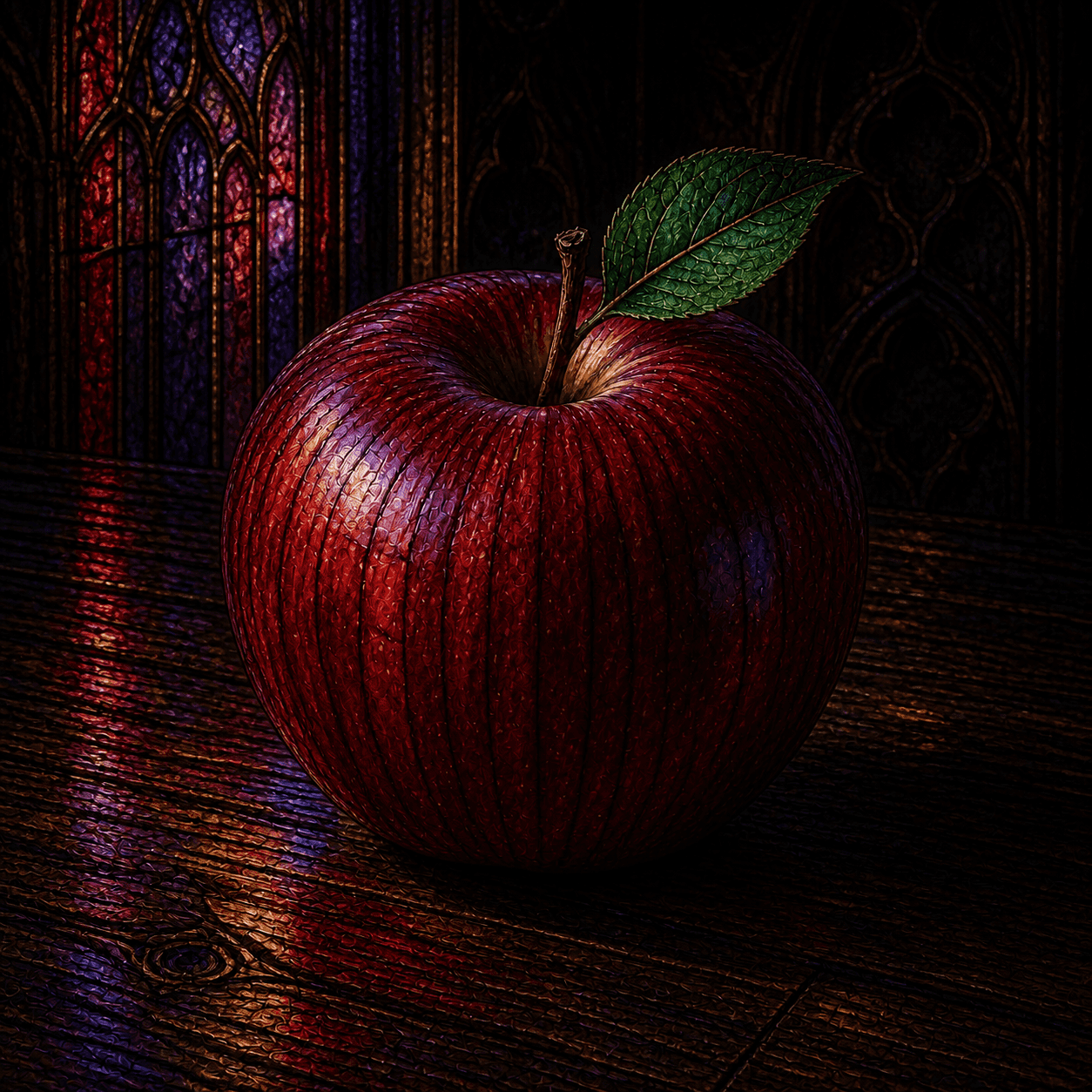
READ THE IMAGE
The true subject is not the apple, but light passing through glass
Pointed tracery, red and violet reflections, rising lines, and dark masonry form a teaching interpretation. Historical Gothic is far more than a gloomy filter.
- 01
See the point pull upward
Window forms close in pointed tips and vertical lines repeatedly lift the eye, echoing Gothic ascent.
- 02
See colour transmitted
Red, violet, and blue seem projected through glass onto fruit and table; stained glass is a luminous enclosure, not a picture hung on a wall.
- 03
Read contrast
The subject receives local light within darkness: Gothic illumination can be directed and ritualised rather than uniformly bright.
- 04
See structure become ornament
Tracery, shafts, and repeated points share load and form pattern; Gothic decoration often grows from construction.
In one sentence
Not ‘spooky medieval style’—
but structure exchanged for height, light, and civic community
Gothic emerged around Paris in the mid-twelfth century. Pointed arch, rib vault, and flying buttress concentrated roof thrust and carried it to external supports, opening walls for larger stained glass. A cathedral was worship space and a public project shaped by bishops, monarchy, guilds, donors, and urban rivalry. Sculpture became more bodily and interactive, while glass, metalwork, manuscripts, and ivory shared pointed, foliate, and linear vocabularies.
VISUAL LANGUAGE
Visual DNA
Structure
Pointed arch, rib vault, flying buttress
Light
Coloured, symbolic, architectural
Stained glass tells stories while turning the wall into a jewel-like translucent screen.Verticality
Layered ascent
Shafts, arches, towers, and clerestories pull the eye toward vault and sky.Figure
More natural and relational
Column-bound elongation gradually yields weight shift, turn, smile, and exchange between figures.Scale
Cathedral to small object
Points, trefoils, and tracery migrate into reliquaries, ivory, furniture, vestment, and prayer book.Where it came from
Structural innovation and urban resources made ‘heavenly light’
Gothic grew from Romanesque experiments and wider pointed-arch traditions. It was never one linear progress: French verticality, English Decorated work, German hall churches, and Italian polychrome façades followed different paths.
Saint-Denis launches Early Gothic
Abbot Suger joins ribs, points, and continuous glazing, linking precious material and light to sacred understanding.
Chartres integrates the High Gothic system
Flying buttress, three-part elevation, and extensive surviving glass join structure, sculpture, and narrative.
Height, glass, and urban rivalry expand
Paris, Amiens, Reims, and other sites push vaults higher and walls thinner as mobile workshops spread skill.
Late Gothic becomes intricate and refined
Flamboyant tracery, courtly International Gothic, and meticulous manuscripts persist alongside Renaissance developments.
ARTISTS & WORKS
Meet it through four works
East end of Saint-Denis
Radiating chapels, ribs, and glass turn wall into a ring of light around the altar—a key Early Gothic experiment.Chartres Cathedral
Architecture, portal sculpture, and extensive twelfth- and thirteenth-century glass form a walk-in encyclopedia of faith and city.Sainte-Chapelle
A two-level royal chapel uses slender masonry to support near-continuous glass, framing relic and monarchy in jewel-like space.Annunciation and Visitation, Reims
Figures turn, look, smile, and reveal bodies beneath drapery, showing High Gothic sculpture's social naturalism.How to recognise it
Do not just find a spire—see structure, light, and body change together
- ✓Do pointed arch, rib vault, and flying buttress carry thrust toward concentrated supports?
- ✓Do clerestory, rose window, and coloured glass turn walls into translucent screens?
- ✓Do clustered shafts and arch lines create sustained upward pull?
- ✓Does sculpture remain architectural yet show more natural weight, expression, and interaction?
STYLE RELATIONS
The church remains, but its structural logic changes
Romanesque Art
Uses massive walls, round arches, and vaults for weighty bays and frame-bound imagery.↗Gothic Art
Moves thrust outward through point, rib, and buttress to gain height and stained light.CURRENTRenaissance
Returns to Classical orders, proportion, and centred perspective to organise humanist space.↗REFERENCES
Sources & image note
The apple heightens stained reflections and dramatic darkness as a contemporary teaching image. Identify Gothic through structural system, glazing, and sculpture—not spires or mood alone.