
Classical Art
Romanesque Art
Thick walls, round arches, and emphatic contour are not synonyms for clumsiness: they order pilgrimage crowds, monastic life, and legible sacred narrative.
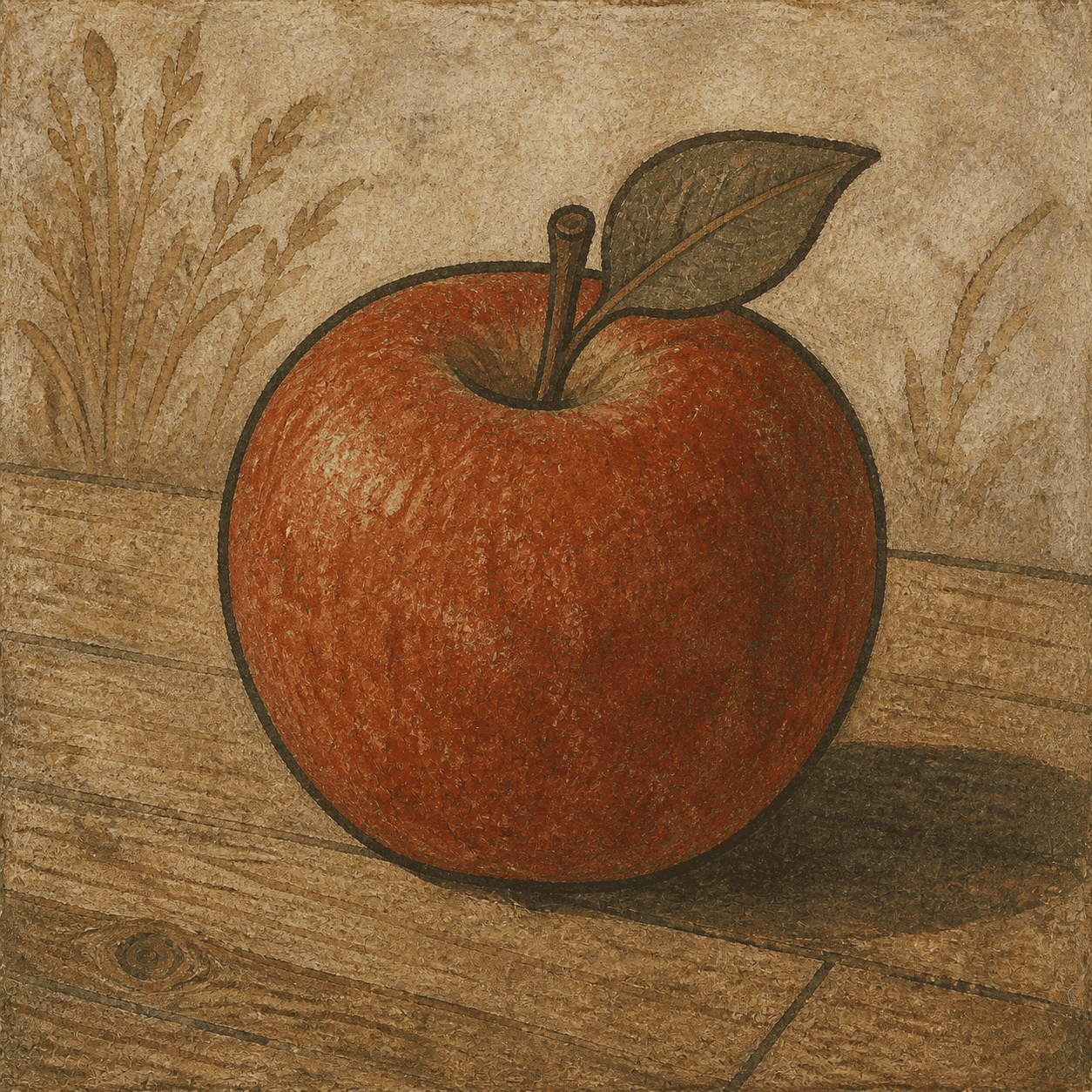
READ THE IMAGE
Like an image left on a massive wall: read contour before volume
Plaster texture, earth colour, heavy outline, and simplified plants suggest Romanesque mural and architectural sculpture. This is an interpretation of ‘architectural image,’ not a historical copy.
- 01
Read the heavy boundary
A broad dark contour locks the apple in place, as mural and portal figures had to remain legible at distance and in dim interiors.
- 02
See form compressed
Volume exists but is simplified into stable masses; Romanesque bodies likewise stretch, bend, or compress to fit tympana, capitals, and walls.
- 03
Read wall-bound colour
Red ochre, earth yellow, and grey-brown seem absorbed by plaster; colour divides forms rather than simulating transparent air and passing light.
- 04
See horizontal structure
Table and background create firm bands, suggesting image constrained by architecture rather than floating in limitless space.
In one sentence
Not ‘crude art before Gothic’—
but western Europe's renewed network of monumental building and image
‘Romanesque’ is a nineteenth-century term for much eleventh- and twelfth-century western European art, first applied to round arches, massive walls, and stone vaults recalling Rome. In practice it embraces distinct traditions in France, Spain, England, Italy, Germany, and beyond. Monastic growth, pilgrimage, and relic cults drove churches, manuscripts, metalwork, and architectural sculpture; images built into portals, capitals, and apses communicated faith with direct, highly charged form.
VISUAL LANGUAGE
Visual DNA
Architecture
Round arch, massive wall, stone vault
Movement
Planned for pilgrims
Aisles, ambulatories, and radiating chapels bring crowds near relics without stopping the high altar rite.Sculpture
Inseparable from building
Tympana, archivolts, and capitals bear both load and stories of judgment, scripture, monsters, and warning.Figure
Frame-bound, gesturally intense
Bodies stretch or compress while gaze, swirling drapery, and gesture keep narrative legible afar.Region
Variation through circulation
Pilgrims and orders exchange forms, yet local materials, workshops, and politics produce distinct versions.Where it came from
People, relics, and makers travelled—and styles travelled with them
Romanesque was not a uniform code issued by one centre. Monastic networks, pilgrimage, conquest, and trade moved techniques and motifs while absorbing Roman, Carolingian, Ottonian, Byzantine, and Islamic influences.
Monastic reform expands networks of building and books
Orders such as Cluny strengthen liturgy, scriptoria, and regional connections, gathering resources and expertise for major projects.
Pilgrimage churches reorganise movement
Churches on routes to Santiago use aisles, ambulatories, and chapels for crowds, relics, and simultaneous services.
Architectural sculpture becomes public narrative
Monumental portals and capitals place judgment, saints, monsters, and moral order directly in the path of entry.
Structural experiments lead gradually toward Gothic
Pointed and rib vaults with concentrated supports emerge in some regions; Romanesque and Early Gothic do not change overnight.
ARTISTS & WORKS
Meet it through four works
Church and reliquary of Sainte-Foy
Ambulatory, radiating chapels, and a lavish gold reliquary show architecture, pilgrimage, economy, and belief sustaining one another.Bayeux Tapestry
Continuous embroidered scenes use contour, text, and borders to recount the Norman conquest beyond church stone carving.Durham Cathedral
Massive piers, alternating supports, incised pattern, and early rib vaults turn heavy masonry into a rhythmic interior.Last Judgment, Autun Cathedral
Gislebertus compresses elongated bodies, urgent gestures, and scale contrast into a tympanum of salvation and fear.How to recognise it
Read the architectural frame before the image within it
- ✓Do round arches, thick walls, stone vaults, and clear bays create a weighty rhythm?
- ✓Do aisles, ambulatory, and chapels organise pilgrims, relics, and multiple rites?
- ✓Do bodies stretch to fit tympanum, capital, or wall while gesture intensifies narrative?
- ✓Do entry and interior images state judgment, salvation, saints, and moral order directly?
STYLE RELATIONS
From icon space to cathedral structure
Byzantine Art
Orders sacred presence through domes, gold mosaic, and authoritative icon types.↗Romanesque Art
Joins massive building, pilgrimage movement, and architectural sculpture into sacred narrative.CURRENTGothic Art
Uses pointed arch, rib vault, flying buttress, and stained glass to release height and light.↗REFERENCES
Sources & image note
The apple borrows plaster earth tones, weighty contour, and architectural bands as a contemporary teaching interpretation. Historical Romanesque art spans many regions and media and was often vividly coloured.