
Classical Art
Byzantine Art
Gold is not background decoration: it converts everyday space into sacred space, while the image becomes an interface with an unseen world.
READ THE IMAGE
Do not begin with likeness—see how light is stored piece by piece
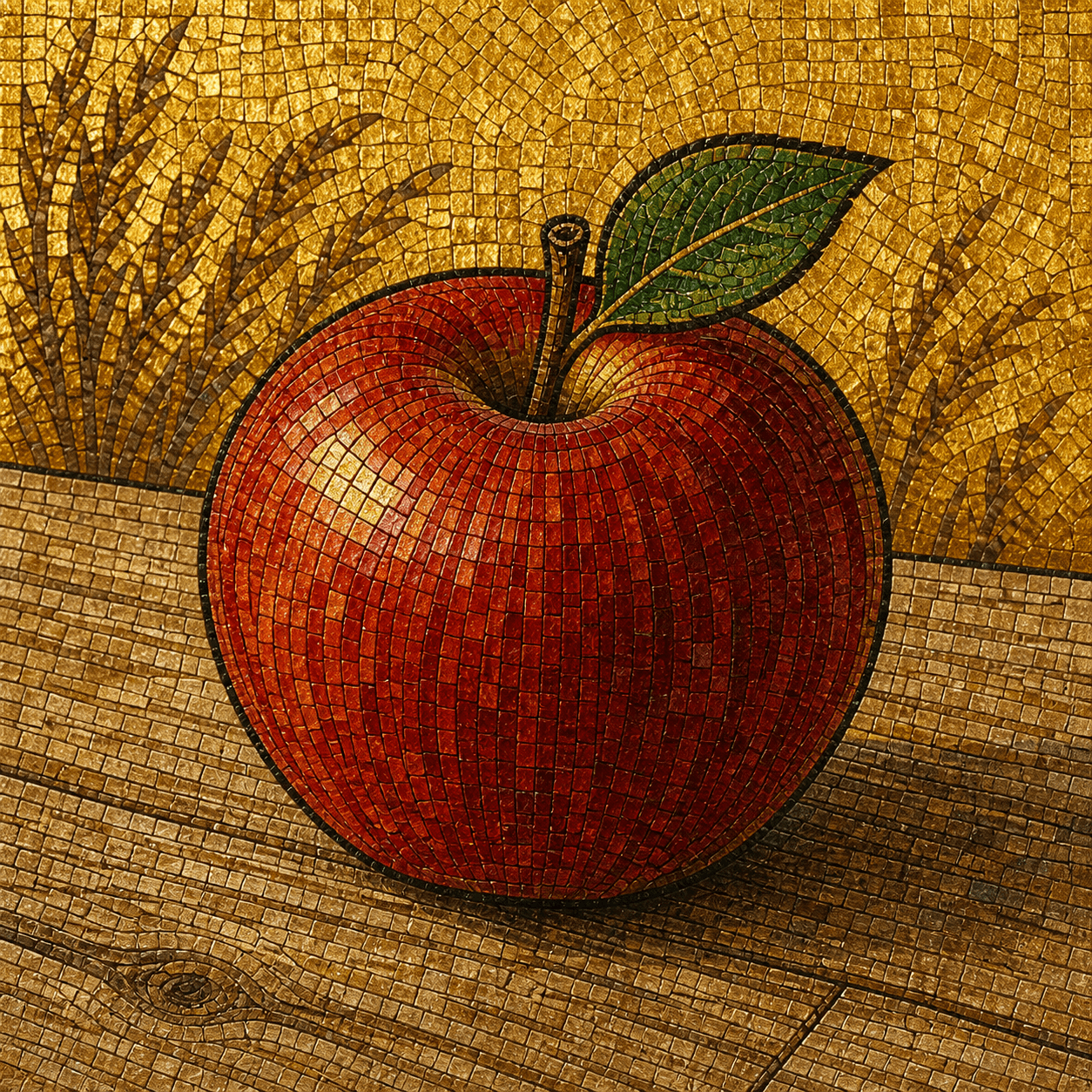
Gold-glass-like tesserae, dark contour, and a stable frontal subject suggest Byzantine mosaic experience. The image borrows material and spatial logic; it is not a historical icon.
- 01
See tesserae, not brushstrokes
Apple, leaf, and ground are made of visible units; their slight differences let the whole shimmer as viewpoint changes.
- 02
See gold cancel distance
The background opens onto no measurable landscape. It acts as a boundless luminous field lifting the subject beyond ordinary time.
- 03
See contour create presence
A dark edge holds the apple clear, frontal, and nearly iconic: the form must first be recognised and contemplated.
- 04
See light without one source
Highlights scatter across tesserae, modelling form while making the surface itself shine; material and architecture generate mosaic light together.
In one sentence
Not ‘flat medieval painting’—
but visible form directing attention to an unseen world
Byzantine art continued the eastern Roman Empire and profoundly shaped Orthodox Christianity. It inherited Classical bodies, architecture, and craft, while increasingly subordinating natural space to theological order: frontal figures, gold fields, inscriptions, gestures, and stable image types made holy persons recognisable and present. Icons were not worshipped as gods but venerated as media to their prototypes; architecture, liturgy, song, incense, and shimmering mosaic formed one encounter.
VISUAL LANGUAGE
Visual DNA
Light
Golden, shifting, non-natural
Figure
Frontal, gazing, hierarchical
Large eyes, stable poses, and clear labels stress spiritual presence over passing action.Space
Hierarchy before perspective
Scale, placement, and gold organise theological importance without a single vanishing point.Type
Repeatable, never merely mechanical
Pantokrator, Virgin and Child, saints, and feasts preserve authoritative types while allowing variation.Whole
Image embedded in architecture and rite
Dome, apse, and wall determine rank; viewers understand images through movement and worship.Where it came from
Debate, destruction, and restoration made images central to sacred order
Byzantium did not suddenly break from Rome; its people called their state the Roman Empire. Classical tradition, Christian theology, and court ritual were repeatedly recombined, then spread through trade, diplomacy, and religion.
Early Byzantium builds Christian space
Constantinople becomes capital; Justinian's Hagia Sophia and Ravenna mosaics join imperial patronage, liturgy, and immense domed interiors.
Iconoclasm contests the legitimacy of images
Sacred figures are restricted and destroyed amid arguments about depicting Christ and distinguishing veneration from idolatry.
Restored icons shape a Middle Byzantine system
After the Triumph of Orthodoxy, Christ, Virgin, angels, prophets, and saints occupy stable ranks within church architecture.
Late Byzantium innovates amid political contraction
Palaiologan mosaic and fresco develop greater movement, emotion, and space; the tradition continues beyond 1453 in Orthodox regions.
ARTISTS & WORKS
Meet it through four works
Hagia Sophia
Pendentives carry a vast dome while window light and original gold mosaic appear to dissolve structural boundaries; later images continually remade the interior.Justinian mosaic, San Vitale
Emperor, clergy, and soldiers face forward in a gold field, joining court, church, and altar ritual.Virgin and Child with Saints icon
Encaustic retains Classical volume while frontal gazes, angels, and the divine hand stage several levels of reality.Deësis mosaic, Hagia Sophia
Christ is flanked by the Virgin and John interceding for humanity; damaged faces retain the softness and emotional force of late Byzantine art.How to recognise it
Remember image type, architectural rank, and material light
- ✓Does a gold or abstracted field remove figures from continuous natural depth?
- ✓Are figures frontal and stable, with inscriptions, gaze, and gesture creating spiritual exchange?
- ✓Do mosaics or frescoes rank sacred figures through dome, apse, and wall placement?
- ✓Is it closer to Early Byzantine Classical volume, strict Middle Byzantine types, or fluid Late Byzantine emotion?
STYLE RELATIONS
Different spaces along one historical continuum
Ancient Roman Art
Uses naturalism, historical narrative, and engineered space to organise civic and imperial experience.↗Byzantine Art
Uses icon types, architectural hierarchy, and material light to join visible and invisible.CURRENTRomanesque Art
Develops massive architecture, portal sculpture, and mural narrative through western monasteries and pilgrimage.↗REFERENCES
Sources & image note
The apple is a contemporary simulation of gold tesserae, dark contour, and luminous field. It is not a sacred icon and cannot replace attention to function, liturgical placement, or icon debates.