
Classical Art
Ancient Roman Art
Rome did not merely inherit Greek form: it turned portrait, history, architecture, and interior illusion into public languages of identity, memory, and power.
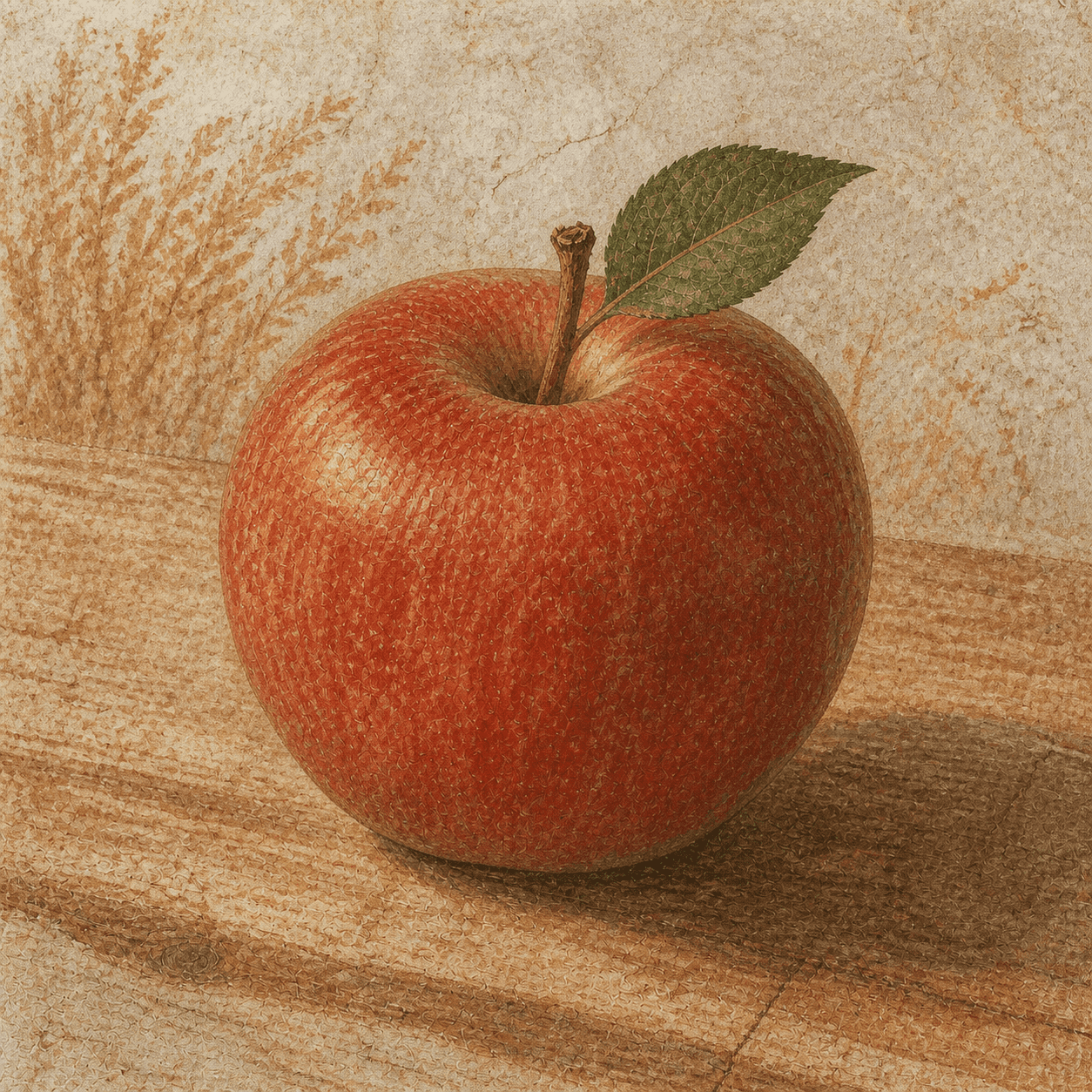
READ THE IMAGE
Begin with the surface: this apple resembles a wall marked by time
Ochres, worn texture, and credible volume suggest Roman painting, portraiture, and material surfaces. This is a teaching interpretation, not a historical replica.
- 01
See controlled volume
The apple has weight and light without becoming flawless; Roman portraits likewise negotiate individual traits and ideal form.
- 02
Read a wall-like skin
Cracks, mottling, and thin colour layers make the image feel attached to plaster rather than floating in digital space.
- 03
Read the earth palette
Red ochre, warm grey, olive, and dark brown evoke mineral colour organised through broad zones and small marks.
- 04
Ask what realism is doing
Shadow anchors the apple while contour and highlight are deliberately clarified; credibility is never neutral recording.
In one sentence
Not an epilogue to Greek art—
but a visual system for imperial society
Roman art absorbed Greek, Etruscan, Egyptian, and provincial traditions, then recombined them for new tasks: portraits preserved family and civic identity; historical relief built public memory; imperial images carried political order; paintings transformed interiors; concrete, arches, and domes reshaped urban experience. ‘Roman style’ is therefore plural, changing with republic, empire, region, patron, and use.
VISUAL LANGUAGE
Visual DNA
Portrait
Verism and idealisation
Narrative
History as public memory
Relief uses procession, depth, identity, and symbol to organise war, ritual, and rule into legible stories.Space
Walls can appear to open
Second Style painting projects illusionistic architecture, while later styles restore flatness and ornament.Architecture
Engineering becomes experience
Concrete, arch, vault, dome, and axis join vast interiors, infrastructure, and civic life.Circulation
Copies, variants, local hybrids
Imperial types travel widely yet combine with regional dress, material, and belief.Where it came from
Rome's power lay in rearranging what it absorbed
Conquest brought artists, works, and ideas; imperial routes circulated images at scale. Roman art could broadcast rule with striking consistency while remaining locally varied in homes, tombs, and provinces.
Republican faces perform civic experience
Ancestor images and veristic portraits turn age and wrinkles into evidence of public service as Greek art floods Rome after conquest.
Augustus builds an imperial visual program
Idealised portraits, the peace altar, and urban projects join military victory, mythical ancestry, and ordered peace.
Domestic painting invents multiple spaces
The four styles preserved at Pompeii and Herculaneum move from simulated masonry to illusionistic architecture and refined flat ornament.
Empire and Late Antiquity recast body and centre
Provincial traditions and new religions develop as portraits and reliefs become more frontal, abstracted, and transcendent.
ARTISTS & WORKS
Meet it through four works
Republican portrait of a man
Deep wrinkles and bone structure turn age into proof of experience, discipline, and civic duty.Augustus of Primaporta
Youthful face, Classical pose, mythic cuirass, and bare feet construct a military victor carrying divine order.Ara Pacis
Portrait procession, mythic panels, and abundant plants weave dynasty, state, prosperity, and ritual together.Pantheon
An immense unreinforced concrete dome, continuous wall, and oculus make engineering, geometry, and moving daylight an interior cosmos.How to recognise it
Ask who it addresses and where it was seen
- ✓Does a portrait stress age and biography, or use an ideal body to create timeless authority?
- ✓Does relief organise real people, ritual, war, and myth into a political narrative?
- ✓Do arch, dome, concrete, and axis structure public space at vast scale?
- ✓Are Greek forms recombined with local dress, materials, religions, or funerary traditions?
STYLE RELATIONS
From the Classical world toward Late Antiquity
Ancient Greek Art
Makes proportion, weight, movement, and idealised naturalism enduring formal questions.↗Ancient Roman Art
Turns multiple traditions toward identity, history, urban space, and imperial circulation.CURRENTByzantine Art
Further subordinates Classical naturalism to frontal, golden, icon-based transcendence.↗REFERENCES
Sources & image note
The apple combines earth colour, worn wall-like surface, and natural volume as a contemporary teaching interpretation. It belongs to no single Pompeian style and cannot represent all Roman art.