
Classical Art
Ancient Greek Art
From geometric order to ideal bodies and dramatic emotion, Greek art repeatedly asked how form could be both credible and proportioned.
READ THE IMAGE
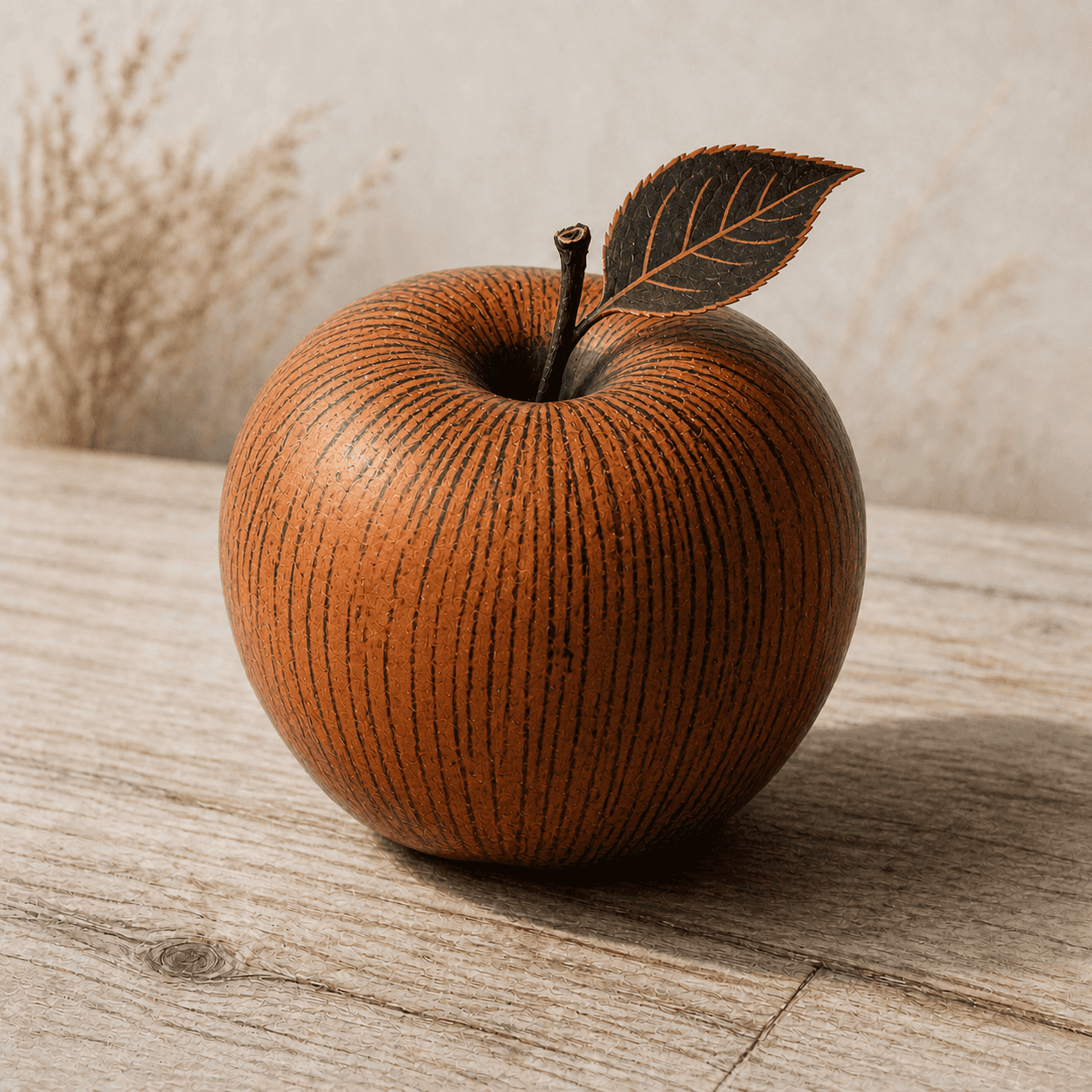
Terracotta surface and sculptural volume meet in one apple
This teaching image combines terracotta, dark drawn lines, and naturalistic volume. It borrows several Greek cues without corresponding to one period or object.
- 01
Read terracotta and dark line
Orange-brown ground and fine dark marks recall the fired black-red relationship of Attic pottery.
- 02
See line explain volume
Curving vertical marks follow the surface much as vase painters used drawing for anatomy, drapery, and action.
- 03
Test proportion and balance
The contour is nearly symmetrical, while leaf, stem, and shadow create a living shift within stability.
- 04
Naturalism is not photography
Light and weight feel credible, but the form is clarified and balanced—closer to idealised nature than a random snapshot.
In one sentence
Not one ‘white statue style’—
but eight centuries of experiments in form
Ancient Greek art spans Geometric, Archaic, Classical, and Hellenistic periods across cities and colonies. In temples, sanctuaries, tombs, athletics, and daily vessels, artists studied bodily proportion, weight shift, motion, narrative, and space. The familiar image of white marble is incomplete: much sculpture was painted, countless bronzes were lost, and pottery preserves extensive images of myth and life.
VISUAL LANGUAGE
Visual DNA
Form
Proportioned, legible
Pose
Motion within balance
Classical bodies shift weight to remain stable yet potentially active.Narrative
Myth on daily objects
Gesture, attributes, and composition tell stories across vessel surfaces.Material
Paint, clay, bronze, marble
Colour and metallic sheen were once integral; pure white is not the original condition.Change
From restraint to drama
Hellenistic works expand torsion, expression, age, and multidirectional space.Where it came from
Each generation redefined what ‘human’ could look like
The Greek world was never one continuous unified state. City-states, workshops, and Mediterranean exchange drove change, while Egyptian and Near Eastern traditions informed early Greek form.
Geometric art orders the surface
Meanders, horizontal bands, and schematic figures create tightly patterned pottery.
Archaic artists build monumental bodies
Kouroi and korai increasingly study anatomy and proportion while retaining frontality and the Archaic smile.
Classical art balances ideal and observation
Weight shift, proportion, and credible movement become central, alongside temples and civic monuments.
Hellenistic art widens emotion and space
Post-Alexander kingdoms encourage dramatic action, varied age and identity, and multidirectional composition.
ARTISTS & WORKS
Meet it through four works
Amphora with Achilles and Ajax Playing a Game
Exekias uses black silhouette, incision, and quiet symmetry to pause two warriors between battles.Doryphoros
Polykleitos embodies Classical proportion and weight shift; the lost bronze survives through Roman copies.Parthenon sculptures
Architecture, myth, and Athenian civic identity join in a continuous, originally coloured sculptural program.Laocoön Group
Twisting bodies, deep carving, and pain turn Hellenistic drama into a multidirectional encounter.How to recognise it
Identify the period before saying ‘Greek style’
- ✓Does form seek proportional order between clear structure and observed nature?
- ✓Does pose suggest action through weight shift and rotation rather than graphic exaggeration alone?
- ✓Does pottery use black-figure, red-figure, or bands to narrate myth and life?
- ✓Is the work closer to Geometric order, Archaic frontality, Classical balance, or Hellenistic drama?
STYLE RELATIONS
Distinguishing neighbouring classical traditions
Ancient Egyptian Art
Centres sacred function, wholeness, composite viewpoint, and hierarchy.↗Ancient Greek Art
Sustains inquiry into proportion, weight, movement, and idealised naturalism.CURRENTAncient Roman Art
Adapts and copies Greek forms while expanding portrait identity, history, and imperial engineering.↗REFERENCES
Sources & image note
The apple combines pottery colour, drawn line, and Classical volume as a contemporary teaching interpretation. Greek art must be read by region, period, material, and use.