
Classical Art
Ancient Egyptian Art
Images do not capture one glance; they fix a subject in its clearest, most ordered, and most enduring form.
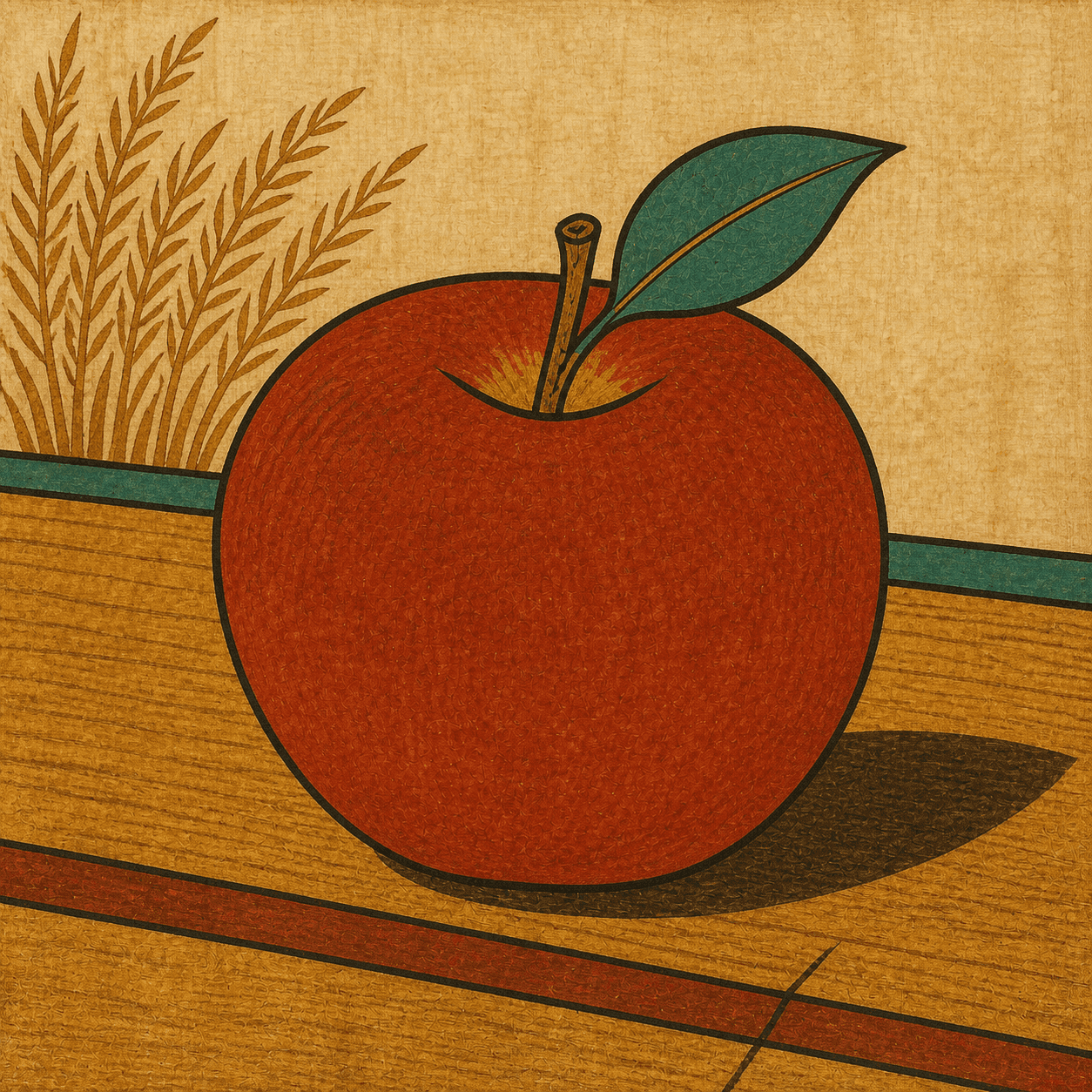
READ THE IMAGE
This is not failed perspective, but another kind of completeness
This teaching image uses flat colour, heavy contour, horizontal zones, and emblematic plants to suggest Egyptian pictorial organisation. Historical works are far more complex.
- 01
Follow the contour
Apple and leaf are enclosed by continuous dark edges, preserving clarity and recognition.
- 02
Read the flat colour
Red ochre, yellow earth, and blue-green occupy bounded areas with little modelling.
- 03
See horizontal levels
Table, decorative bands, and background stack like registers used to organise historical narratives.
- 04
Find the most informative view
The leaf reads in profile while the tabletop approaches a view from above; viewpoints combine to clarify information.
In one sentence
Not recording a passing glance—
but making images work for eternity
Ancient Egyptian art spans more than three millennia across architecture, sculpture, relief, painting, objects, and writing. Images in temples and tombs were bound to ritual, kingship, memory, and afterlife, so they emphasised order, wholeness, and recognition. Two-dimensional figures combine profile heads and legs with frontal eyes and shoulders; scale can signal status, and registers organise action. This is a functional visual grammar, not an inability to draw realistically.
VISUAL LANGUAGE
Visual DNA
Contour
Clear, closed
Viewpoint
Composite, informative
Each part appears from its clearest angle before joining the whole.Scale
Hierarchical
Size may express status and sacred importance, not only distance.Structure
Registers and grids
Horizontal bands order scenes; proportional grids regulate bodies.Word-image
Interdependent
Hieroglyphs, names, titles, and pictures complete meaning together.Where it came from
Stability is order repeatedly remade—not stagnation
Core conventions emerged early and endured because images were believed to act within ritual and afterlife. Yet dynasties, regions, and materials produced change; the Amarna period is a striking exception.
The Narmer Palette establishes key conventions
Registers, hierarchical scale, royal regalia, and victory poses appear together and persist for millennia.
The Old Kingdom builds a classical system
Pyramid complexes, idealised royal figures, tomb reliefs, and proportional grids become systematic.
The New Kingdom expands temple and tomb imagery
Imperial resources support colossal building, painted tombs, royal monuments, and vivid scenes of life.
Amarna briefly rewrites the rules
Akhenaten's reign favours elongated, softer, and more intimate royal images before many conventions return.
ARTISTS & WORKS
Meet it through four works
Palette of Narmer
An early synthesis of kingship, order, composite view, and ritual construction rather than simple reportage.Step Pyramid complex of Djoser
Unites royal burial, ritual space, and stone technology as monumental permanence.Paintings from the Tomb of Nebamun
Join formal convention with banquets, hunting, and observed nature—far from uniformly rigid imagery.Gold Mask of Tutankhamun
Combines royal likeness, divine emblems, precious materials, and protective function.How to recognise it
Remember: wholeness, hierarchy, function
- ✓Do contour and flat colour keep forms clearly recognisable?
- ✓Do body parts or objects combine several informative viewpoints?
- ✓Do size and position indicate status rather than perspective alone?
- ✓Do text, gesture, dress, and objects serve ritual, kingship, or afterlife?
STYLE RELATIONS
Different image logics around the ancient Mediterranean
Ancient Egyptian Art
Centres function, enduring order, composite viewpoint, and hierarchical scale.CURRENTAncient Greek Art
Develops sustained inquiry into bodily proportion, movement, and idealised naturalism.↗Ancient Roman Art
Adapts Greek traditions while expanding portraiture, historical narrative, engineering, and imperial communication.↗REFERENCES
Sources & image note
The apple is a contemporary teaching interpretation using flat colour, contour, and registers. It is not an Egyptian object and cannot stand in for architecture, sculpture, writing, or ritual function.