
Painting Media
Gouache
Gouache moves with water, but unlike transparent watercolour it does not chiefly borrow luminosity from bare paper. High pigment loading and often white or filler scatter light at the paint surface, producing matte, revisable colour fields that can cover—while remaining re-soluble and shifting in value as they dry.
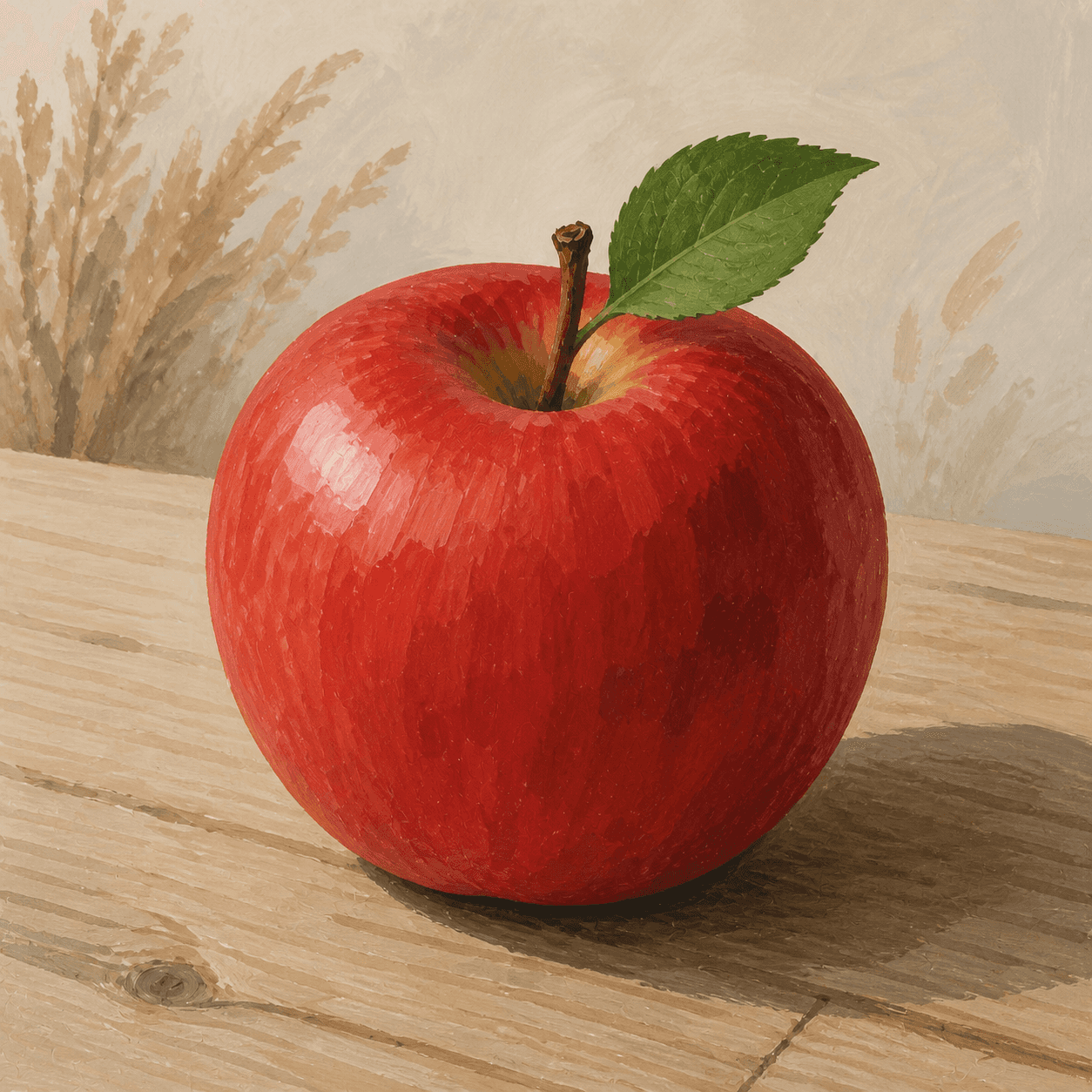
READ THE IMAGE
See the apple first as mutually covering planes, then return light on top of the matte surface
Ground, table, and fruit are adjacent or overlapping painted areas rather than a sequence of transparent washes. Pale orange and pink-white can sit directly over red; cool violet and brown-red construct shadow without depending on paper white.
- 01
See highlight cover darkness
Pale pink and cream repaint the red base, retaining short bristle marks along their edges.
- 02
See dense matte colour
Red, orange, and blue-grey dry to low-reflectance surfaces whose hue stays legible from varied angles.
- 03
See planes joined and corrected
Leaf, fruit, and background are built as discrete areas whose contours can be cut clean by a later layer.
- 04
See the wet-to-dry shift
Dark mixtures often dry lighter and pale ones may deepen slightly, so shadow and highlight need a dry check.
In one sentence
Give water-based colour covering power—
and revise from dark to light in matte layers
Gouache is often described as opaque watercolour. It shares water and soluble binders with transparent watercolour, but gains hiding power through greater pigment loading and commonly white pigment or filler. Light scatters primarily at a rough paint surface instead of travelling through a thin film to bounce from paper, so colour appears even, subdued in sheen, and easy to reproduce photographically. Traditional bodycolour, designers' gouache, and modern opaque watercolour overlap, yet their recipes do not all contain white in the same way.
VISUAL LANGUAGE
Cover-and-matte DNA
Plane
Mixed colour becomes shape
White
Light can be added back
Mixed white lowers transparency and chroma and lets pale colour cover a dry dark.Water
Consistency sets mark and coverage
Too thin behaves like wash; too dry drags, powders, or cracks; creamy paint commonly makes a flat field.Matte
Scatter suppresses specular glare
Even low sheen made gouache valuable for posters, publication art, animation backgrounds, and copy photography.Return
Water can wake a dry layer
A new pass may lift the ground; light placement, full drying, and little scrubbing preserve clean colour.Where it came from
Opaque water-based pigment is ancient; gouache as a modern material name formed through European bodycolour, design education, and manufactured paint
Water-based colour strengthened with white occurs across manuscript, decorative, and miniature traditions. Eighteenth-century European makers used opaque bodycolour for architecture, landscape, and fans. Manufactured zinc white, sold as Chinese white from the 1830s, expanded stable light mixing. In the twentieth century, tube colour, commercial art, and modernism gave matte planes new public languages.
Opaque aqueous painting crosses traditions
Mineral colour, glue, white grounds, and fine handling serve manuscripts, court painting, sacred image, and ornament.
European bodycolour serves landscape and design
Marco Ricci, Paul Sandby, and James Stuart work dark-to-light on toned paper for displayable views.
Chinese white and manufactured paint expand mixing
Zinc white, cakes, and tubes support illustration, poster, architectural rendering, and travel study.
Modern art, publishing, and animation share matte fields
Taeuber-Arp's geometry, design originals, and Matisse's cut-outs carry gouache from intimate sheet to environment.
ARTISTS & WORKS
Meet it through four makers
James ‘Athenian’ Stuart
Builds monuments from dark to light on blue-grey or buff paper, joining survey record, theatrical incident, and correction.Sophie Taeuber-Arp
Translates textile grid, geometric rhythm, and opaque flat paint into a lucid order for modern abstraction.Henri Matisse
Has assistants coat paper in gouache, then turns continuous colour into movable, rearrangeable form with scissors.Mary Blair
Develops modern animation concepts and children's publishing through forceful fields, simplified space, and temperature contrast.How to recognise it
Do not stop at bright colour; test whether coverage, sheen, edge, and reactivation belong to one material logic
- ✓Can pale colour genuinely cover dark rather than merely reveal paper or use digital lightening?
- ✓Are broad areas evenly matte while retaining some stroke and paper relief?
- ✓Do correction and overlap show soluble layers lifting, mixing, or being covered again?
- ✓Do shadow and highlight account for drying shift instead of freezing every wet value?
STYLE RELATIONS
Three covering paint systems
Gouache
Water-soluble, reactivatable, matte, and covering, often with a marked drying shift.CURRENTTransparent Watercolour
Depends on paper light and glazing; pale colour generally cannot cover a dark.↗Acrylic Painting
Forms an acrylic-polymer film, usually water-resistant when dry, and can be transparent or opaque.↗REFERENCES
Sources & image note
The apple is a contemporary gouache teaching interpretation concentrating matte coverage, joined flat fields, pale-over-dark paint, and dry-brush correction. A screen cannot reproduce real surface scatter, powdering risk, or wet-to-dry value change.