
Painting Media
Watercolour
Watercolour brightness often comes not from white paint but from light passing through transparent colour and reflecting off paper. Water load, sizing, drying moment, and pigment behaviour decide whether an edge stays crisp, blooms, or deposits a tide line.
READ THE IMAGE
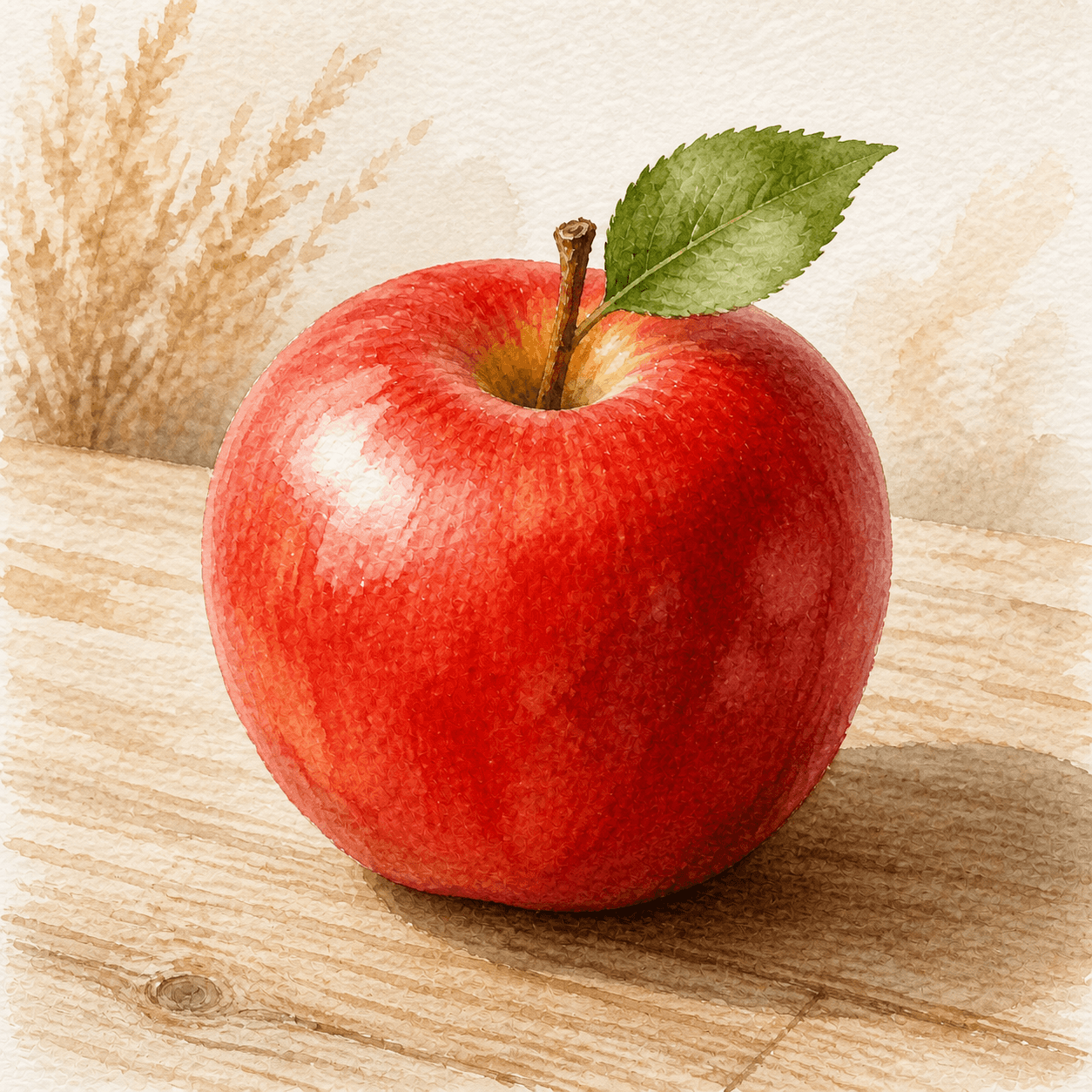
The apple's light is not painted white; the paper had to be saved there from the first wash
Several transparent warm reds build the fruit, edges stay crisp on dry paper and soften toward a wet ground, cool glaze deepens shadow, and paper tooth plus tide marks keep colour breathing.
- 01
Let paper white carry the brightest light
Highlight and leaf veins use untouched support or lifted colour, so luminosity comes from beneath.
- 02
Match edge to moisture
Fruit contour is firmer on dry paper while colours meeting in a wet background diffuse and back-run.
- 03
Mix through transparent layers
Red, orange, and cool violet glaze rather than becoming one heavy brown-black mixture.
- 04
Read deposit and paper tooth
Moving water carries pigment into hollows and tide edges, making grain part of skin.
In one sentence
Move transparent pigment with water—
and let paper white, flow, and drying jointly make light
Watercolour generally combines pigment with a binder such as gum arabic and is diluted for use on paper, vellum, or another support. As water evaporates, binder fixes pigment. Transparent colour may remain thin enough for paper to shine, or grow dense and mix with white as bodycolour or gouache. The medium is not uniformly pale; it makes negotiation among water, pigment, support, and time visible.
VISUAL LANGUAGE
Water-and-paper DNA
White
Paper stores light in advance
Water
Flow decides edge
Moisture gradients control diffusion, bloom, deposit, and mixing speed.Paper
Sizing and tooth change behaviour
Hot press is fine, cold press moderate, rough granular; sizing slows immediate fibre absorption.Layer
Glaze after drying
Transparent passes deepen hue and value; excessive reworking muddies colour and damages paper.Lift
Subtraction recovers light
Blotting wet paint, gentle washing, or scraping can brighten but cannot infinitely restore support.Where it came from
Water-based pigment crosses cultures and uses; Britain only later framed transparent watercolour as a named national art
Water-based painting is ancient. European medieval artists illuminated manuscripts and coloured maps; Renaissance makers used it for nature study, design, and portrait miniature. In eighteenth-century Britain, tinted topography developed into independent painting as improved paper, dry cakes, and portable boxes enabled a celebrated golden age.
Water-based pigment serves image and text
Cultures use water-mixed colour on paper, wall, silk, and vellum; Europe illuminates manuscripts.
Observation, design, and miniature expand
Portability and fast drying suit direct records of plant, animal, place, and dress.
British watercolour becomes independent art
Tinted topography yields to stronger colour, fluent wash, and atmosphere through Turner and Girtin.
Manufacture and global modern practice
Cakes, moist pans, metal tubes from 1846, and varied papers support fieldwork, illustration, and abstraction.
ARTISTS & WORKS
Meet it through four artists
Albrecht Dürer
Joins close transparent layers and observational line so plant, animal, and ground possess scientific precision and life.J. M. W. Turner
Makes sea, mist, and light out of paper reserve, wash, blotting, and scraping.Winslow Homer
Uses direct masses, reserve, and clear wash for coastal weather, labour, and tropical brilliance.John Singer Sargent
Rapidly organises building, figure, and reflection through bold stroke, wet joining, and opaque accent.How to recognise it
Test whether transparency, edge, and tide arise from real moisture relation rather than a digital sticker
- ✓Is the brightest light reserved, masked, or lifted from paper?
- ✓Do hard edge, soft edge, and tide line match local moisture?
- ✓Does layered colour retain transparent depth rather than turn uniformly opaque and muddy?
- ✓Do grain, tooth, and deposit change with stroke and flow?
STYLE RELATIONS
Three aqueous languages
REFERENCES
Sources & image note
The apple is a contemporary watercolour teaching interpretation emphasising transparent glazing, paper-white highlight, and wet-dry edges. A screen cannot reproduce actual paper, pigment granulation, and reflected light.