
Painting Media
Graphite Sketch
Graphite drawing uses no lead: its core combines plate-like carbon crystals with clay. A point makes exact line and the side lays tone; particles accumulate across paper tooth and produce a distinctive silvery reflection under raking light.
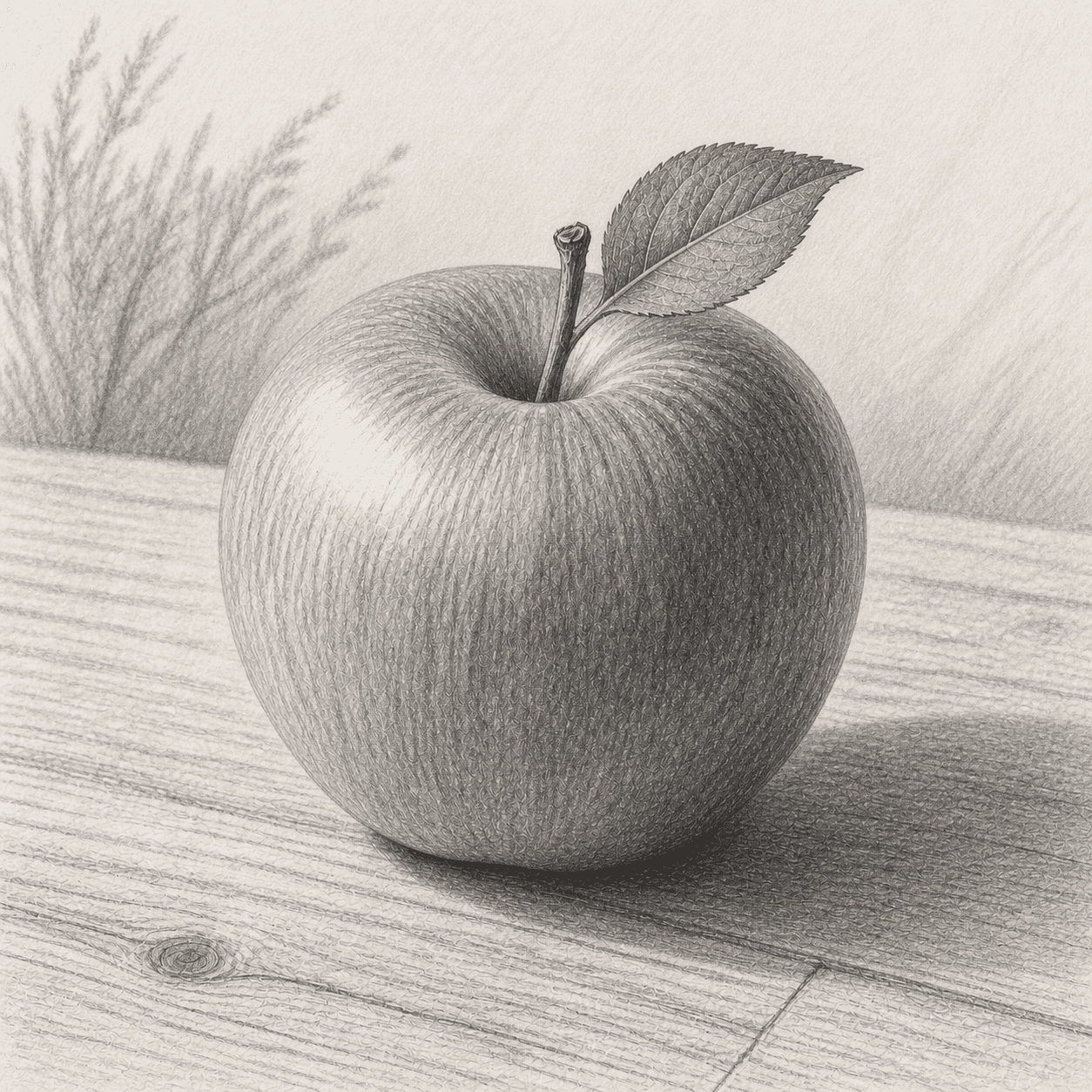
READ THE IMAGE
Find structure with line, wrap hatching around the apple, then recover light from grey with an eraser
Contour only sets a boundary; spacing, direction, and number of layers create volume. Curved hatches turn around the belly, crossing tightens shadow, marks flatten across the tabletop, and highlight saves paper or lifts it with kneaded eraser.
- 01
Let line wrap form
Short arcs turn around the fruit rather than imposing one diagonal hatch everywhere.
- 02
Build value through density
More layers, closer spacing, and softer grades deepen shadow while paper tooth and direction remain legible.
- 03
Lose and find edges
The lit contour stays clear while the dark side can weaken into cast shadow and surrounding space.
- 04
Let lifting retain material trace
Skin highlight comes from reserve or gently removed graphite, not a digital white overlay.
In one sentence
Distribute reflective carbon platelets across paper tooth—
and model volume through additive hatch and subtractive lift
Graphite is a crystalline form of carbon whose plate-like particles readily slide and adhere to paper or vellum. Modern pencils adjust hardness through graphite-clay proportion: more graphite generally makes a softer, darker core, more clay a harder, paler one. A heavily worked layer can burnish into metallic grey instead of growing indefinitely black, so paper tooth, pressure, and point shape matter as much as grade.
VISUAL LANGUAGE
Line, value, and paper DNA
Line
Direction explains structure
Density
Spacing controls value
Parallel and crossed layers darken gradually while preserving gesture and air.Paper
Tooth catches particles
Smooth sheet supports detail; rough tooth breaks and sparkles tone; hard burnishing fills texture.Stump
Blending rewrites surface
A paper stump unifies tone, but finger oil contaminates support and excess rubbing removes structure.Lift
Eraser is a drawing tool
Kneaded eraser dabs soft light; firmer edges can cut a sharp reflection or correction.Where it came from
Natural graphite moved from a rare sixteenth-century mineral to Conté's graphite-clay recipe and a graded modern drawing system
High-purity graphite from Borrowdale, England, was cut into strips and wrapped in string or held in a porte-crayon; Central Europe also used graphite for drawing in the sixteenth century. Restricted supply prompted substitutes. In the 1790s Nicolas-Jacques Conté mixed powdered graphite with clay, extruded and fired it, establishing the wood-cased pencil familiar today.
Natural graphite enters European drawing
Soft pure Borrowdale sticks make fluent silver-grey marks but remain a scarce resource.
Wood casing and holders improve portability
Graphite separates from black chalk and metalpoint in travel record, design, and precise portraiture.
Conté establishes an adjustable core
Graphite-clay proportion, firing, and a wood case make hardness and mass production controllable.
Grades connect art, education, and industry
H–B systems serve academy, drafting, comics, and autonomous paper works; mechanical and powdered forms extend use.
ARTISTS & WORKS
Meet it through four artists
Jean-Auguste-Dominique Ingres
Controls portrait proportion with a hard fine point and slight tone, keeping dress and face largely free of massed smudge.Thomas Gainsborough
Rapidly organises trees through soft graphite, stump, and wash, leaving paper tooth and movement in landscape.Georges Seurat
Lets dark Conté-like media grain over rough paper so untouched light releases figure and lamp from darkness.Vija Celmins
Rebuilds ocean, night sky, and web in very slow graphite layers, making reproduced image contend with handmade time.How to recognise it
Judge grain, burnish, and modelling line—not every greyscale filter as a pencil drawing
- ✓Do grade, pressure, spacing, and layers construct value?
- ✓Does heavy grey show graphite's oblique silver sheen rather than charcoal's deep matte black?
- ✓Does paper tooth interrupt particles, with physical stump and eraser edges intact?
- ✓Does hatch direction explain form, space, and action instead of coating the whole image uniformly?
STYLE RELATIONS
Three black-and-grey drawing media
REFERENCES
Sources & image note
The apple is a contemporary graphite teaching interpretation showing form hatch, crossed dark, broken paper tooth, and erased light. Screen grey cannot accurately reproduce the original's oblique silver sheen, indentation, or loose particles.