
Illustration
Hyperrealistic Illustration
It does not stop at looking photographic; it recombines focus, texture, and reflection that one photograph cannot hold into an over-clear reality.
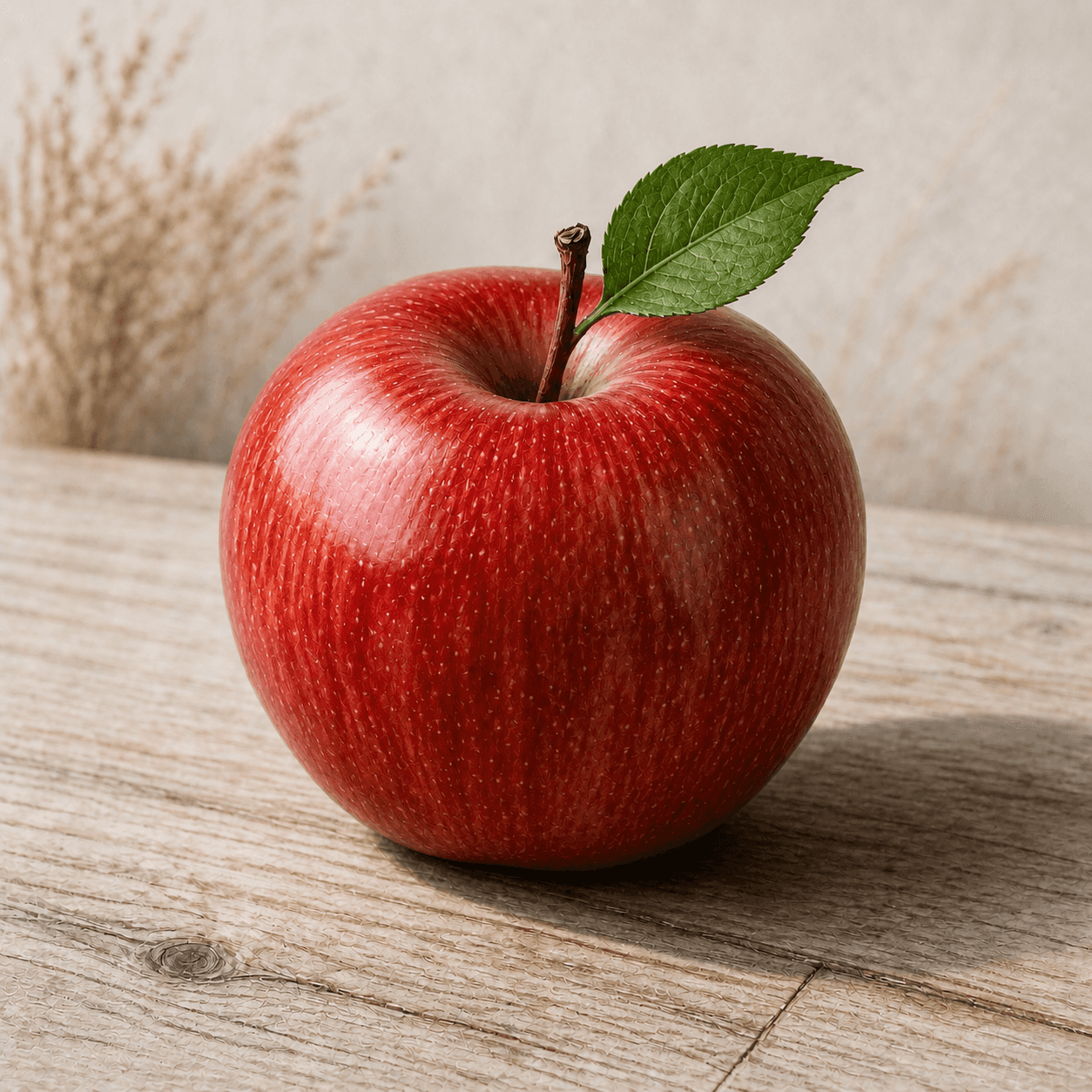
READ THE IMAGE
Ask first why it is clearer than ordinary sight
Skin specks, veins, stem fibres, and timber all retain high resolution while focus is redistributed across depth. Hyperrealism is not detail count but designed extraordinary seeing.
- 01
Measure microdetail
Every skin mark remains stable beyond the time and attention of casual sight.
- 02
Read controlled reflection
Highlight edge, colour bleed, and reflected darks explain curvature beyond a white spot.
- 03
Notice extended focus
Apple, leaf, and table remain clear as if several focus distances were combined.
- 04
Find intensified reality
Colour, sharpness, and cleanliness are heightened so the object feels more complete and consumable than life.
In one sentence
Use photographs as evidence—
to build a reality more concentrated than one photograph
Hyperrealistic illustration constructs material, reflection, tiny imperfection, and optical depth from photography, 3D, or observation. It shares photographic reference with late-1960s Photorealism, while commercial and digital work often combines focus, removes accident, and intensifies clarity. The result is not neutral reality but highly edited visual evidence.
VISUAL LANGUAGE
Over-clarity DNA
Detail
Dense, multi-scale
Focus
Extended, composite
Several distances remain clear beyond single-shot depth of field.Optics
Reflection, refraction, scattering
Material gains credibility through complete light behaviour.Surface
Precise, imperfect
Specks, scratches, and fibres avoid empty plastic smoothness.Edit
Intensified, cleaned
Reality is selectively heightened for product or narrative priority.Where it came from
From Photorealist painting to digital multi-source synthesis
Photography freed painters from copying reality but posed another question: what happens when a photograph is enlarged, projected, and repainted? Digital tools later carried this reconstruction into illustration and commerce.
Photorealism takes shape
Artists in New York and California use photographs as primary references for near-microscopic verisimilitude.
Reflection and surface become tests
Windows, cars, gumball machines, and faces expose how photography cuts and mediates reality.
Digital painting meets 3D
Scanning, layers, texture maps, and high-resolution rendering expand commercial realism.
Composite reality becomes normal
Advertising and concept art combine photos, 3D, and drawing into impossible but convincing scenes.
ARTISTS & WORKS
Meet it through four makers
Richard Estes
Combines city photographs so glass reflections and all-over focus exceed one lens.Audrey Flack
Connects photographic precision, symbolic still life, and gendered experience through jewels and reflection.Chuck Close
Enlarges portrait photographs into gridded surfaces, exposing image structure within accuracy.Sharon Core
Builds real sets to photograph paintings, reversing which medium imitates which.How to recognise it
Do not count details alone; test how the image exceeds the lens
- ✓Does microdetail stay consistent across several scales?
- ✓Do focus, reflection, and perspective suggest multiple references?
- ✓Do imperfections reinforce material rather than add random noise?
- ✓Does extraordinary clarity serve a product, knowledge, or psychological effect?
STYLE RELATIONS
Three relations to realistic intensity
REFERENCES
Sources & image note
The apple is a contemporary teaching interpretation stressing microdetail, extended focus, and exact reflection. It borrows Photorealist questions but is not a historical movement work.