
Painting Media
Impasto
Impasto is not a roughness filter. Paint physically rises from the support: ridges and peaks catch frontal light, cast micro-shadows, and alter colour as the viewing angle changes. It is both a painting method and a low relief whose support, drying, and conservation must bear real structure.
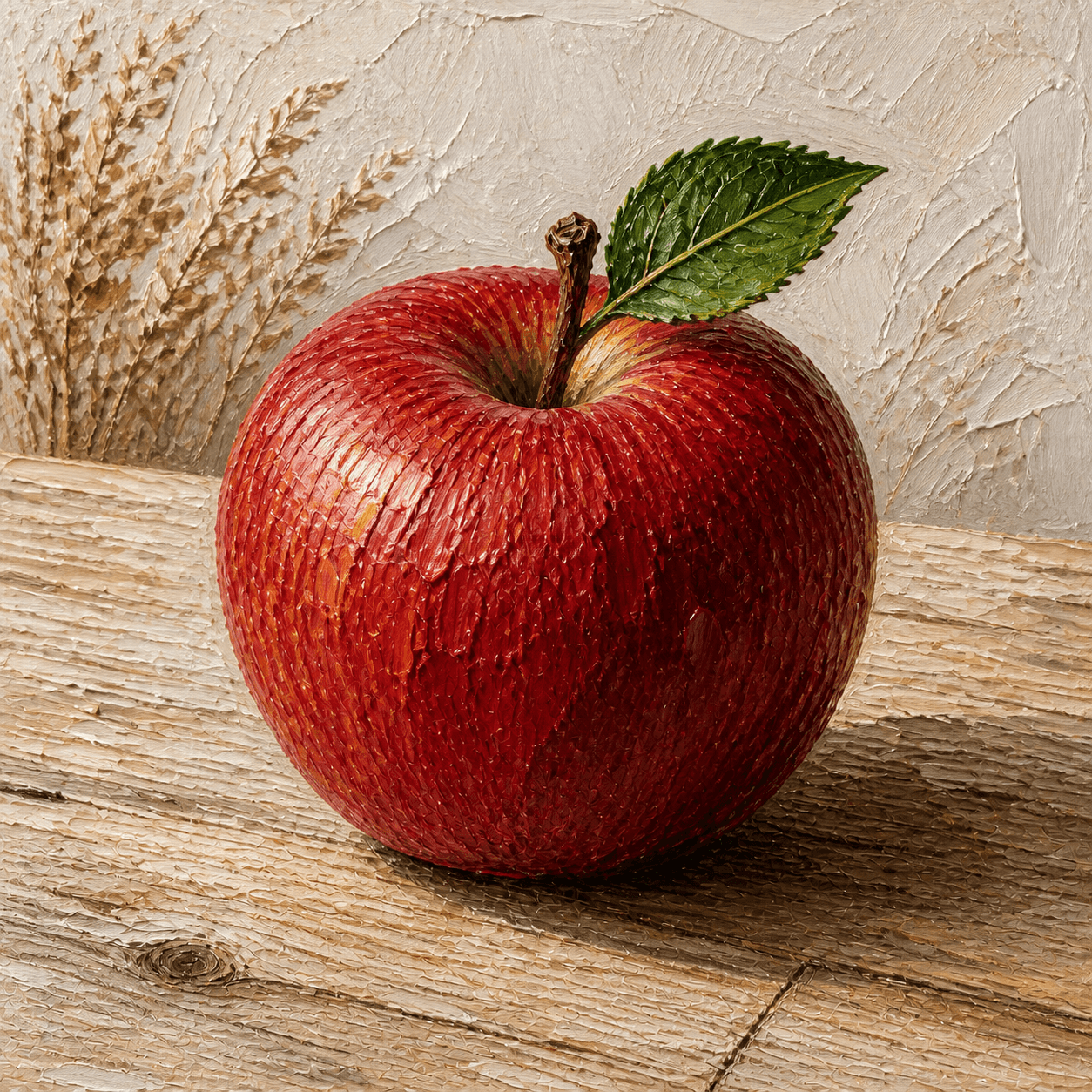
READ THE IMAGE
Light on the apple is not only depicted by colour; every raised passage physically intercepts it
Short thick orange-white ridges cross the lit red, cooler lower marks align in shadow, a knife edge changes the silhouette, and long tabletop pulls direct gravity and space laterally.
- 01
See ridges catch raking light
A highlight peak brightens on one side and casts a thin shadow on the other; moving light changes the contrast.
- 02
Make thickness serve function
Focus and light rise highest while shadow and ground subside, avoiding uniform inflation.
- 03
Distinguish knife from brush
A knife leaves flat crests, sharp margins, and grooves; a stiff brush leaves bundled ridges.
- 04
Let the underlayer speak through gaps
Fresh body does not homogenise the ground; earlier colour flashes between peaks and troughs.
In one sentence
Turn paint from image into terrain—
and compose with real thickness, tool pressure, and raking light
Impasto, from Italian, names paint thick enough to preserve tool marks. It belongs to no single style: Rembrandt used raised lead white to evoke metal and skin light, Van Gogh drove sky and plant through directional ridges, and modern artists treat paint as plastic matter. Stability depends on binder, pigment, filler, medium, ground flexibility, and drying. Arbitrary excess oil, solvent, or non-paint material can create structural failure.
VISUAL LANGUAGE
Paint-terrain DNA
Peak
Height directly modulates light
Direction
Tool travel remains visible
Ridges wrap form, knife cuts plane, and speed plus pressure becomes compositional rhythm.Break
Body can layer without mixing
Dry brush or knife touches only high points, keeping colours adjacent instead of homogenised.Body
Formula must hold relief
Heavy paint, compatible gel, or high-volume pigment retains peaks; too little binder powders.Time
Touch-dry is not cured inside
Thick oil may remain soft and wrinkle; deep acrylic also needs internal water migration.Where it came from
From selective post-Renaissance relief through Rembrandt's material light and Van Gogh's moving ridge to the painting-sculpture boundary
Earlier European oil painting often favoured smooth layers with selected highlights; sixteenth-century Venetian painters enlarged visible handling. Rembrandt and peers selectively raised light. Nineteenth-century tubes and direct outdoor practice made body more accessible, and Van Gogh directionalised each stroke. Twentieth-century gels, aggregate, and tools expanded relief again.
Visible body opens smooth painting
Late Titian and peers let scumble and raised stroke participate in colour at viewing distance.
Selective relief evokes matter and light
Rembrandt raises chain, cloth, and facial highlight against thin darkness.
Manufactured paint supports direct ridge
Tubes and plein-air work reduce preparation; Van Gogh assigns motion and feeling to thick direction.
Surface becomes subject
From Expressionism to matter painting, knife, squeegee, extrusion, and polymer gel move painting toward relief.
ARTISTS & WORKS
Meet it through four artists
Rembrandt
Sets raised lead-white light against thin dark so chain, cloth, and skin carry actual weight.Vincent van Gogh
Organises field, cypress, and sky through aligned ridges, making surface rhythm equal spatial movement.Chaim Soutine
Combines dense wet colour, torqueing strokes, and altered contour to make still life and landscape bodily.Frank Auerbach
Scrapes and repaints until compressed strata retain the time of seeing and revision.How to recognise it
Real impasto must survive raking-light and structural tests; it is not one uniform bump map
- ✓Does relief vary with tool, form, and focus rather than coat the image evenly?
- ✓Under raking light, do highlights and shadows correspond to actual height?
- ✓Do adjacent colours retain physical sequence on crest, groove, and broken stroke?
- ✓Do edge, wrinkle, crack, and support load follow material and drying logic?
STYLE RELATIONS
Three painted-surface strategies
REFERENCES
Sources & image note
The apple is a contemporary impasto teaching interpretation emphasising short ridges, knife facets, broken undercolour, and micro-shadow. A flat screen cannot reproduce true height, weight, shifting shadow, or the no-touch condition of paint peaks.