
3D Art
Isometric
Isometric view projects a three-dimensional object onto a flat picture without making distance smaller. Three principal axes stay parallel and scale-consistent, making space feel measurable, stable, and deliberately unlike a camera.
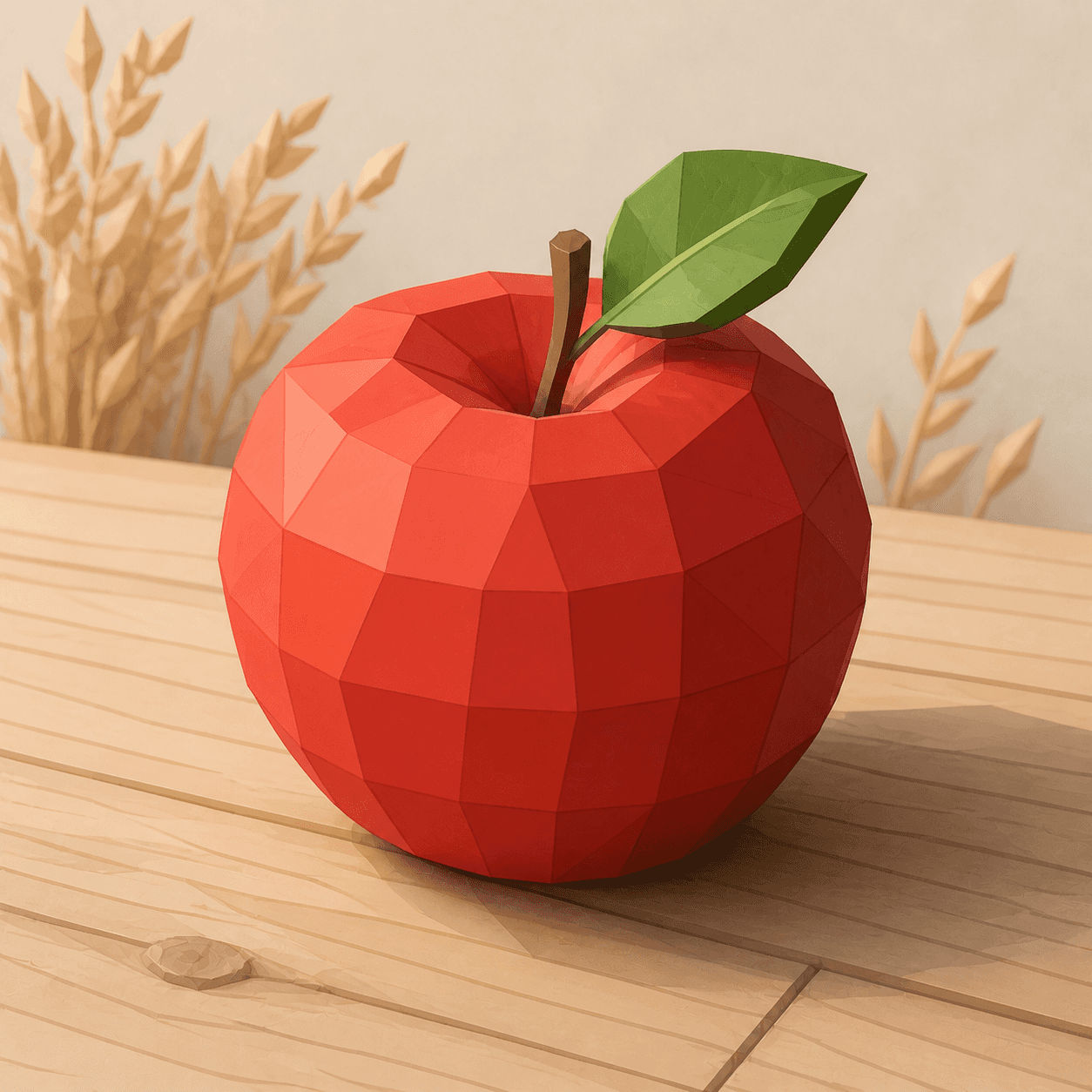
READ THE IMAGE
The apple sits inside a spatial grid that never vanishes
The tabletop's receding edges do not converge on a vanishing point, and apple and leaf obey the same directional system. Equal modules remain equal near and far, so the scene reads like a model that could be counted cell by cell.
- 01
Keep parallel lines from converging
Table edges, ground divisions, and major leaf directions stay parallel; this is not lens-like perspective.
- 02
Reuse one three-axis system
A vertical and two diagonal axes recur. Every new object should join the same directional grammar.
- 03
Keep scale across distance
Equal blocks do not shrink in the depth of the image; occlusion, layers, and value carry depth instead.
- 04
Let clarity outrank realism
Clean boundaries, colour planes, and countable modules serve reading rather than optical foreshortening.
In one sentence
Project three-dimensional form along fixed parallel axes—
and exchange optical realism for readable, constant scale
Isometric belongs to axonometric projection: it has no vanishing point and does not make parallel edges meet in the distance. In strict isometric projection, all three coordinate axes share the same foreshortening. In design practice, vertical is commonly drawn upright and the two horizontal axes near 30°, often called an isometric drawing. It is not camera space, but a graphic system that deliberately preserves direction and scale rules.
VISUAL LANGUAGE
Axonometric-space DNA
Axis
Directions come before objects
Parallel
Recession never vanishes
Like edges do not converge to a horizon; top and two side faces can be read together.Scale
Distance keeps one measure
Repeated modules do not shrink by location, so complex scenes remain comparable.Layer
Use overlap and value for depth
Order comes from occlusion, shadow, colour zoning, and height rather than perspective shortening.Grid
Modules make space legible
Buildings, furniture, roads, and objects become a coherent system of shared directions.Where it came from
Born from the measuring needs of technical drawing, it moved through architectural explanation and game maps into a graphic language for clear complex space
Axonometric views served mechanics, architecture, and technical explanation: several faces could be read in one image without the drastic distance change of perspective. Twentieth-century games and maps used this stability for navigable space. Digital design later turned it into a graphic language for icons, infographics, and miniature worlds.
Engineering drawing becomes systematic
Axonometric and isometric drawings make multi-faced objects legible in one 2D explanation.
Technical illustration broadens
Catalogues, maps, and teaching diagrams organise parts, buildings, and processes with parallel axes.
Games make axonometry playable
A stable oblique view supports movement, grid strategy, and readable scene occlusion.
Digital illustration reclaims miniature worlds
Interfaces, infographics, and brand images use modules, colour zones, and non-vanishing space for order.
ARTISTS & WORKS
Meet it through four cases
Engineering isometric
Shows top and side faces together on common axes so an assembly relationship can be understood.SimCity 2000
Its stable diagonal city grid makes roads, buildings, and hierarchy quickly legible.Monument Valley
Combines isometric-like framing, colour planes, and impossible space so rotating paths becomes the puzzle.Isometric infographic
Breaks factory, city, or process into aligned modules, using space to organise complex information.How to recognise it
Find the stable three-axis system first, then test whether distance truly avoids perspective shortening
- ✓Do building, table, and object edges in the same direction remain parallel?
- ✓Do repeated units retain the same width and height ratio in the distance?
- ✓Does the image use overlap, value, and layers rather than vanishing points for depth?
- ✓Do added elements obey the existing axes instead of rotating freely and breaking the grid?
STYLE RELATIONS
Three ways to organise space
Isometric
Parallel axes and constant scale make 3D relations comparable; no vanishing point.CURRENTLinear Perspective
Parallel lines meet at vanishing points and distant forms shrink to simulate a viewing position.↗Low Poly
Concerns mesh facets and normals; it may use an isometric camera or any other view.↗REFERENCES
Sources & image note
The apple is a contemporary teaching interpretation using isometric-style axes, no vanishing point, and constant module scale. It is an accessible drawing convention, not a strict engineering projection for measurement; curves, surfaces, and local light are simplified for visual study.