
Modern Art
Land Art
Moving work from the white cube into land, weather, and geological time: site becomes material, scale, and co-author.
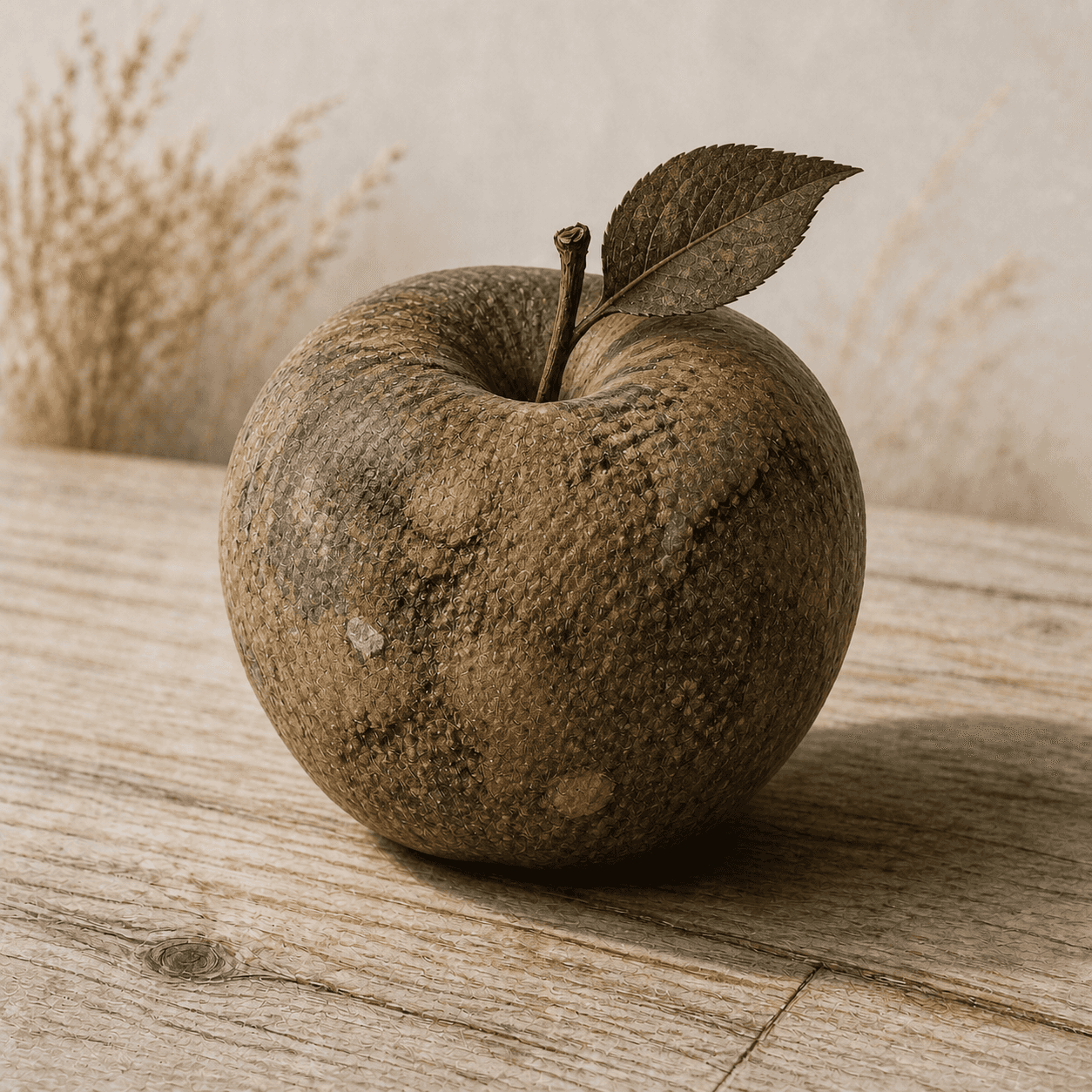
READ THE IMAGE
A stone-like apple can cue material, but cannot replace a site
This teaching image turns skin into earth and rock. Actual Land art usually asks for walking, weather, and duration. The issue is how a work changes land and is changed by it—not a natural palette.
- 01
Ask where matter comes from
When soil, rock, and branches are real, extraction, transport, and return become part of the work.
- 02
Translate scale
Enlarge a tabletop apple to a lakeshore or canyon and looking becomes walking, distance, and bodily measure.
- 03
Read erosion and change
Cracks, deposits, salt, and dead leaves suggest weathering; completion is not a fixed endpoint.
- 04
Ask whose land
Every site already has ecology, ownership, and Indigenous history. ‘Empty wilderness’ is never a blank canvas.
In one sentence
Not styling nature—
but admitting site and time into the work
Land art links to Conceptualism and Minimalism in the 1960s and 1970s. Artists excavated, piled, walked, and arranged natural material, or carried samples, maps, photographs, and films into galleries. Works range from subtle temporary traces to permanent alterations made with heavy machinery. Today they must also be read through ecological impact, stewardship, land ownership, and Indigenous histories.
VISUAL LANGUAGE
Method DNA
Site
Specific, irreplaceable
Material
Earth, rock, water, plant
Natural matter keeps weight, smell, change, and provenance.Scale
Footprint to landform
Both slight arrangements and thousand-ton projects occur.Time
Erosion, season, entropy
Flooding, salt, weather, and growth keep rewriting the work.Document
Map, photograph, film
Remote or temporary sites enter public memory through media.Where it came from
Leaving the gallery without leaving institutions or politics
Artists resisted portable, saleable objects and carried Minimalist scale and Conceptual documentation into quarries, urban margins, and western landscapes. Yet remote projects still depended on money, machinery, photography, and institutions, while supposedly empty land involved existing communities and environmental costs.
Earth Works
Dwan Gallery in New York presents models, plans, and documents for projects too large or remote to enter the room.
Double Negative is excavated
Michael Heizer cuts two immense trenches across a Nevada mesa, composing with removed volume.
Spiral Jetty
Smithson pushes basalt and earth into Great Salt Lake, where water level and salt repeatedly hide and reveal it.
Sun Tunnels align with the sky
Nancy Holt's four concrete cylinders frame solstice sunrises and sunsets, connecting desert, cosmos, and viewer.
ARTISTS & WORKS
Meet it through four artists
Robert Smithson
Used site/non-site, entropy, geology, and mediated documents to think through changing terrain.Nancy Holt
Used tunnels, apertures, light, and astronomy to orient bodies toward land and sky.Ana Mendieta
Temporarily pressed bodily silhouettes into mud, sand, fire, and plants, linking migration, gender, and belonging.Richard Long
Made walking, tracks, and site-made stone circles into works of travel, measure, and slight intervention.How to recognise it
Read site, process, and document together
- ✓Does a work depend on one site's geology, climate, route, or celestial event?
- ✓Are earth, stone, water, and plants actual matter rather than natural-looking decoration?
- ✓Do erosion, growth, flooding, or seasons participate in change?
- ✓Are photographs, maps, and films records of a site, or another layer of the work?
STYLE RELATIONS
Different centres of land-based practice
REFERENCES
Sources & image note
The apple offers only a close material cue; it cannot simulate site scale, walking, or land politics. Land art should be read across object, document, stewardship, and specific place.