
South Asian Art
Madhubani
Madhubani painting is more broadly called Mithila painting. It is not a portable ethnic pattern but a tradition developed by women across north Bihar and Nepal's Terai on domestic walls and floors for weddings, festivals, and household worship. After the move to marketable paper, artists also addressed caste, migration, illness, and women's experience.
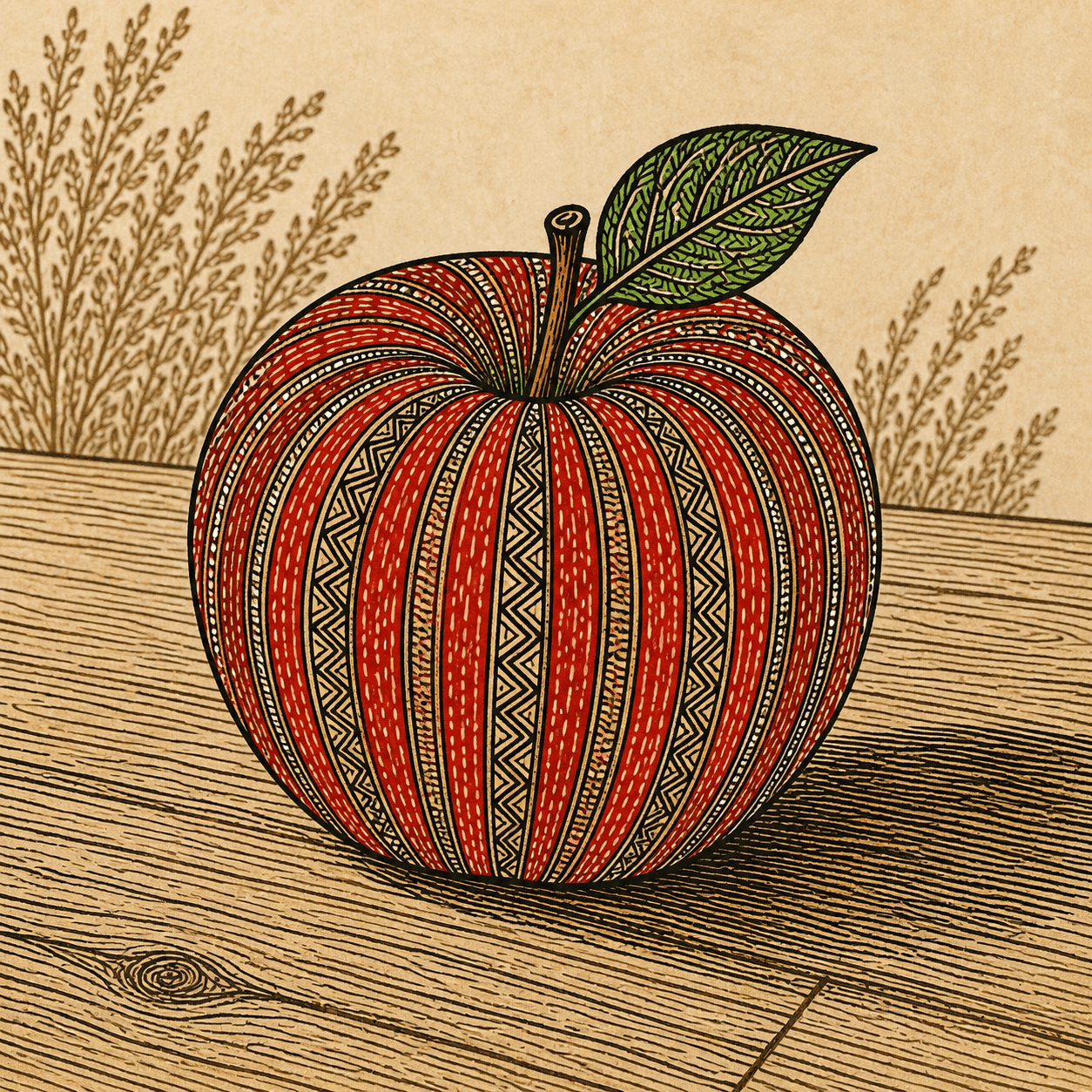
READ THE IMAGE
See how line turns a surface into ritual order before merely checking whether every void is filled
Double contour, radial bands, zigzag, hatch, and patterned leaf evoke Mithila paper painting. The apple is not a central bridal emblem and lacks communal making or ritual placement.
- 01
See double line build a fillable boundary
Fruit, leaf, and stem close in heavy paired contours whose gaps receive dots or hatch. Line divides colour and becomes a decorative band itself.
- 02
See repetition replace tonal modelling
Red bands, zigzags, and dotted rows radiate from the cavity to imply roundness without continuous light and shade; direction and rhythm make volume.
- 03
See intervals acquire relation
Leaf interior fills with curls and each fruit band changes texture. All-over density is not a mechanical fear of blankness but a way symbols and boundaries interlock.
- 04
See black line equalise near and far
Table grain, shadow, branches, and fruit all receive forceful line while scale and red maintain emphasis. A ritual wall need not use atmospheric perspective for one focus.
In one sentence
Not a generic double-line pattern—
but a changing tradition of Mithila domestic ritual, women's knowledge, and paper art market
Mithila women have long painted bridal rooms, household shrines, exterior walls, and courtyard floors. Wedding kohbar combines lotus, bamboo, fish, turtle, parrot, sun, moon, and deities around fertility, lineage, longevity, and conjugal blessing; senior women often draw, kin and neighbours assist, and girls learn nearby. Caste communities developed saturated bharni, linear kachni, tantric icons, and Dalit women's godna tattoo and gobar-earth vocabularies, with boundaries continually changing. After drought in the 1960s, government and handicraft programmes encouraged wall imagery on saleable paper. Portability brought signatures and income while transforming scale, subject, material, and power.
VISUAL LANGUAGE
Visual DNA
Double line
Contour becomes a patterned band
Fill
Repetition constructs density
Crosshatch, wave, zigzag, dot, and scale change by zone, distinguishing forms while holding surface continuity.Symbol
Bridal imagery cultivates fertility and relation
Lotus and female principle, bamboo and lineage, fish and fecundity, turtle and longevity must be read within rite.Material
Wall, floor, and paper demand different acts
Mud plaster, dung, rice paste, soot, plant colour, poster paint, and ink alter absorption, duration, and saleability.Author
Communal women's knowledge becomes signed practice
Paper enables artists such as Sita Devi and Ganga Devi to gain individual reputations while the market changes whose styles become visible.Where it came from
From household wall-floor ritual through drought-era paper transition to public voices of women, Dalit artists, and contemporary issues
Calling Mithila painting timeless hides decisive change. No firm historical evidence proves the popular origin legend at Sita's wedding; what can be tracked are specific communities, twentieth-century documentation, policy intervention, and artists' innovation.
Wall and floor painting inhabit family rite
Women make kohbar, deity images, and aripan for wedding, initiation, and Chhath; designs pass through family observation, song, and collaboration.
Earthquake survey brings murals into outside records
The 1934 Bihar earthquake exposes paintings in collapsed houses; British officer William Archer photographs and publishes them, prompting new urban classifications.
Drought accelerates commercial paper painting
Government worker Bhaskar Kulkarni encourages women to paint paper for non-agricultural income; Ranti, Jitwarpur, and other villages become centres.
More communities and personal subjects enter
Dalit women develop godna and gobar languages and men join production; artists record election, forest protection, migration, AIDS, cancer, and gender violence.
ARTISTS & WORKS
Meet the transformation through four artists
Mahasundari Devi, Auspicious Kohbar Diagram
Central lotus, vertical stalk, sun, moon, fish, birds, and marriage emblems move from wall to paper while retaining bridal fertility metaphor.Sita Devi's bharni deity paintings
Saturated red, yellow, and blue with forceful contour bring Durga, Krishna, and other deities forward; signed success makes paper a source of women's income and status.Ganga Devi, Cancer Series
The artist places American treatment, hospital machinery, pain, and bodily experience inside kachni line and narrative frame, making inherited grammar carry private modern trauma.Jamuna Devi's gobar/godna painting
A Dalit artist uses earth-brown ground, tattoo-like line, plants, animals, and daily labour to challenge upper-caste visibility and make material and community part of the subject.How to recognise it
Judge region, rite, community, and medium—not only double line and crowded pattern
- ✓From which Indian or Nepali Mithila village, community, and named artist does it come, and is bharni, kachni, tantric, or godna attribution evidenced?
- ✓How do lotus, bamboo, fish, turtle, sun-moon, and deity combine in marriage, worship, or personal narrative instead of serving as loose decoration?
- ✓Was it mud-wall mural, aripan floor drawing, or market paper painting, and how did support change scale, duration, and authorship?
- ✓Does dense fill show hand rhythm and zonal variation, or has a digital filter mechanically patterned an arbitrary object?
STYLE RELATIONS
Household rite, princely court, and modern public mural need separate histories
Madhubani
Moves from Mithila bridal rooms and floors to signed paper art, changing through women's knowledge, community pattern, and contemporary narrative.CURRENTRajasthani Miniature
Is patronised by multiple princely courts and organises epic, devotion, ragamala, hunt, and court identity on paper.↗Mexican Muralism
Addresses urban publics through modern public buildings, revolutionary politics, and monumental narrative under different institutions and scale.↗REFERENCES
Sources & image note
Double line, radial bands, red-black palette, and dense fill borrow a Mithila paper-painting surface. The apple has no kohbar rite, community attribution, or personal narrative and cannot substitute for an actual work.