
South Asian Art
Rajasthani Miniature
Rajasthani miniature is not one uniform ‘princely style.’ Mewar, Marwar, Bundi, Kota, Bikaner, Jaipur, and Kishangarh each sustained courts, ateliers, and visual accents; epic, devotion, musical mood, monsoon, and hunt form distinct emotional worlds through intense fields of colour.
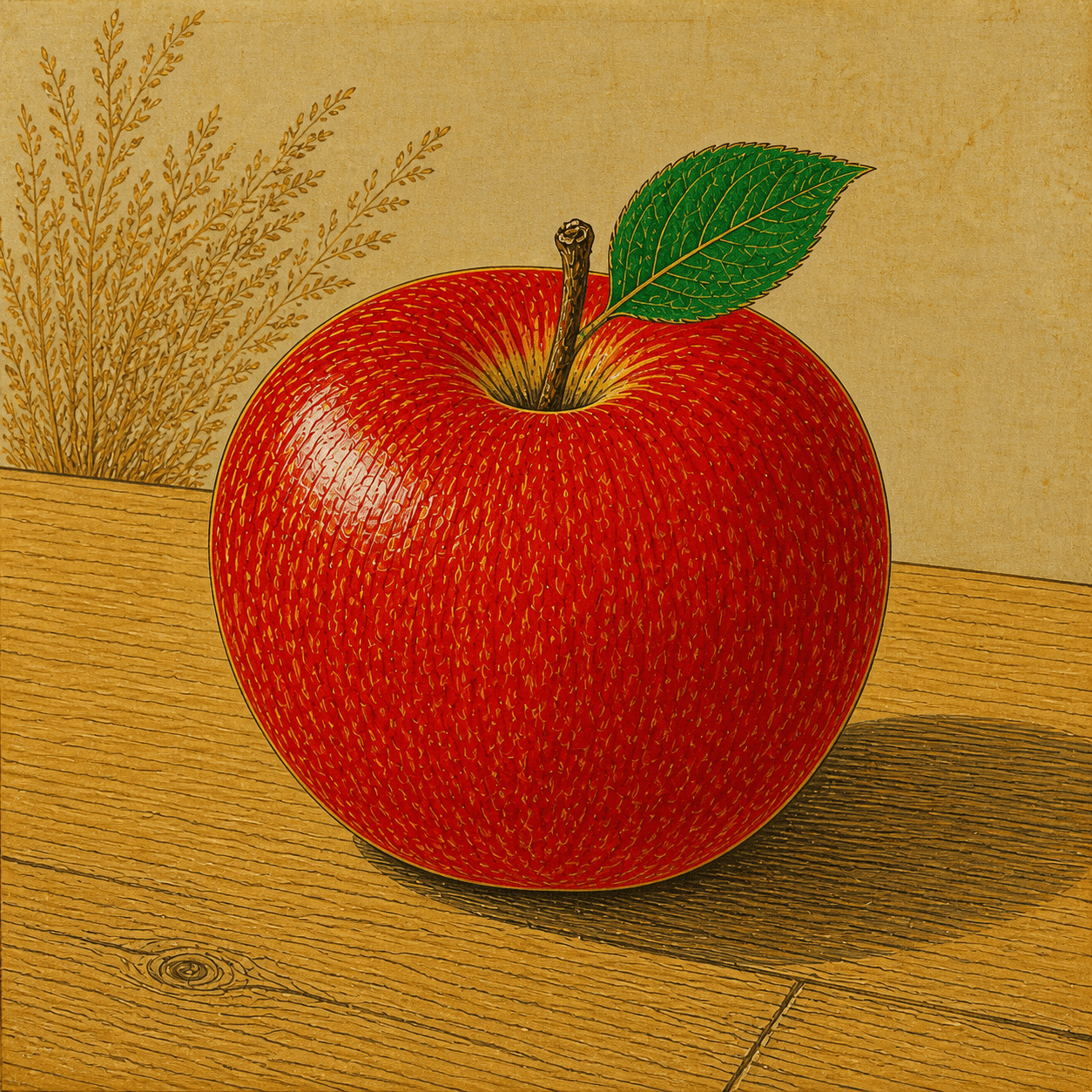
READ THE IMAGE
Read red, green, and gold as emotional intensity before asking whether they look as natural as Mughal study
Saturated vermilion, emerald leaf, hard contour, and dense gold hatch suggest early Rajput colour. The isolated still life lacks verse, human relation, and seasonal narrative.
- 01
See red establish emotion before volume
Most of the fruit stays incandescent vermilion while gold strokes vibrate above it. Colour creates heat and rank before limited shading explains roundness.
- 02
See contour press form to the foreground
Black line tightens continuously around fruit and leaf, bringing the subject close like a cut silhouette and keeping narrative legible against vivid grounds.
- 03
See emerald resist atmospheric fading
Nearly pure green confronts red without greying by distance. Different Rajasthani schools use opposed colour fields to express season, desire, or divine appearance.
- 04
See shadow become patterned action
The long dark at right fills with repeated hatch, more a sign of movement or night than a strictly measured optical result.
In one sentence
Not one regional manner—
but many Rajput courts using image to cultivate devotion, poetry, kingship, and local identity
Rajasthani miniature conveniently groups several princely traditions in present-day Rajasthan and nearby regions. Early works inherit forceful line, frontality, and saturation from western Indian Jain manuscripts; from the sixteenth and seventeenth centuries they selectively absorb Mughal portrait, space, nature, and material technique. Courts respond differently: Mewar favours bright epic and dynastic chronicle; Bundi–Kota excel in humid landscape, elephant combat, and predator hunt; Bikaner grows delicate through Mughal and Deccani ties; Kishangarh elongates figures to convert Krishna–Radha love into courtly devotion. Those differences cannot be flattened into one recipe.
VISUAL LANGUAGE
Visual DNA
Colour field
Saturation organises feeling directly
Poetry-image
Sound, season, and desire become visible
Ragamala personifies music, baramasa maps months through weather and lovers, and devotional poetry links divine and human love.Multiple view
Palace, garden, and wild ground unfold together
Aerial courtyard and profile figure coexist so relation and action stay visible beyond one vanishing point.Locality
Each court develops an accent
Face, cloud, building, tree, palette, and subject follow atelier, marriage, war, and painter movement.Kingship
Hunt and festival turn land into rule
Enlarged ruler, mount, fort, and procession both record and idealise, binding terrain to dynasty.Where it came from
From western Indian manuscript language and Rajput devotion to conscious court differentiation after Mughal exchange
These kingdoms fought the Mughals but also allied, intermarried, and served them. Exchange is not a tale of tradition being contaminated; artists, gifts, booty, and politics continually reordered visual resources.
Western Indian manuscript meets early Rajput language
Hard line, bright field, and compressed space from Gujarat Jain codices enter Malwa, Mewar, and related centres while epic and ragamala widen subjects.
Mewar, Bundi, and Kota establish court ateliers
Nasruddin paints ragamala at Chawand; Bundi fuses vivid plane with Mughal space, and after separation Kota develops dramatic elephant combat and hunts.
Mobile Mughal painters accelerate a golden age
As imperial patronage contracts, artists reach Bikaner, Jaipur, Jodhpur, and other courts, where fine technique meets local religion and dynasty.
Kishangarh, Nathdwara, and late courts expand
Nihal Chand idealises Savant Singh and singer Bani Thani as Krishna and Radha while pilgrimage icons, festival scrolls, and large court chronicles continue.
ARTISTS & WORKS
Meet it through four courtly languages
Nasruddin, Sorathi Ragini
A heroine in forceful profile and saturated colour inhabits a Chawand garden as verse and mode become person through waiting, gesture, and season.Mewar Bhagavata Purana, Krishna Lifts Mount Govardhan
Krishna shelters dense cattle and villagers beneath the mountain; red, yellow, and green zones make a huge crowd legible in episodes.Kota Royal Tiger Hunt
Elephant-borne ruler, tiger, hunters, and curling forest form a diagonal vortex; abundant landscape dramatises danger, valour, and territorial command.Nihal Chand, Bani Thani
Arched brow, lotus eye, pointed nose, and elongated profile turn a historical singer into a Radha ideal through Savant Singh's Krishna devotion and courtly love.How to recognise it
Name the court and series before invoking a generic ‘Rajasthani style’
- ✓Is it Mewar, Marwar, Bikaner, Bundi, Kota, Jaipur, or Kishangarh, and do face, cloud, tree, building, and palette support that attribution?
- ✓Which Ramayana, ragamala, baramasa, Krishna cycle, or dynastic chronicle did it belong to, and what poetry disappears from a detached leaf?
- ✓How do plane, exaggerated scale, and multiple view express devotion or drama rather than failure to understand perspective?
- ✓What was selectively absorbed from Mughal portrait, natural observation, or European topographic view, and what was refused?
STYLE RELATIONS
Imperial archive, regional court, and village ritual painting are not substitutes
Rajasthani Miniature
Across princely states, uses epic, devotion, music, season, and hunt to build local feeling and kingship.CURRENTMughal Miniature
Develops individual portrait, natural observation, chronicle, and ranked album through a central imperial atelier.↗Madhubani
Comes from Mithila household and ritual wall-to-paper traditions with different makers, uses, and image grammar.↗REFERENCES
Sources & image note
Saturated red-green, forceful contour, and gold hatch evoke early Rajput colour intensity, but the apple has no figures, verse, court attribution, or serial context and cannot represent every Rajasthani school.