
South Asian Art
Mughal Miniature
Mughal miniature is not Persian miniature transplanted to India. It began with Persian masters and atelier structures returned by Humayun, then under Akbar, Jahangir, and Shah Jahan absorbed Indian painters, European prints, and imperial appetite for observation to picture recognisable faces, individual animals, witnessed history, and ordered power.
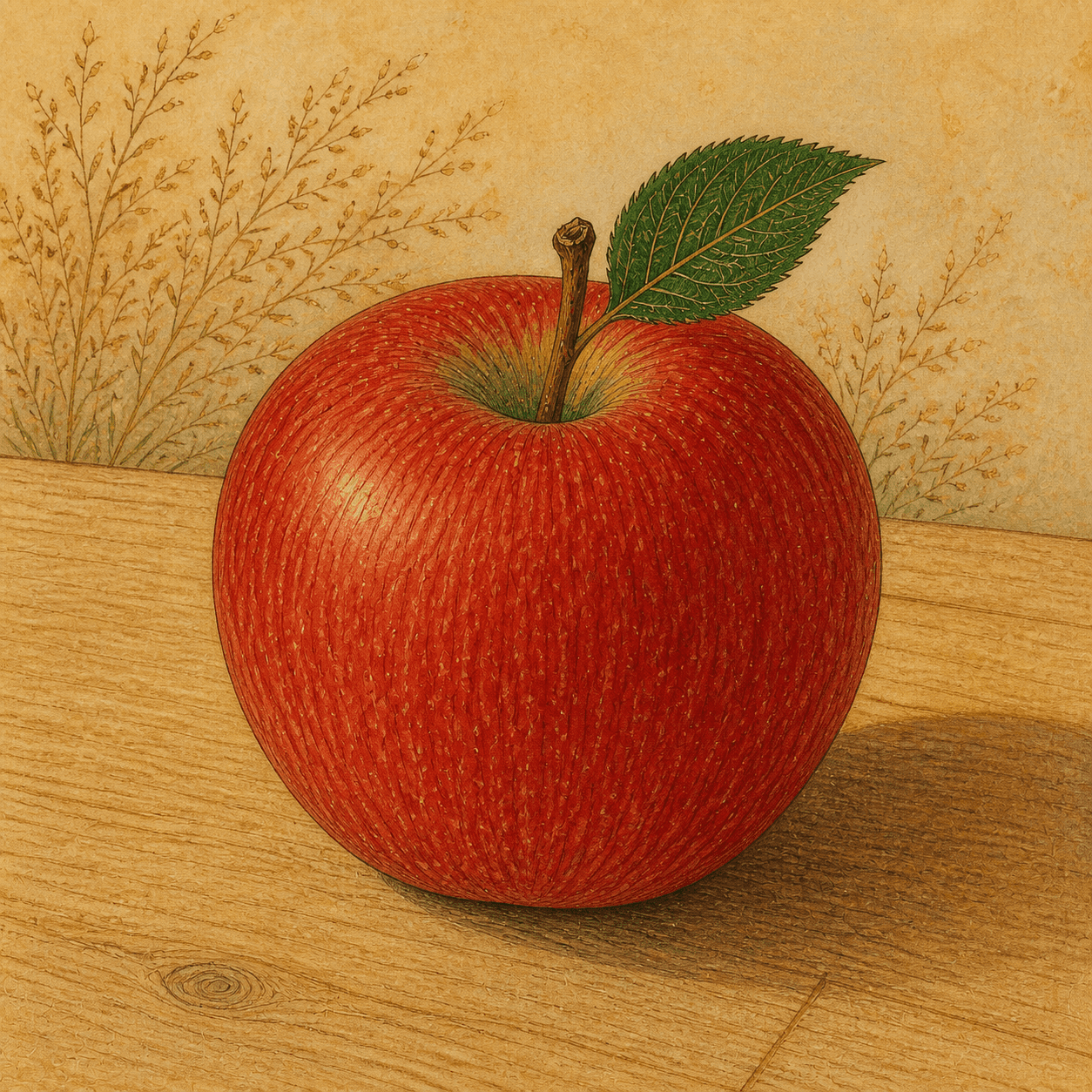
READ THE IMAGE
Compared with the previous page, see ornament retreat while the skin and weight of one apple come forward
Fine line, warm paper, and gold flecks remain, but fewer vines cover the fruit. Freckles, veins, and cast shadow evoke Mughal interest in individual and natural observation.
- 01
See fine modelling inside a clear edge
The contour stays precise while many translucent red strokes accumulate volume; light and shade retain skin particles rather than becoming one jewel field.
- 02
See the leaf identified individually
Serration, midrib, and side veins are separately drawn, making the leaf more than a symbolic green shape. Jahangiri painters often treated flora and fauna as distinct subjects.
- 03
See cast shadow locate the object
A clear shadow falls to lower right and a table diagonal marks near space. It is not strict European perspective, but weight and position matter more than in a typical Persian poetic landscape.
- 04
See prepared paper meet observed detail
Background branches still resemble an album border while the apple approaches natural-history study. Mughal albums regularly combine portrait or specimen with lavish floral margins.
In one sentence
Not an Indian branch of Persian style—
but a multiethnic empire turning atelier collaboration, record, discrimination, and power into image
Babur founded the Mughal empire in 1526. After exile at the Safavid court, his son Humayun invited Mir Sayyid ‘Ali and ‘Abd al-Samad to India. Akbar expanded the atelier, engaging scores of Indian Muslim and Hindu painters on the Hamzanama, Akbarnama, and a Persian Mahabharata; one artist might design, another colour, another paint faces. Jahangir preferred individual authorship, recognisable portraits, rare animals, and allegories, and claimed he could distinguish painters' hands. Jesuit prints supplied volume, halo, and European emblem. Here naturalism is not neutral science: it helps an emperor identify people, possess the world, and rank it.
VISUAL LANGUAGE
Visual DNA
Portrait
The face becomes a political record
Observation
Animal and plant become individual life
Feather, skin, blossom, and behaviour derive from close looking, sometimes recording diplomatic gifts or newly encountered species.Collaboration
One page can preserve several hands
Marginal notes credit designer, colourist, and portraitist; Akbar's atelier especially depended on large teams.Album
Single image and calligraphy meet in new binding
Portraits, studies, European pictures, and older Persian script are remounted in muraqqaʿ with gilded floral margins.Empire
Visible difference is made hierarchical
Audience, hunt, conquest, and allegory position the emperor through scale, halo, or axis, both recording and manufacturing order.Where it came from
From Humayun's Persian masters to Akbar's multiethnic narrative factory, Jahangir's observation, and Shah Jahan's ceremony
Mughal ‘synthesis’ is not a list of ingredients but an institution made through conquest, translation, travel, and skilled collaboration. As the imperial atelier contracted, painters moved to Rajasthan, the Punjab Hills, and Deccan courts, transforming regional painting.
Humayun returns with Safavid atelier resources
Persian masters Mir Sayyid ‘Ali and ‘Abd al-Samad enter the Mughal court, train painters for young Akbar, and launch monumental projects.
Akbar expands narrative and translation
Roughly 1,400 cloth Hamzanama images develop violent action; Akbarnama and Razmnama convert current history and Sanskrit epic into Persianate imperial knowledge.
Jahangir foregrounds author, portrait, and nature
The atelier narrows and individual style gains prestige; Mansur records turkey, zebra, and Kashmir flowers while Abu'l Hasan constructs complex imperial allegories.
Shah Jahan formalises ceremony; artists disperse
Padshahnama uses symmetry, regalia, and audience to picture perfect order; reduced patronage under Aurangzeb sends artists toward Rajput, Pahari, and other centres.
ARTISTS & WORKS
Meet it through four works
Hamzanama, Zumrud Shah Falls into a Well
An oversized cotton page packs diagonals, architecture, and violent movement as Persian design and Indian colour and physiognomy serve an oral adventure cycle.Akbarnama, Akbar Taming the Mad Elephant Hawai
Elephants charge across a collapsing bridge while crowds witness from bank and window; danger becomes a stage for courage, destiny, and observed dynastic history.Mansur, Zebra
An animal sent from Ethiopia via Turkey is recorded in profile with precise hair and hoof; Jahangir's inscription folds observation into gift exchange and imperial circulation.Bichitr, Jahangir Preferring a Sufi Shaikh to Kings
The emperor on an hourglass throne gives a book to a saint while Ottoman sultan, James I, and the painter rank below by spiritual and political order.How to recognise it
Judge individual likeness, observed subject, attributed labour, and imperial use together
- ✓Does a face, animal, or plant have individual traits rather than an ideal type, and whose archive and authority does such accuracy serve?
- ✓Do margins name painters or distinguish design, colour, and portrait labour, and did the page belong to manuscript or later album?
- ✓How are Persian script and stacking, Indian colour and bodies, and European shading or emblem reorganised rather than simply juxtaposed?
- ✓Can Akbar's team narrative, Jahangir's portrait-natural history, Shah Jahan's ceremonial order, and later regional diffusion be separated?
STYLE RELATIONS
Poetic page, imperial observation, and Rajput emotion use different mechanisms
Mughal Miniature
Develops individual portrait, natural observation, chronicle narrative, and imperial album through a multiethnic court atelier.CURRENTPersian Miniature
Provides major precedents through Persian poetry, ideal figure, stacked space, calligraphy, and binding.↗Rajasthani Miniature
Across distinct kingdoms, absorbs Mughal technique but often organises epic, devotion, season, and intense colour as emotional worlds.↗REFERENCES
Sources & image note
Fine line, layered red, observed veins, and directional shadow suggest Mughal natural history, but the apple has no atelier attribution, album margin, or historical specimen identity and is not a scientific record.