
South Asian Art
Persian Miniature
Persian miniature is not a small picture covered with Middle Eastern pattern. ‘Miniature’ conventionally points to minute workmanship, not necessarily tiny dimensions. It belongs first to books and court ateliers, narrating kingship, love, war, and mystical experience through poetry, calligraphy, illumination, and binding.
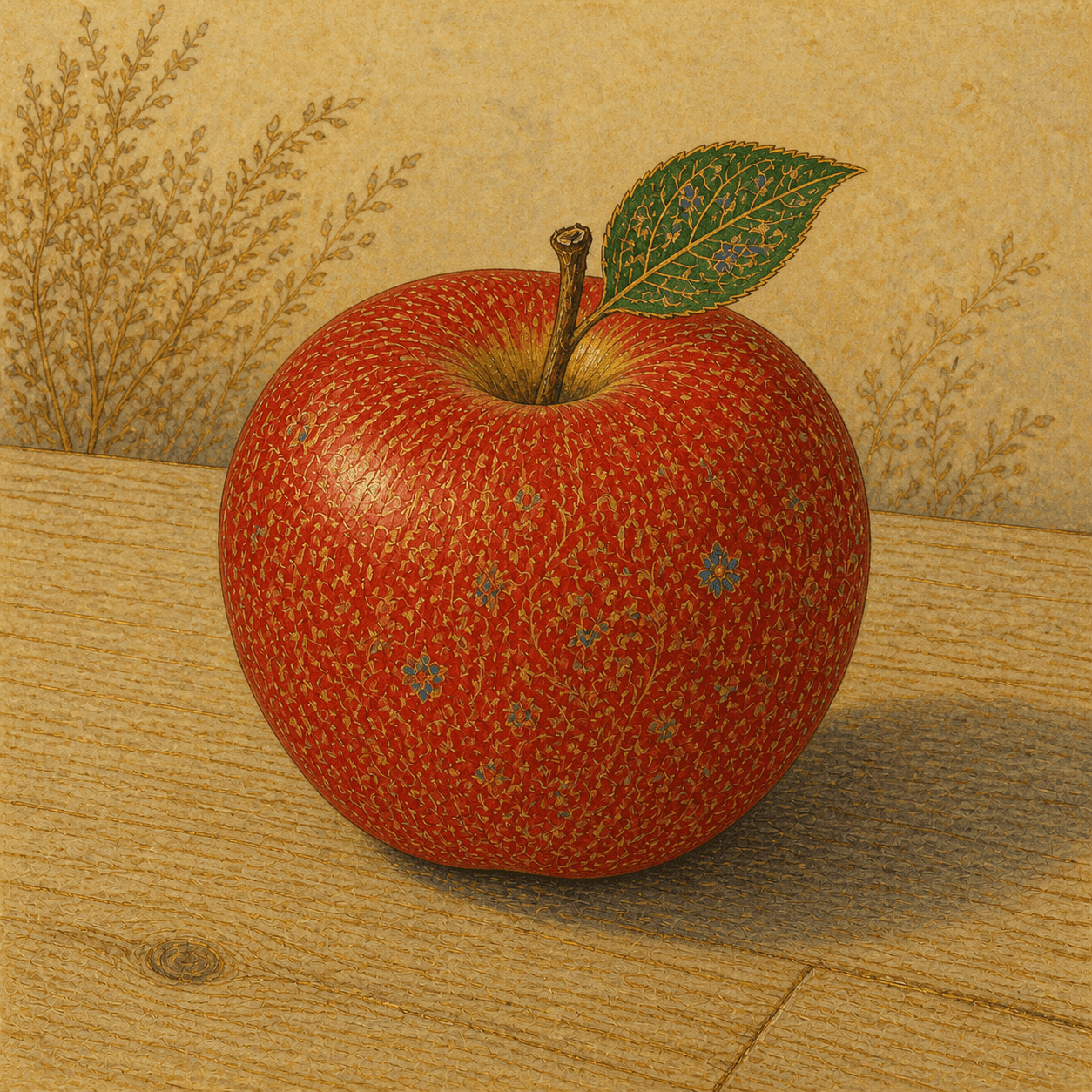
READ THE IMAGE
Imagine the apple as one crafted scene on a page, not an isolated piece of ‘oriental pattern’
Gold vine, blue florets, fine contour, and warm paper evoke manuscript craft. Without calligraphy columns, margins, narrative figures, or binding, this remains a modern exercise.
- 01
See gold build another space over colour
Fine gold vines cross red skin without vanishing under natural light. Gold does not model highlight; like illumination, it calls attention back to the page as object.
- 02
See jewel colours remain distinct
Vermilion, deep green, and ultramarine flowers keep clear identities divided by line. Colour can establish rank and rhythm without greying into one atmosphere.
- 03
See detail solicit slow, close viewing
Leaf veins, gold flecks, and petals first merge into sheen, then separate at reading distance, echoing a codex held and examined page by page.
- 04
See volume and ornament coexist
The apple retains modern still-life shading while vines stay legible across its turn. Historical painting likewise can combine spatial cue and surface order without one-point perspective.
In one sentence
Not an autonomous micro-decoration—
but Persian-language book art joining text, image, material, and courtly power
Persian painting served epic, lyric, ethical writing, and chronicle across Iran and a broader Persianate world. Pages emerged through copying, ruling, painting, gilding, trimming, and binding by several specialists; an image could nest inside text columns, break its frame, or span facing pages. Idealised figures in contemporary dress enact ancient stories, while opened buildings, rising rocks, clouds, and gardens allow several places and moments to coexist. The European collecting term ‘miniature’ can hide the primary fact that a detached painting once belonged to a complete manuscript.
VISUAL LANGUAGE
Visual DNA
Page
Painting and calligraphy choreograph reading
Stacking
Space rises rather than recedes
Slope, chamber, and figure climb the sheet while multiple viewpoints make more of an event visible.Finish
Opaque colour and precious metal make density
Mineral and plant pigment, fine brush, burnished gold, and prepared paper sustain close inspection of textile, rock, and flora.Narrative
One page can extend a moment
Text selects a turning point while gesture, scale, and repeated settings enlarge its duration beyond a frozen instant.Exchange
Iranian language absorbs foreign form
After Mongol conquest, Chinese cloud, rock, dragon, phoenix, and paper arts recombine with Iranian poetry, building, and dress.Where it came from
From Ilkhanid cross-cultural experiment through Herat refinement to Safavid monumental books and album pages
Persian painting was never one immutable national style. Patronage centres shifted, artists were moved, and manuscripts circulated as diplomatic gifts and war booty, giving Tabriz, Shiraz, Herat, Qazvin, and Isfahan distinct accents.
Ilkhanid ateliers recombine China and Iran
Jami‘ al-Tawarikh and the Great Mongol Shahnama join Chinese cloud-rock, Mongol dress, West Asian narrative, and occasional Western composition at new emotional scale.
Timurid Herat refines the courtly book
Baysunghur's atelier gathers master calligraphers, painters, and binders; Bihzad advances narrative through complex architecture, crowd action, and psychological detail.
Safavid Tabriz reaches a lavish peak
The Shahnama of Shah Tahmasp takes about twenty years and two generations to produce 258 paintings, joining Turkmen energy to Herat finish.
Patronage turns toward albums and single figures
As courts move to Qazvin and Isfahan, Riza ‘Abbasi and others use elongated figures and open grounds for albums; manuscript production does not disappear at once.
ARTISTS & WORKS
Meet it through four manuscript pages
Great Mongol Shahnama, The Funeral of Isfandiyar
Horizontal mourners, violent gesture, and Chinese-inflected ink landscape make an ancient hero's death palpable as collective grief at the Ilkhanid court.Baysunghur Shahnama, Gulnar Sees Ardashir
Palace, garden, textile, and figure rise in layers as calligraphy and painting hold exceptional order across a large page, epitomising Herat teamwork.Bihzad, The Seduction of Yusuf
Seven doors and polychrome architecture become a moral maze; tiny protagonists occupy its narrative centre while Sa‘di's text frames the image.Sultan Muhammad, The Court of Gayumars
People, animals, rocks, and plants gather as a luminous cosmos; the king centres authority without governing through one-point perspective.How to recognise it
Return a leaf to its text, atelier, city, and binding before judging
- ✓How do calligraphy columns, heading, gold ruling, and painting divide a page, and is the object now a folio separated by the art market?
- ✓Are opaque watercolour, gold or silver, and fine brush layered materially, or does a modern print only mimic dense motif?
- ✓Which passage from Shahnama, Khamsa, or chronicle is pictured, and how do gesture and architecture advance that narrative?
- ✓Can Ilkhanid, Timurid Herat, Safavid Tabriz, and Isfahan album painting be distinguished while tracking mobile artists?
STYLE RELATIONS
Persian poetry, Mughal observation, and Ottoman court record have different emphases
Persian Miniature
Joins Persian poetry, idealised figures, stacked space, calligraphy, and binding through a court atelier.CURRENTMughal Miniature
Inherits the Persian atelier while intensifying individual portraiture, natural observation, and Indo-European exchange.↗Islamic Geometry
Uses repetition, proportion, and tessellation on architecture and objects rather than operating as narrative manuscript painting.↗REFERENCES
Sources & image note
Gold line, vine, jewel colour, and prepared-paper tone borrow a manuscript surface for the apple, but there is no calligraphy, passage, figure narrative, or binding sequence. It trains close looking only.