
Islamic Art
Islamic Geometry
Islamic geometry is not one starry wallpaper representing the whole Muslim world. Compass, straightedge, grid, and module are only beginnings; stone, brick, wood, stucco, tile, and textile make related structures into radically different surfaces across cities, periods, and craft traditions.
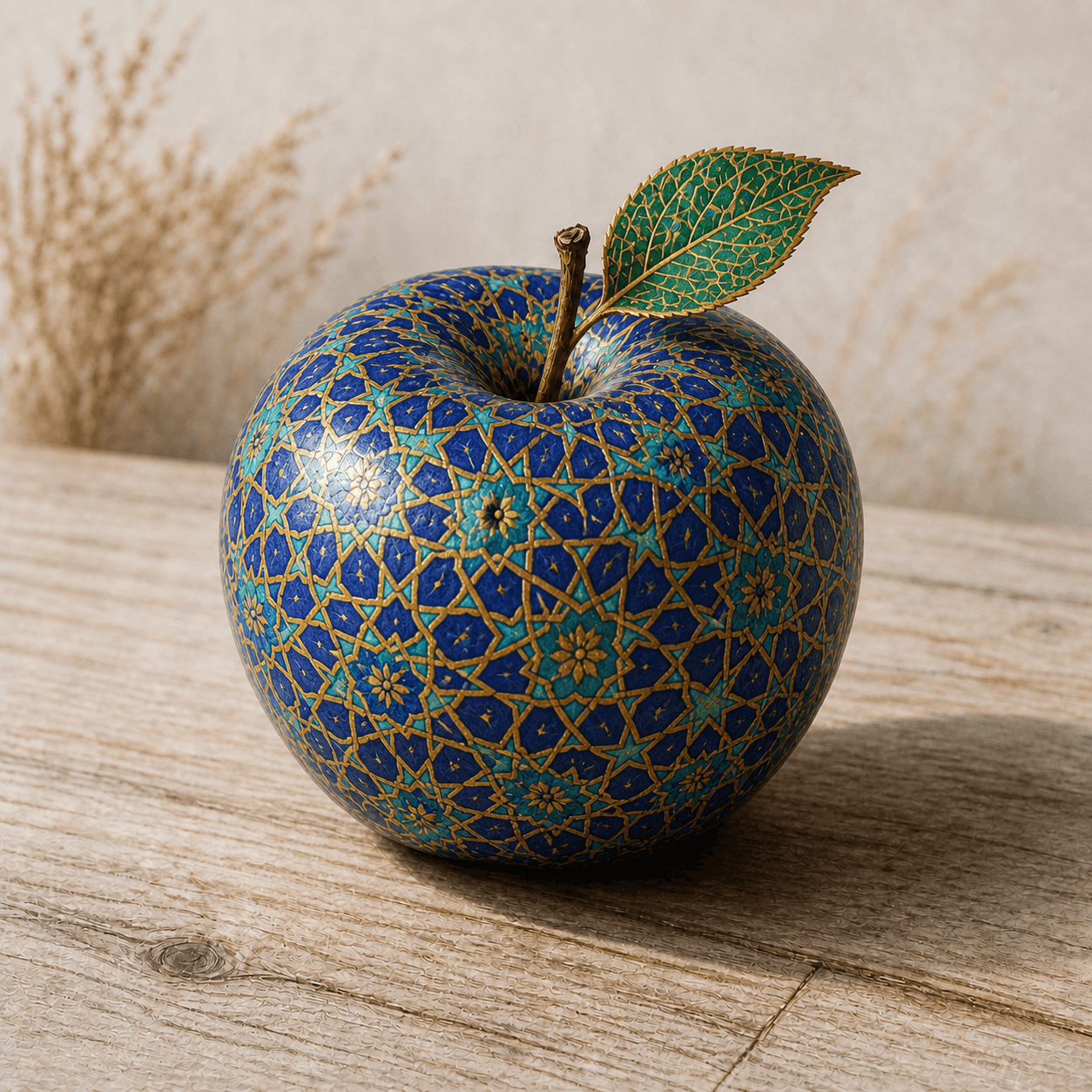
READ THE IMAGE
Do not merely count stars: find the repeat, connection rule, and distortion across a curved surface
A tenfold star network wraps the round apple in cobalt, turquoise, and gold like tile and inlay. Historical patterns are laid out for a particular plane, dome, or object.
- 01
Find star centres and adjacent nodes
Turquoise tenfold stars are not isolated badges; each point joins gold bands and neighbouring polygons so local units close only as a network.
- 02
See interlace make over-under order
Gold bands alternate above and below at crossings, creating woven depth. The rule must remain consistent or the whole path breaks.
- 03
See curvature disturb regularity
Stars read fully at front and compress around the edge. Real makers adjust modules, cut tile, or change grids rather than paste a plane unchanged onto any curve.
- 04
See colour as material zoning
Cobalt field, turquoise star, and gold skeleton create three readings, like glazed mosaic or wood inlay making geometry physical through seams.
In one sentence
Not decoration left by an image ban—
but craft practice using geometric construction to coordinate scale, material, architecture, and moving sight
Geometric ornament in Islamic art inherited Greek, Roman, Sasanian, and late-antique forms and expanded them across the Islamic world. Makers could construct an underlying grid from circles, regular polygons, and axes, then select stars, polygons, interlace, or girih lines; one scheme might become brickwork, zellij, wood mosaic, carved stucco, or paint. Geometry often coexists with calligraphy, vegetal arabesque, and figures. Religious spaces usually restrict figural imagery, but court manuscripts, objects, and secular buildings are rich in people and animals, so an absolute ‘Islam forbids images’ does not explain the tradition.
VISUAL LANGUAGE
Visual DNA
Construction
Compass and straightedge generate proportion
Tessellation
Units cover a surface without gaps
Rotation, reflection, and translation organise repeat while edge, corner, and dome require crop or hierarchical transition.Interlace
Bands establish continuous paths
Alternating crossings send the eye along routes without endpoints; knot depth depends on consistent order.Material
Seam and technique reveal geometry
Zellij cutting, girih strips, brick bond, stone inlay, and muqarnas constrain angle, line width, colour, and scale differently.Region
There is no single ‘Islamic pattern’
Maghribi zellij, Iranian glazed brick, Mamluk woodwork, Ottoman tile, and Mughal stone inlay form distinct languages.Where it came from
From late-antique geometry through medieval star-network expansion to regional systems across materials
Mathematical learning relates to but does not equal workshop practice. Design scrolls, incised traces, and building surveys show layout traditions, yet many makers remain unnamed and not every complex pattern came from a court mathematician.
Early Islamic architecture reworks antique ornament
Umayyad and Abbasid monuments absorb Byzantine mosaic, Sasanian stucco, and Roman pavement as geometry, plant, and script form new ensembles.
Brick, wood, and stucco expand star networks
From Córdoba and Cairo to Iran and Central Asia, octagonal stars, polygons, and interlace enter domes, minbars, and façades through diverging crafts.
Complex girih and zellij systems mature
Tenfold networks in Iran and Central Asia develop alongside cut-tile mosaic in the Maghrib, spanning large walls, corners, and domes.
Imperial workshops and modern study redistribute design
Ottoman, Safavid, and Mughal makers combine geometry with flower and script; surveys, fairs, and pattern books turn it into a global design resource.
ARTISTS & WORKS
Meet it through four architectural surfaces
Great Mosque of Córdoba, mihrab dome
Intersecting ribs frame a stellar centre while gold mosaic and script unite structure, light, and prayer direction rather than filling a wall indiscriminately.Minbar of Sultan Lajin, Cairo
Wooden stars and polygons assemble through strips, ivory, and ebony as geometry changes across doors, panels, and working joinery.Alhambra zellij, Granada
Hand-cut monochrome glazed pieces form stars, polygons, and braid along the lower wall, coordinated with vegetal stucco and calligraphy above.Darb-i Imam Shrine, Isfahan
Tenfold girih in glazed tile crosses the portal at nested scales, showing one underlying rule generating several star sizes.How to recognise it
Unpack underlying grid, symmetry, edge treatment, and material technique in order
- ✓Can circle centres, repeat units, or star family and operations of rotation, reflection, and translation be found?
- ✓Does every interlace crossing alternate consistently, or is it visual complexity that cannot close?
- ✓How does the pattern meet window, corner, dome, or vessel—crop, terminate, or switch grid?
- ✓Is it zellij, brick, wood mosaic, stone inlay, stucco, or digital print, and do real material seams compose?
STYLE RELATIONS
Geometric construction, written rhythm, and vegetal arabesque combine but remain distinct
Islamic Geometry
Organises architectural and object surfaces through grid, symmetry, tessellation, and material seam.CURRENTArabic Calligraphy
Builds visual structure from legible language, pen motion, proportion, and sacred or poetic content.↗Art Nouveau
Uses plant line and industrial-era total design; repeated ornament belongs to a different historical institution.↗REFERENCES
Sources & image note
The apple wraps a tenfold network and gold interlace over curvature as a teaching image. With no actual tile seam, wooden joint, architectural boundary, or workshop layout, it represents no single regional tradition.