
Classical Art
Mannerism
Once naturalism had been mastered, artists deliberately stretched proportion and compressed space, making elegance, virtuosity, and unease appear together.
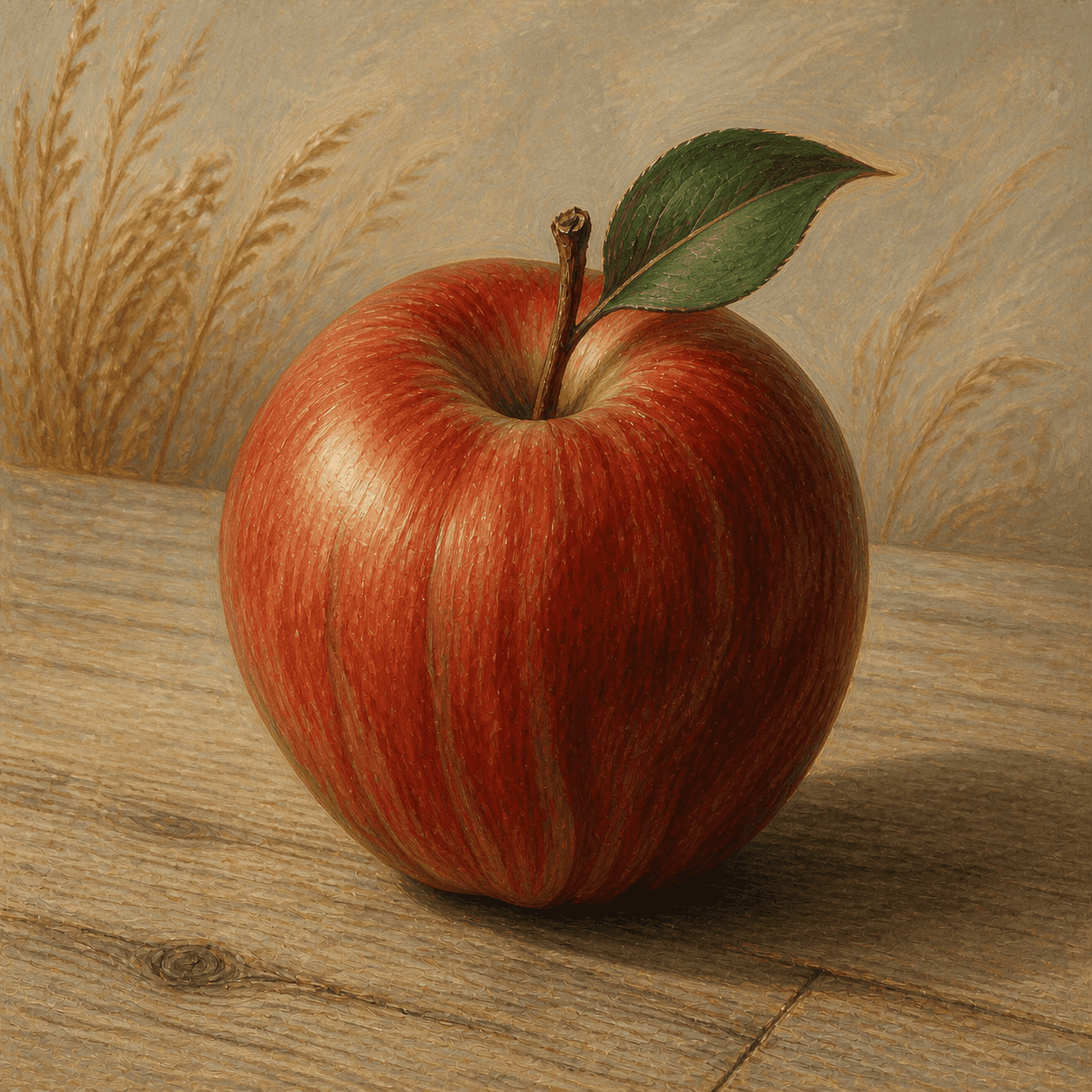
READ THE IMAGE
It remains credible, yet every feature moves half a step beyond nature
Rather than copy an elongated body, this teaching image uses stretched marks, oversized subject, cool pale ground, and compressed depth to create controlled dissonance.
- 01
See vertical elongation
Highlights and grooves extend into fine arcs, giving the round fruit an elegance akin to long necks and fingers.
- 02
See the subject crowd the frame
The apple fills the foreground while plants press near the edges; depth exists but feels deliberately compressed.
- 03
Read uneasy colour
Warm orange-red sits against grey-green and cream—refined yet not fully natural, like many Mannerist palettes.
- 04
See technique displayed
Surface, leaf, and stem remain conspicuously articulate; the image announces that it has been carefully made.
In one sentence
Not a decline in Renaissance skill—
but a conscious twist of perfected rules
Mannerism is a later label for aspects of European art around 1520–1600, rooted in Italian maniera—manner or style. Artists inherited the virtuosity of Michelangelo and Raphael yet favoured elongated bodies, twisted poses, compressed or contradictory space, cool jewel colour, and complex allegory. Addressed to church and court audiences fluent in artistic reference, works displayed cultural capital through seemingly effortless technique and artificial elegance.
VISUAL LANGUAGE
Visual DNA
Proportion
Elongated, unstable, elegant
Pose
Serpentine, twisting
Bodies rotate on several axes, often beyond narrative need.Space
Compressed, broken, ambiguous
Figures crowd the foreground while scale and distance resist easy explanation.Colour
Cool, jewelled, non-natural
Pink, acid green, pale blue, and orange create refinement and estrangement.Audience
Learned and allusive
Allegory, quotation, and virtuosity invite court viewers to decode art-historical references.Where it came from
After ‘perfection,’ style itself became the problem
Raphael's death, the 1527 Sack of Rome, and religious conflict form part of the context, but Mannerism was not simply crisis reflected. It also grew from artistic rivalry, court taste, print circulation, and self-conscious quotation of masters.
Tension appears within the High Renaissance
Michelangelo's complex bodies and Raphael's workshop provide forms a younger generation could intensify.
Early Mannerism takes shape in Florence and Rome
Pontormo, Rosso, and Parmigianino remake naturalism through unstable composition, altered proportion, and emotive colour.
Courtly maniera becomes a language of power
Bronzino develops cool portraiture and intricate allegory for the Medici, aligning refinement with aristocratic identity.
The style travels, then yields toward Baroque
Fontainebleau and Prague absorb twisted bodies and ornament, while Caravaggio and the Carracci seek new directness and order.
ARTISTS & WORKS
Meet it through four works
Pontormo, Deposition
Pink and blue figures float in compressed space; interlocking bodies lack firm ground and turn grief into an elegant vortex.Parmigianino, Madonna of the Long Neck
The Virgin's neck, fingers, huge lower body, and tiny distant figure abandon proportion for artificial beauty.Bronzino, Allegory with Venus and Cupid
Porcelain skin, entangled bodies, and elusive symbols join courtly wit with sensory attraction.Giambologna, Rape of the Sabine Women
Three bodies spiral upward without one privileged front, requiring the viewer to circle its technical invention.How to recognise it
First see that it knows the rules—then find where it breaks them
- ✓Are bodies elongated, twisted, or impossibly combined while remaining exquisitely finished?
- ✓Is space crowded, discontinuous in scale, or lacking stable gravity?
- ✓Is colour cool, jewelled, and detached from natural illumination?
- ✓Do quotation, allegory, and virtuosity address an art-literate audience?
STYLE RELATIONS
Once rules are mastered, stability is deliberately undone
REFERENCES
Sources & image note
The apple suggests Mannerism through subtle elongation, spatial compression, and colour tension rather than copied figure distortion. Historical identification requires body, composition, patronage, and allegory together.